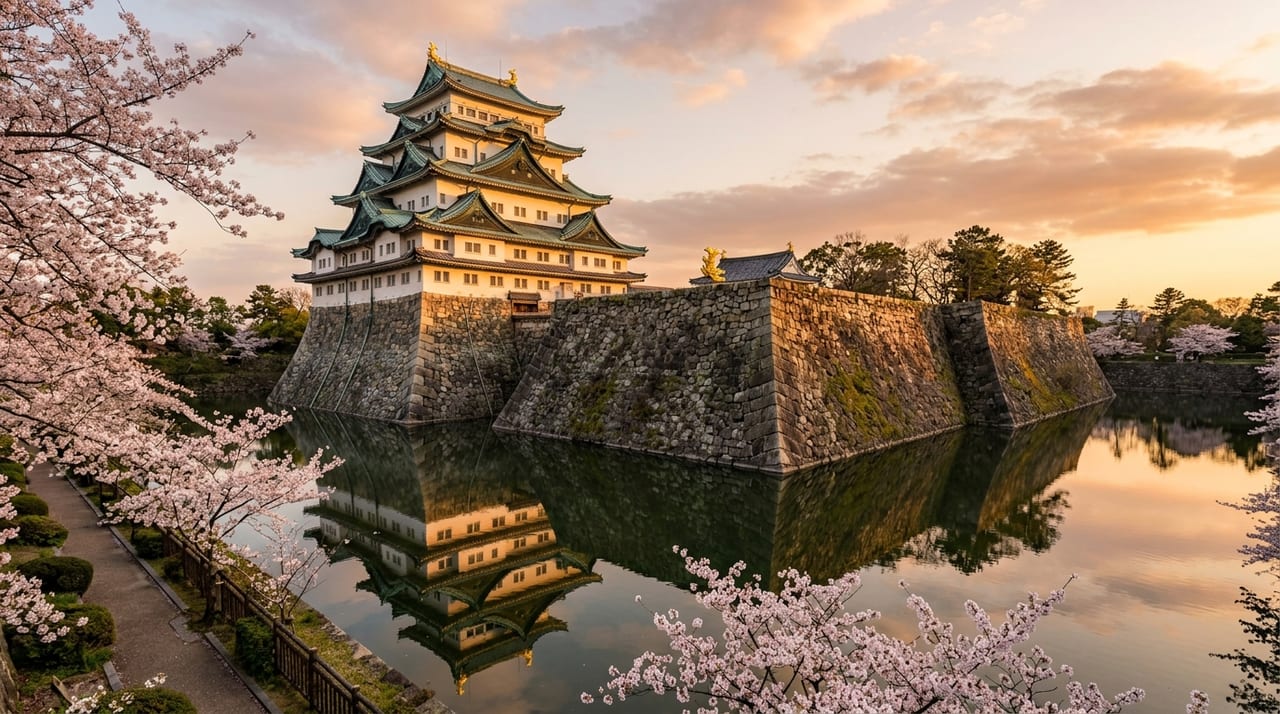
 * Image is for illustrative purposes only.
Nagoya Castle
名古屋城
Nagoya Castle is a historic castle in the Chūbu region (Built in 1610 (Keichō 15)). Its lord was Tokugawa Yoshinao (first lord of Owari Tokugawa).
Overview
About the Castle
Nagoya Castle is a magnificent castle that Tokugawa Ieyasu ordered built in Keichō 15 (1610), as the front line of defense of the western provinces against the Toyotomi family in Ōsaka and as the final stage of the unification of the realm. As a tenka-bushin, he assigned stone wall construction to 20 outside daimyo houses of the western provinces, including Katō Kiyomasa and Fukushima Masanori, and completed it in just three years. Katō Kiyomasa was in charge of the stone walls of the most important tenshudai (keep base). The largest boulder in the castle, in front of the Honmaru East Second Gate, is called the 'Kiyomasa-ishi' (Kiyomasa Stone), but the wall was built by Kuroda Nagamasa. The five-story keep, crowned with golden shachihoko, boasted its majestic presence throughout the realm as a symbol of Owari, and as the castle of the Owari Tokugawa house, the foremost of the Tokugawa gosanke, it reached the height of splendor throughout the Edo period.
Architecture and Structure
The first lord of the domain, Tokugawa Yoshinao, was Ieyasu's ninth son, and he received numerous famous swords and armor from Ieyasu. Yoshinao valued martial arts and scholarship equally and is known as an enlightened lord who built the cultural foundation of the Owari domain. The Honmaru Palace is regarded as the masterpiece of early modern castle palaces, and its wall paintings, executed by painters of the Kanō school, including Kanō Sadanobu and Tan'yū, gather the finest of Japanese painting from the Momoyama to the early Edo period. The rooms arranged according to rank, namely the Genkan, Omote-shoin, Taimenjo, and Jōrakuden, vividly tell of the authority of the shogunal house and the prosperity of the Owari domain. In the Nagoya air raids of Shōwa 20 (1945), the keep and Honmaru Palace were reduced to ashes, but the Honmaru Palace completed its full reconstruction in Heisei 30 (2018), reviving its dazzling appearance of the past.
Present Appearance
In the restoration, prewar glass-plate photographs and detailed survey drawings (Shōwa-era survey drawings) were used, realizing a faithful reproduction that included the wall paintings. Plans to rebuild the keep in wood are also underway, and Nagoya Castle is a living castle that continues to evolve today. The golden shachihoko is both a symbol of the authority of the Owari Tokugawa house and the very identity of the city of Nagoya; for the people of Nagoya, it is a source of pride. Nagoya Castle is one of the most politically and militarily important castles among Japan's castles, and as a presence symbolizing both the unification of the realm and Tokugawa rule, it holds a special place in Japanese history.
Connection to Swords
Owari Nagoya is also known as a 'city of the arts,' a city where warrior culture such as Noh, the tea ceremony, and flower arrangement still thrives strongly, and the richness of its cultural sphere centered on the castle rivals even Kanazawa. The restoration of the Honmaru Palace at Nagoya Castle is a milestone of Japan's cultural property restoration projects, and its exquisite craftsmanship overwhelms visitors. Nagoya is the central city of the Chūbu region, and as a transportation hub located between Tokyo and Ōsaka, it is ideally situated as a base for sword-touring trips. It is also possible to tour the sword culture of Owari and Mino in a single day, from Nagoya Castle to Inuyama Castle and Seki City.
Connection to Swords
The Owari Tokugawa family was one of the Japanese daimyo houses boasting the most substantial sword collections, having generation after generation collected and handed down a vast number of famous swords, including National Treasures and Important Cultural Properties. Its origin lies in the group of swords the first lord Yoshinao received from his father Ieyasu, and thereafter successive lords enriched it in both quality and quantity. The highlight of the collection is the group of tantō by Awataguchi Yoshimitsu, and several of Yoshimitsu's masterpieces were handed down, including the meibutsu (celebrated treasures) Namazuo Tōshirō, Gotō Tōshirō, and Hōchō Tōshirō. Yoshimitsu was a master smith of the Awataguchi school of Yamashiro Province in the Kamakura period, and his tantō are said to be the supreme peak in the history of Japanese swords. The collection also held Sōshū-den masterpieces, beginning with the meibutsu Tarōsaku Masamune. The Tokugawa Art Museum still holds and displays these treasures today, and its regularly held special sword exhibitions draw enthusiasts from across the country. Owari Province lay within the sphere of influence of the Mino tradition, and exchange with smiths of Seki and Mino was lively. The Owari domain employed Ujifusa, Nobutaka, and others as house smiths, meeting the demands of the domain's retainers. The sword culture of Owari was supported by the authority of the foremost of the gosanke and the economic power of 619,000 koku, and it boasted a depth and diversity among the finest in Japan. Touring Nagoya Castle and the Tokugawa Art Museum is the finest course for experiencing the history of Japanese swords in condensed form. In the sword galleries of the Tokugawa Art Museum, the lighting and display cases are designed to draw out to the fullest the beauty of each blade's hamon (temper line) and jigane (steel ground), allowing visitors to experience the essence of appreciating Japanese swords. Nagoya remains a city where sword enthusiasts gather today, and it is one of the cities where the culture of Japanese swords has taken the deepest root.
Highlights
- golden shachihoko — the symbol of Nagoya; the golden shachihoko of the Keichō era displayed the authority of the Owari Tokugawa house to the realm
- Honmaru Palace (fully restored) — the Kanō school wall paintings brought back to life, the masterpiece of early modern castle palace architecture
- Tokugawa Art Museum — permanent display of swords, sword fittings, and armor handed down by the Owari Tokugawa family, a must-visit shrine for sword enthusiasts
- Southwest Corner Turret and Southeast Corner Turret (Important Cultural Properties) — precious surviving structures that escaped wartime destruction
- Ninomaru Garden (Place of Scenic Beauty) — a garden of karesansui (dry landscape) and pond, conveying the garden culture of the Owari domain
- Kiyomasa-ishi (Kiyomasa Stone) and the stone walls of the tenka-bushin — the castle's largest boulder, the 'Kiyomasa-ishi' (its wall built by Kuroda Nagamasa), and the tenshudai built by Katō Kiyomasa; the pinnacle of the daimyo's castle-building skill
* Opening hours and admission fees are subject to change. Please check the official website before visiting.