 * Image is for illustrative purposes only.
Suwahara Castle (Makinohara Castle)
諏訪原城(牧野原城)
Suwahara Castle (Makinohara Castle) is a historic castle in the Chūbu region (Built in Tenshō 1 (1573) by Takeda Katsuyori as a base for the invasion of Tōtōmi; captured by Tokugawa Ieyasu in Tenshō 3 (1575) after the Battle of Nagashino and used as a logistics base for the campaign against Takatenjin Castle). Its lord was Takeda Katsuyori (builder) → Tokugawa Ieyasu (captured Tenshō 3 (1575)) → Imagawa Ujizane (briefly lord) · Makino Yasunari and other castle wardens.
Overview
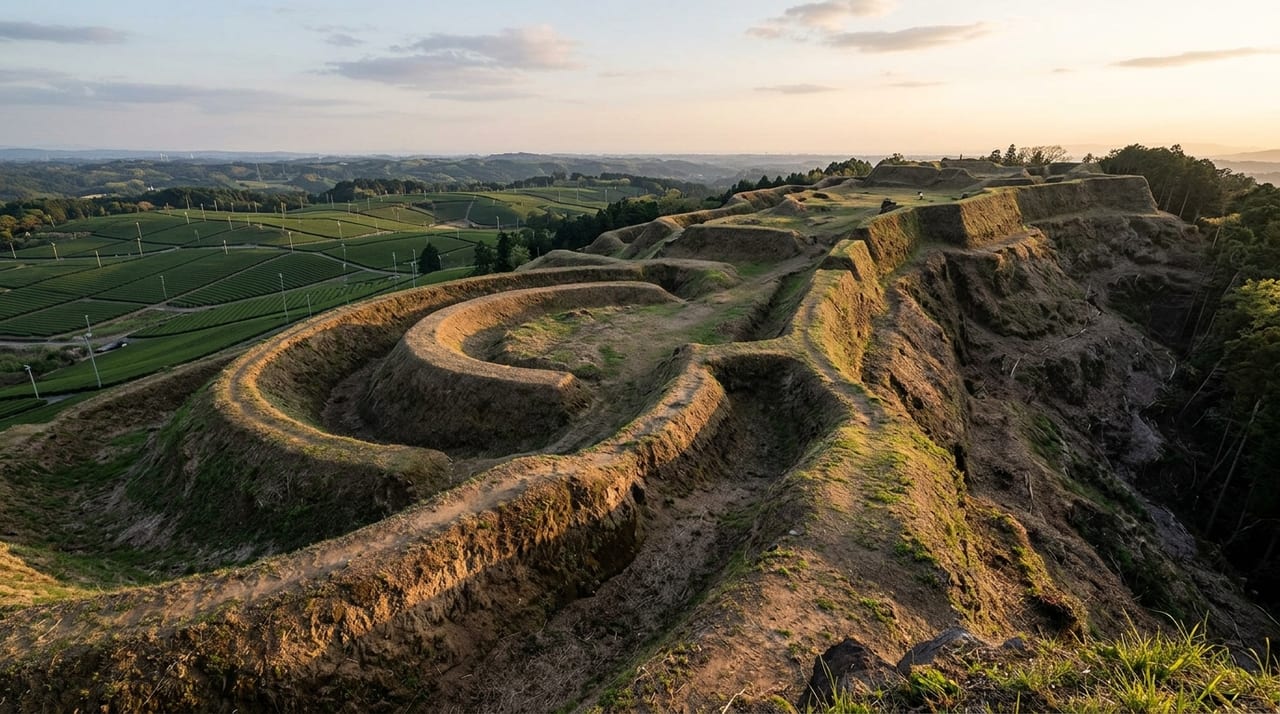
Suwahara Castle is a mountain castle on the edge of the Makinohara Plateau, where large tea fields spread, in Shimada City, Shizuoka Prefecture (formerly Kanaya Town, Haibara District). Takeda Katsuyori built it in Tenshō 1 (1573) as a base for the invasion of Tōtōmi (western Shizuoka Prefecture). The layout skillfully makes use of the cliffs of the Makinohara Plateau, and remains of maru-umadashi (round barbican) and mikazuki-bori (crescent moat) survive in good condition. It was once regarded as a typical example of Takeda-style castle construction, but excavations conducted in Heisei 21–27 (2009–2015) revealed that the remains from the Takeda period were limited to the honkuruwa (main enclosure) and a small maru-umadashi at the southern end, and that the ni-no-kuruwa (second enclosure) and the large maru-umadashi were highly likely the result of Tokugawa renovation.
In the 5th month of Tenshō 3 (1575), the Takeda army suffered a crushing defeat to the combined forces of Oda and Tokugawa at the Battle of Nagashino. This battle, in which the Takeda cavalry corps suffered devastating damage through the concentrated use of firearms, is recorded in textbooks as a turning point in Sengoku history. After the great defeat at Nagashino, as Takeda forces rapidly declined, Tokugawa Ieyasu captured Suwahara Castle in the same year. Ieyasu renamed the castle 'Makino Castle' and thereafter used it as a supply and siege base for isolating and capturing Takatenjin Castle.
Takatenjin Castle was the most important Takeda stronghold in Tōtōmi, but in the 3rd month of Tenshō 9 (1581), the garrison, pressed by a siege of starvation, charged and died in battle, and the castle fell. In the success of the capture of Takatenjin Castle, Suwahara Castle functioned as the linchpin of the siege network, and the two castles are understood as an important pair that shows the rise and fall of Takeda power in Tōtōmi.
The castle ruins are currently designated as a National Historic Site, and multiple maru-umadashi remains, large dry moats, and earthen ramparts survive in good condition. The ruins are surrounded by tea gardens on the Makinohara Plateau, and the site is impressive for the contrast between steep moats and earthen ramparts rising from the greenery.
Connection to Swords
The relationship between Suwahara Castle and the Japanese sword comes down to three things: the Takeda-style castle construction, the military culture of the Takeda clan behind it, and the Battle of Nagashino, the 'turning point between sword and firearm'.
It is said that Baba Nobuharu, one of the Takeda Four Generals, and others were involved in the layout (design) of Suwahara Castle, and one can sense the bond between the ideas of Takeda-style castle architecture and bushidō and sword culture.
In the sense that the Battle of Nagashino destroyed mounted warriors with three-stage volley fire (although this modern popular belief includes some exaggeration), it symbolizes Japan's 'transition from a culture of swords and horses to a culture of firearms and separation of warriors and farmers'. Within this transition, the position of samurai swords gradually began to shift from 'the main weapon in actual combat' to 'a symbol of samurai status, ceremonial dress, and art object'. As a castle standing at that turning point, Suwahara Castle also has symbolic significance from the perspective of sword history.
Highlights
- Maru-umadashi earthworks (National Historic Site) — multiple surviving maru-umadashi and mikazuki-bori showing the castle-building techniques of the Takeda and Tokugawa
- Large dry moats and earthen ramparts — large-scale defensive earthworks using the edge of the Makinohara Plateau
- Suwahara Castle Visitor Center — an information facility on the grounds of the first parking lot of the castle ruins
- Takatenjin Castle ruins (Kakegawa) — a contested Takeda-Tokugawa stronghold forming a pair with Suwahara Castle, a National Historic Site
- Large tea gardens of the Makinohara Plateau — one of Japan's leading tea-producing areas surrounding the castle ruins, a spectacular sight during the new tea season
- Ōigawa Railway and Shimada City — a historical sightseeing route combining SL trains with the castle ruins and tea gardens
* Opening hours and admission fees are subject to change. Please check the official website before visiting.