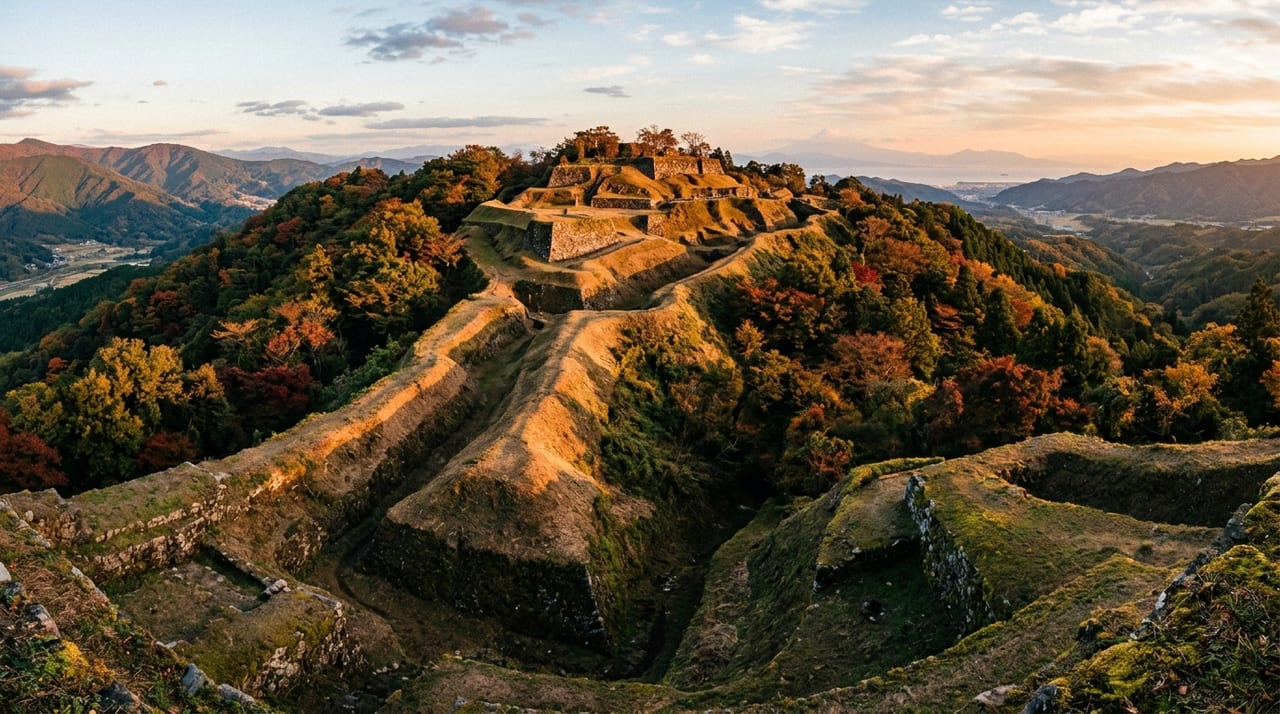
 * Image is for illustrative purposes only.
Nirayama Castle
韮山城
Nirayama Castle is a historic castle in the Chūbu region (Developed in the late 15th century by Ise Moritoki (Hōjō Sōun) as a base for ruling Izu; an important stronghold of the Later Hōjō clan until the Odawara Campaign led by Toyotomi Hideyoshi in Tenshō 18 (1590)). Its lord was Ise Moritoki (Hōjō Sōun) → Hōjō Ujinori → Naitō Nobunari.
Overview
Nirayama Castle is a hirayama-jō located in Izunokuni City, Shizuoka Prefecture. It is known as a castle that heralded the start of the Sengoku period. Hōjō Sōun, the founder of the Later Hōjō clan (Odawara Hōjō clan), developed it as a base for subjugating Izu. Sōun originally went by the name Ise Moritoki, a warrior who had been an official of the Muromachi shogunate. After entering Izu during the turmoil that followed the Ōnin War, he took control of Izu in Meiō 2 (1493) and became one of the first sengoku daimyō.
Nirayama Castle was built on the Ryūjō hill and is a hirayama-jō located at a strategic point that overlooks and commands the crossroads of the highways running the length of the Izu Peninsula. Its layout is a renkaku-style arrangement, with the Honmaru, Ninomaru, Gongen Kuruwa, and Sannomaru linked north to south along the ridge. The Later Hōjō clan used the castle as its base for ruling Izu for about 100 years.
In the Odawara Campaign led by Toyotomi Hideyoshi in Tenshō 18 (1590), castles across the Kantō surrendered and were vacated one after another. Nirayama Castle, under the command of Hōjō Ujinori, held out for about three months with about 3,600 troops against about 44,000 Toyotomi forces. It was ultimately surrendered after peace negotiations. The castle's tenacious resistance is remembered as a history that displays the prestige of the Later Hōjō clan. After the surrender, Nirayama Castle became the seat of Naitō Nobunari, a retainer of Tokugawa Ieyasu. In 1601, however, Nobunari was transferred to Sunpu, the castle was abandoned, and Nirayama subsequently became a direct shogunal domain (tenryō) of the Edo shogunate.
Today the castle ruins are designated as a national Historic Site, and remains such as kuruwa (enclosures), dorui (earthen walls), and karabori (dry moats) survive. Nearby is the Nirayama Reverberatory Furnace (World Cultural Heritage), which serves as a central tourist attraction as an important facility that tells the history of steel technology in the bakumatsu period.
Connection to Swords
Nirayama Castle's connection to Japanese swords can be understood through the Later Hōjō clan, a sengoku daimyō family, and the sword culture nurtured in its domain of Sagami.
The Later Hōjō clan was a daimyō house that ruled Kantō, Izu, and Sagami for five generations over about 100 years, and it required large quantities of swords and armor to maintain its large armies. Sagami (Kanagawa Prefecture) was a production center of swordsmiths who made the Sōshū-den, one of the highest peaks of Japanese swordmaking, and it produced master smiths such as Masamune, Yukimitsu, and Hiromitsu. Odawara, the Later Hōjō clan's home base, lay within the Sōshū-den sphere, and Nirayama Castle functioned as its southwestern forward base.
The Nirayama Reverberatory Furnace (World Heritage) of the bakumatsu period is interesting as a modern development of the relationship between Western-style forging and ironmaking techniques and Japanese swords. A reverberatory furnace is a facility that uses molten iron to cast cannon, and in the sense of technology that handles iron, it belongs to a cultural lineage with the same roots as Japanese sword-forging techniques. As a place that transmits the iron technology of the bakumatsu period, Nirayama holds an interesting position in the context of sword history as well.
Highlights
- Nirayama Castle Ruins (national Historic Site) — the Izu stronghold that Hōjō Sōun used as his main castle and that Hōjō Ujinori later defended; earthen walls and dry moats survive
- Honmaru Site, Ryūjō hill — from the Honmaru Site on the Ryūjō hill, a panoramic view of Izu's farmland, Hakone, and Mount Fuji
- Nirayama Reverberatory Furnace (World Cultural Heritage) — a bakumatsu-period Western-style ironmaking facility, a modern development of Japanese sword-forging culture
- Within the Sōshū-den sphere — Kamakura, where master smiths of Sagami such as Masamune and Yukimitsu were active, lay within the Later Hōjō domain
- Odawara Castle (main castle of the Later Hōjō clan) — the home base of the Later Hōjō clan for about 100 years
* Opening hours and admission fees are subject to change. Please check the official website before visiting.