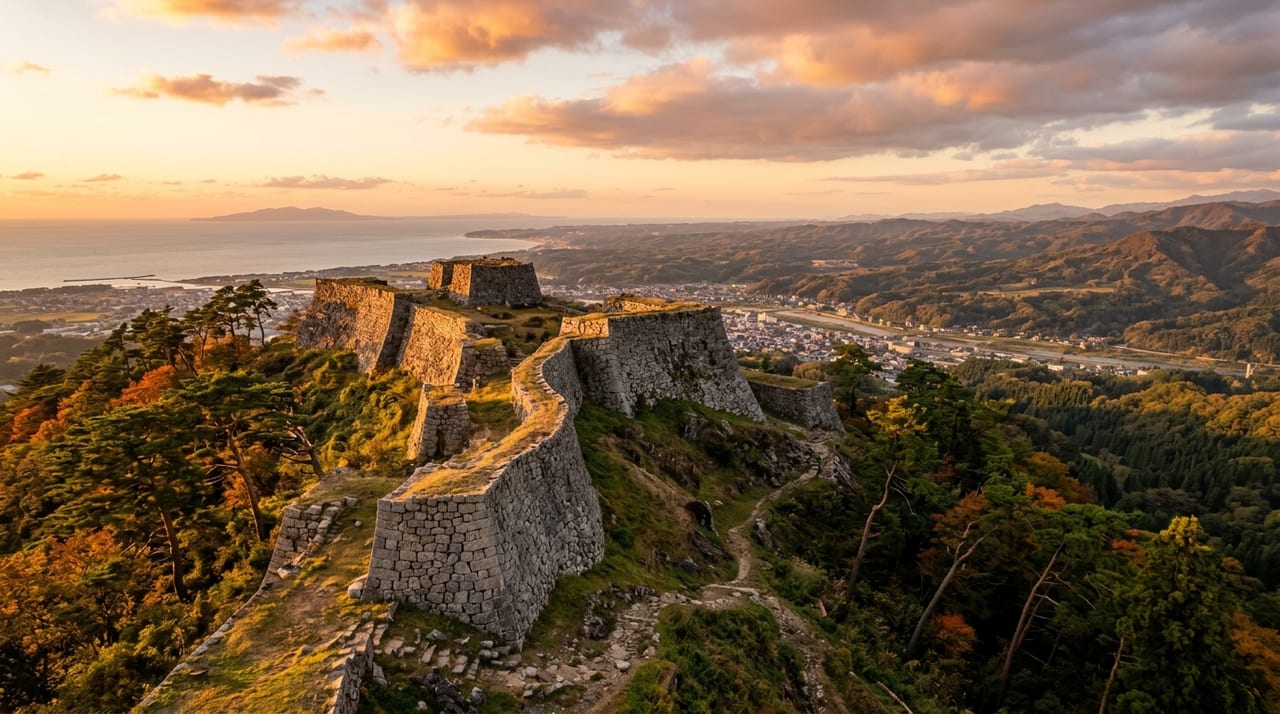
 * Image is for illustrative purposes only.
Murakami Castle (Maizuru Castle)
村上城(舞鶴城)
Murakami Castle (Maizuru Castle) is a historic castle in the Chūbu region (Said to have been built by the Honjō clan in the early 16th century; developed as a modern castle by the Hori clan in the Edo period). Its lord was Honjō Shigenaga / Hori clan / Matsudaira and Naitō clans, among others (Murakami domain).
Overview
Murakami Castle is a mountain castle located in Murakami, Niigata Prefecture, and is affectionately known by the elegant name “Maizuru Castle” (Maizuru-jō). It was built on the summit of Mt. Gagyū (Gagyū-san, elevation 135 m), a fortress that played an important role as a strategic stronghold on the Sea of Japan side (northern Echigo) throughout the Sengoku to Edo periods.
The castle is said to have been built by the Honjō clan in the early 16th century during the Sengoku period, and it was originally called Honjō Castle. During the Sengoku period, Honjō Shigenaga rose to prominence as a powerful Echigo warrior, using this castle as his base. Shigenaga served Uesugi Kenshin, and he is known for rebelling against Kenshin in Eiroku 11 (1568) in response to a request from Takeda Shingen.
In Keichō 3 (1598), Murakami Yorikatsu, a retainer of Hori Hideharu, entered the castle and began remodeling it into an early-modern castle. Under Hori Naoyori, the castle was completed with stone walls, a tenshu platform, and other features. Afterward, lords changed frequently, including the Matsudaira clan, and from Kyōhō 5 (1720) onward the Naitō clan served as lords across generations until the late Edo period.
During the Boshin War at the end of the Edo period, the Murakami domain split between a pro-shogunate faction and a pro-new-government faction. In Keiō 4 (1868), domain retainers of the pro-shogunate faction set fire to the castle and retreated toward the Shōnai area. The castle was abandoned in the Meiji period, and nearly all of its buildings were lost. However, its massive stone walls survive in good condition and are designated as a National Historic Site.
Murakami City is also known as “Japan’s northernmost tea-producing region,” and the historic streetscape of the castle town has been preserved and maintained.
Connection to Swords
The connection between Murakami Castle and Japanese swords is inseparable from the sword culture of Echigo. Although swordsmiths were active in various parts of Echigo Province (present-day Niigata Prefecture), they are not included in the Gokaden (Yamato, Yamashiro, Bizen, Sōshū, Mino), the major traditions of Japanese swordsmithing, and no single, established school known as “Echigo-mono” was formed. Honjō Shigenaga, lord of Murakami Castle, was a formidable Echigo warrior who was active under Uesugi Kenshin.
Tales also link Uesugi Kenshin, his lord, to famous swords handed down in the Uesugi family, such as the “Sanchōmō.”
Hori Naoyori, who became lord of the Murakami domain, was a son of Hori Naomasa. After passing through Sakado and Nagaoka in Echigo, he was transferred to Murakami in Genna 4 (1618).
Samurai residences such as the Wakabayashi Residence (a National Important Cultural Property) remain in Murakami City, carrying the samurai culture of northern Echigo down to the present day.
Highlights
- Stone Walls — Massive stone walls of an early-modern castle that survive in good condition, designated as a National Historic Site
- Tenshu Platform — The tenshu keep was lost, but the stone-walled platform conveys the scale of the castle in its heyday
- Views from Mt. Gagyū — Spectacular views taking in Murakami city, the Sea of Japan, and the Asahi-dake Range
- Murakami Castle Ruins Park — A historic park with walking paths that wind around the stone walls
- Wakabayashi Residence (samurai residence) — A National Important Cultural Property that conveys the samurai culture of the Edo period
- Murakami Castle Town Streetscape — “Murakami, castle town,” where historic buildings have been preserved
* Opening hours and admission fees are subject to change. Please check the official website before visiting.