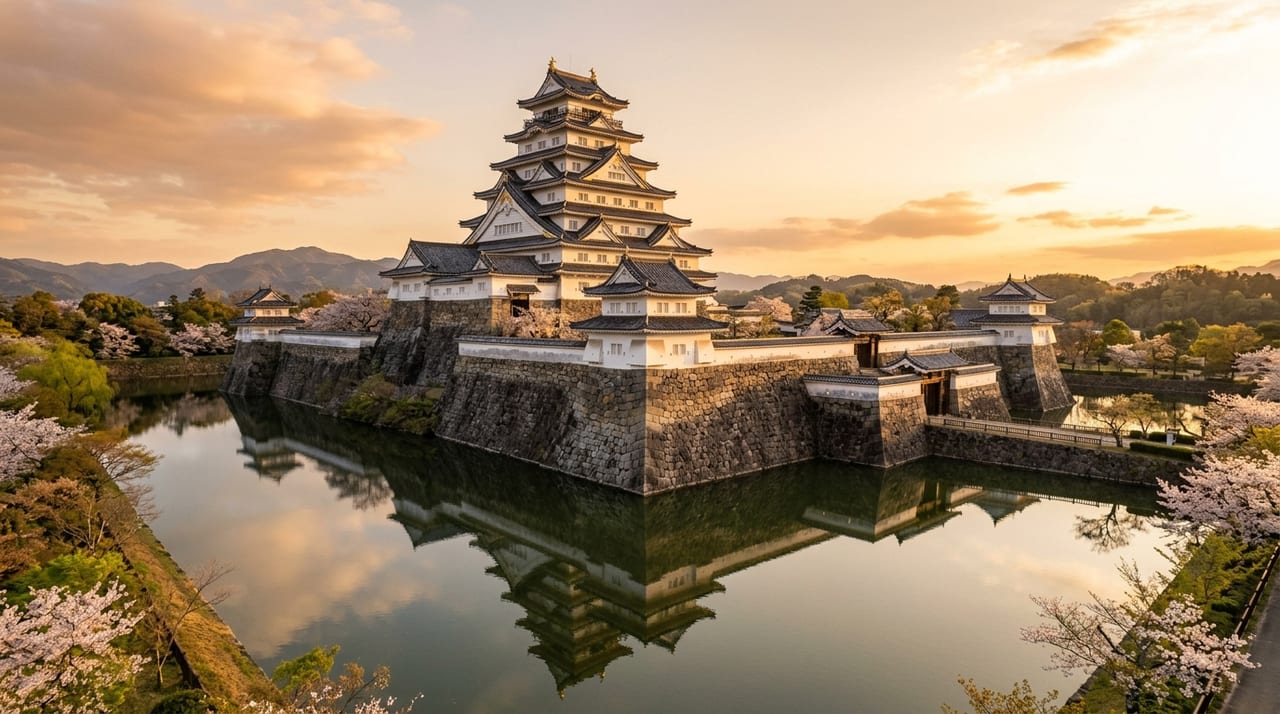
 * Image is for illustrative purposes only.
Fukui Castle (Kitanoshō Castle)
福井城(北ノ庄城)
Fukui Castle (Kitanoshō Castle) is a historic castle in the Chūbu region (Built in the 11th year of Keichō (1606)). Its lord was Yūki Hideyasu / Echizen Matsudaira clan.
Overview
About the Castle
Fukui Castle is a grand castle complex built in 1606 (Keichō 11) by Yūki Hideyasu, the second son of Tokugawa Ieyasu, on the site of the former Kitanoshō Castle. Hideyasu was granted 680,000 koku of Echizen as a reward for his merit at the Battle of Sekigahara, and he set about building a castle town befitting that power and prestige. The place name “Kitanoshō” was changed to “Fukui” in 1624 (Kan'ei 1) by Matsudaira Tadamasa, the third feudal lord, and the castle flourished as the main castle of the Echizen Matsudaira family throughout the Edo period. The honmaru, built with stone walls and surrounded on all four sides by water moats, is said to have had a main keep with four tiers and five stories. (The tradition of a “nine-story” keep belongs to the predecessor, Kitanoshō Castle [the castle of Shibata Katsuie], and there are various theories about the details.) Hideyasu was born as the son of a concubine of Ieyasu, yet he had the complicated background of being adopted by Toyotomi Hideyoshi, and after the Battle of Sekigahara he became a great lord of Echizen. The assessed yield of 680,000 koku was among the largest of the fudai and shinpan daimyō, showing his standing as a pillar of the Tokugawa shogunate. However, Hideyasu died of illness in 1607 (Keichō 12) at only 34 years old.
Shibata Katsuie and the Tragedy of Kitanoshō Castle
Kitanoshō Castle, the predecessor of Fukui Castle, was the largest castle in Hokuriku, built by Shibata Katsuie around 1575 (Tenshō 3). Katsuie was a fierce warrior who controlled Hokuriku during the Sengoku period, and he had fought fiercely against Uesugi Kenshin on Nobunaga's orders. Known as “Oni Shibata” (Demon Shibata), Katsuie's imposing martial prowess made him an outstanding presence among the Sengoku warlords. Defeated by Hashiba Hideyoshi at the Battle of Shizugatake in 1583 (Tenshō 11), Katsuie returned to Kitanoshō Castle and met a fierce end there together with his wife, Lady Oichi. Lady Oichi was Nobunaga's younger sister, and after her tragic marriage to Azai Nagamasa she became Katsuie's wife. She was said to be the most beautiful and dignified woman of the Sengoku period. Katsuie's clean end and Lady Oichi's way of life, as she followed him in death, have been passed down to later generations as embodying the pride of the samurai and a tragic beauty. Her three daughters, Chacha, Hatsu, and Gō, survived and lived turbulent lives that shaped the Sengoku period: Chacha became a concubine of Toyotomi Hideyoshi, Hatsu became the wife of Kyōgoku Takatsugu, and Gō became the wife of Tokugawa Hidetada.
Echizen and Sword Culture
Echizen Province has long been famous as a major center of Japanese swordmaking, and a group of smiths known as the “Echizen kaji” (Echizen smiths) produced many renowned blades. Echizen smiths have been active since the Nanboku-chō period, and smiths such as Echizen Chiyozuru Kuniyasu took root in this land. Under the patronage of the Echizen Matsudaira family, Echizen smiths maintained high skill throughout the Edo period and continued to forge practical, dignified swords. Echizen Yasutsugu, who settled in Echizen in the Keichō era, established his position as official swordsmith to the Tokugawa shogunal house, and became the highest peak of the subsequent lineage of Echizen smiths.
Architecture and Remains
At the present Fukui Castle site, the honmaru stone walls and the inner moat still preserve their appearance from the past. Fukui Prefectural Government Office stands on top of the stone walls, forming a distinctive landscape in which the center of modern administration coexists with historical heritage. The stone wall beneath the main keep base is especially impressive, and its enormous kiri-zumi (cut-stone) masonry shows the high technical level of early modern castle architecture. In one corner of the Fukui Castle site stands a statue of Yūki Hideyasu, which is still loved by citizens today as the founder of the Echizen Matsudaira family. After the castle was abolished, only the stone walls and moats remained for a long time, but recent development has progressed to create a historic park that is easy to visit.
Culture and Tourism
Fukui is well known in modern times as a “holy land of eyeglasses” and the home of “Echizen crab,” but the history of the castle and the warrior culture of Echizen run deep through the city. The nearby Ichijōdani Asakura Family Historic Ruins are designated as a Special Historic Site and Special Place of Scenic Beauty of Japan. They are the remains of a castle town built by the Asakura family, who ruled Echizen in the Sengoku period, and the ruins of samurai residences, townhouses, temples, and gardens have been excavated and preserved. This site is one of the finest medieval castle-town ruins in Japan and preserves the essence of Asakura culture, also called the “Little Kyoto of Hokuriku.” Eiheiji, the head temple of the Sōtō sect, is also a cultural treasure representing Fukui. It is a strict Zen training monastery founded by Zen master Dōgen.
Echizen Swordsmithing Culture and Swordsmiths
Echizen has long been known as a place of swordsmithing, and Echizen Uchihamono (Echizen Hamono) continues today to enjoy worldwide fame as one of Japan's leading blade-producing regions. Swordsmiths settled in Echizen Province from the Nanboku-chō period and forged excellent swords. The successive lords of Fukui Castle protected the works of Echizen swordsmiths, kept domain-official swordsmiths, and supported the sword culture of the warrior class. Even today, Echizen City (formerly Takefu City) has a thriving bladesmithing industry, and its craftsmanship is an extension of the tradition passed down from the medieval swordsmiths. By visiting the Echizen blade workshops together with Fukui Castle, you can experience at the same time two great elements of Japanese samurai culture, the castle and the sword, in a rare journey.
Connection to Swords
Echizen Province was known throughout the country as a place of Japanese sword production, and the Echizen Matsudaira family, which was based at Fukui Castle, played the role of patron of that sword culture. The history of Echizen smiths is long: in the Nanboku-chō period, Echizen Chiyozuru Kuniyasu was active, and smiths who followed in his tradition continued to forge swords in the land of Echizen without interruption. The most famous representative swordsmith of Echizen is “Echizen Yasutsugu.” The first Yasutsugu settled in Echizen in the Keichō era, and with the trust of Tokugawa Ieyasu and Tokugawa Hidetada, he served as official swordsmith to the shogunal house. Yasutsugu, who was permitted by Ieyasu to use the “Aoi crest,” is also called “Aoi Shimosaka,” and as an official Tokugawa sword smith he held the highest authority in the sword culture of the Edo period. Yasutsugu's style is based on a hada of itame-hada with a hamon that mixes notare and gunome, and later he also produced copies of the Sōshū-den. The lineage of Echizen Yasutsugu was handed down over generations, establishing branches in Echizen and Edo, and continued to supply high-quality swords throughout the Edo period. The lineage of Echizen swordsmiths can be traced through the sword materials kept at the Fukui City History Museum and the Fukui Prefectural History Museum. Sword and armor artifacts have also been found in excavations of the Ichijōdani Asakura Family Historic Ruins, which reveal the reality of sword culture in Echizen during the Sengoku period.
Highlights
- Honmaru stone walls and inner moat — a historic landscape coexisting with the modern prefectural government office, a rare administrative heritage in Japan
- Statue of Yūki Hideyasu — a commemorative statue honoring the founder of the Echizen Matsudaira family
- Ichijōdani Asakura Family Historic Ruins — the “Little Kyoto of Hokuriku,” a Sengoku castle town excavated and preserved as a national Special Historic Site
- Fukui City History Museum — holds swords, armor, and sword fittings of the Echizen Matsudaira family
- Shibata Shrine (site of Kitanoshō Castle) — a shrine enshrining Shibata Katsuie and Lady Oichi, and a remnant of the castle's predecessor
- Tōjinbō and Eiheiji — two major attractions of Echizen's nature and Zen culture, classic sightseeing spots in Fukui
* Opening hours and admission fees are subject to change. Please check the official website before visiting.