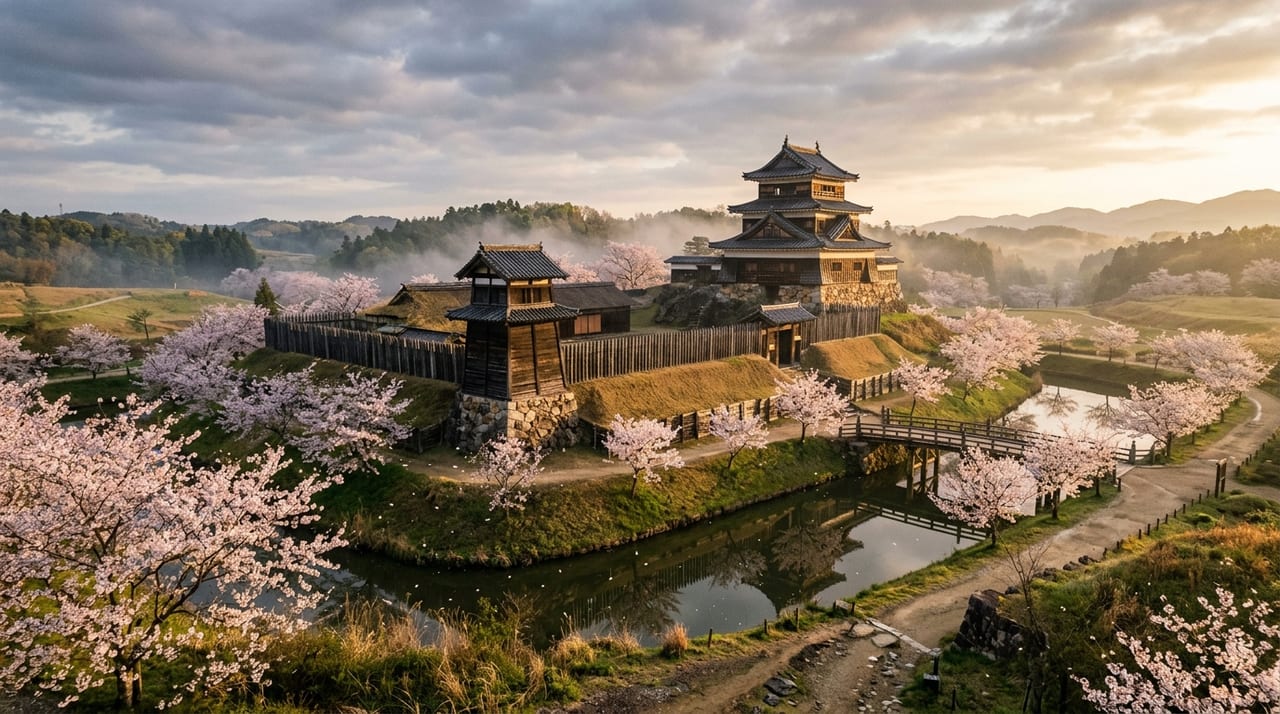
 * Image is for illustrative purposes only.
Nagakute Castle
長久手城
Nagakute Castle is a historic castle in the Chūbu region (A small castle enclosure developed by a local landowner in the Muromachi period. Burned by Hashiba forces during the Battle of Nagakute in Tenshō 12 (1584), it marks a turning point in Sengoku history). Its lord was Katō Tadakage (castle lord) → battlefield for both Tokugawa and Hashiba forces in the Battle of Nagakute.
Overview
Nagakute Castle is a small castle enclosure in Nagakute, Aichi Prefecture (formerly Nagakute town, Aichi District). It is known as the castle set on fire by Hashiba forces during the Battle of Nagakute (also called the Battle of Komaki and Nagakute) in the 4th month of Tenshō 12 (1584). The castle itself is said to have been developed in the Muromachi period by the local landowning Katō family as a small earthwork castle. The castle site is now a residential area, and a monument marking the site remains (designated historic site of Nagakute City).
The Battle of Nagakute was a clash between the forces of Toyotomi Hideyoshi (then Hashiba Hideyoshi) and the allied forces of Tokugawa Ieyasu and Oda Nobukatsu in Owari and Mino. It is regarded as the greatest military trial in Hideyoshi's process of unifying the realm. On the 9th day of the 4th month of Tenshō 12 (1584), Ikeda Tsuneoki and Mori Nagayoshi of Hideyoshi's side took Iwasaki Castle and advanced toward Nagakute, aiming to attack Ieyasu's power base, Mikawa (eastern Aichi Prefecture). Ieyasu detected this and carried out a lightning surprise attack before Hideyoshi's main force could arrive.
In the main battle of Nagakute, Hideyoshi's side lost several powerful daimyō and commanders in quick succession, including Ikeda Tsuneoki, his son Ikeda Motosuke, and Mori Nagayoshi. Ikeda Tsuneoki in particular was a foster brother of Oda Nobunaga and a powerful commander on Hideyoshi's side, and his death dealt a heavy blow to Hideyoshi. Although Hideyoshi held the strategic advantage in numbers, after the localized defeat at Nagakute he ultimately chose to make peace with Ieyasu.
This settlement led to Ieyasu submitting to Hideyoshi (from Tenshō 13 (1585) to Tenshō 14 (1586)). It therefore had an extremely important outcome in Japanese history, as it laid the groundwork for Ieyasu to later establish the Tokugawa shogunate as his successor power. The Nagakute area is widely known as "the battlefield where Ieyasu won against Hideyoshi," and the city of Nagakute makes this history the core of its local identity.
Connection to Swords
The connection between Nagakute Castle and the Japanese sword is deeply rooted both in the Battle of Nagakute, a great battle at the end of the Sengoku period, and in the sword culture of its principal figures.
Ikeda Tsuneoki, who died in the Battle of Nagakute, had served Oda Nobunaga from childhood as Nobunaga's foster brother. His eldest son Motosuke also died on the same day. Items associated with the Ikeda family are transmitted through collections such as the Hayashibara Museum of Art, which houses heirlooms of the Ikeda family of the Okayama domain.
Tokugawa Ieyasu is said to have personally taken the front line and directed the battle at Nagakute. Ieyasu is said to have had a lifelong association with Muramasa blades. Because his father Matsudaira Hirotada was wounded by a Muramasa blade and his son Nobuyasu committed seppuku with one, there is a legend that Ieyasu shunned Muramasa as an ill-omened blade that brought calamity upon him. The Battle of Nagakute was a real battle fought at the period closest to these traditions about Ieyasu and swords, and it is therefore significant as a living record of sword use on the battlefield.
Highlights
- Nagakute Battlefield (national historic site) - graves and head mounds of Ikeda Tsuneoki, Motosuke, and Mori Nagayoshi; the main battlefield of the Battle of Nagakute
- Nagakute Castle ruins (Nagakute City designated historic site) - a monument marks the site (no structural remains survive)
- Irokaneyama Historical Park - a small hill where Tokugawa Ieyasu set up his headquarters, and an overlook offering a view of the whole battle
- Nagakute City Local History Room - exhibits on the course of the Battle of Nagakute, excavated artifacts, and armor and helmets
- Komakiyama Castle (Komaki City) - the Tokugawa base of the Battle of Komaki, which is paired with the Battle of Nagakute
- Expo 2005 Aichi Commemorative Park (Morikoro Park) - a large park within Nagakute City, combining historical strolls with nature sightseeing
* Opening hours and admission fees are subject to change. Please check the official website before visiting.