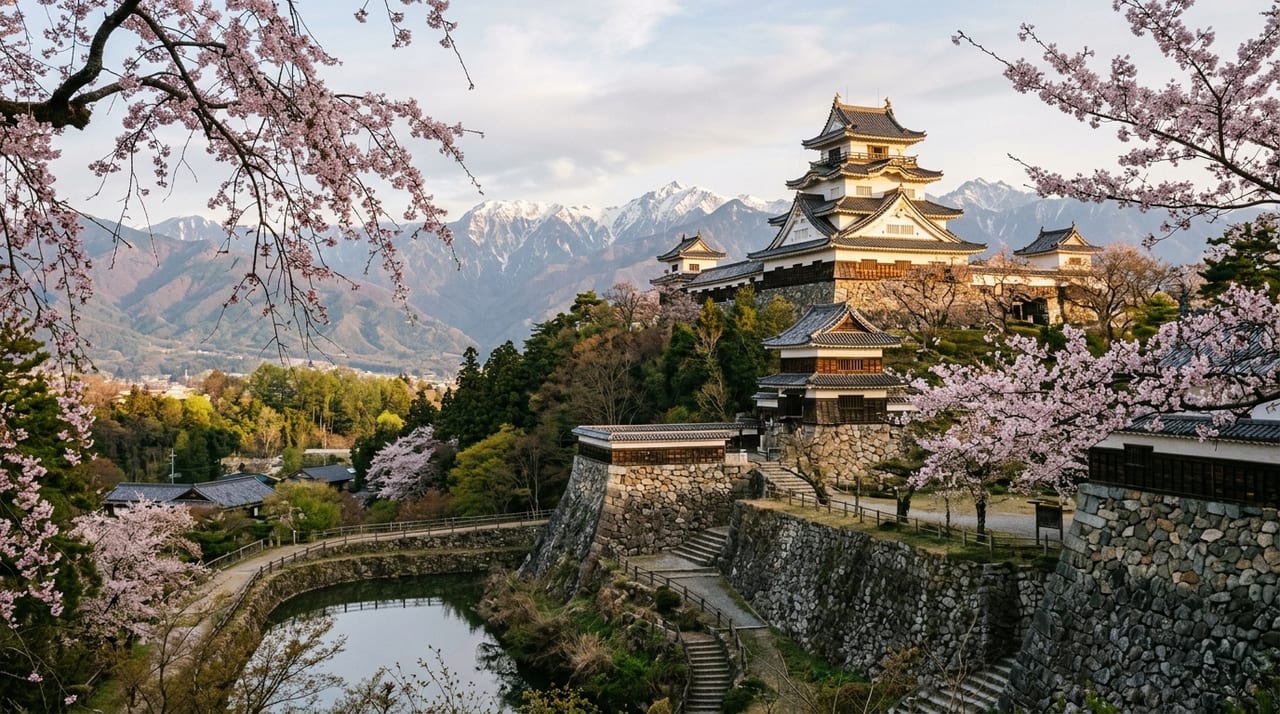
 * Image is for illustrative purposes only.
Iida Castle
飯田城
Iida Castle is a historic castle in the Chūbu region (Said to have been built by the Banzai clan in the Muromachi period). Its lord was Banzai clan / Ogasawara clan / Wakisaka clan / Hori clan.
Overview
About Iida Castle
Iida Castle is a hirayamajiro (a castle on a hill near flat ground) at the southern end of the Ina Valley in southern Nagano Prefecture. It was built on a terrace on the west bank of the Tenryū River and is a key strategic point of southern Shinano. Its history is said to have begun when the Banzai clan built it in the Muromachi period. In the Sengoku period it came under the control of Takeda Shingen and functioned as an important base for governing the Ina Valley. After the Honnō-ji Incident, Tokugawa Ieyasu took control of the Ina Valley, and throughout the Edo period Iida Castle developed as the center of politics and economy of the Iida Domain. Domain lords changed among the Ogasawara, Wakisaka, and Hori clans, which is also evidence that Iida remained a strategically important point for the shogunal family.
Geography and Culture of the Ina Valley
The Ina Valley, where Iida is located, is a long, narrow basin sandwiched between two mountain ranges of the 3,000-meter class, the South Alps and the Central Alps. Receiving the abundant waters of the Tenryū River, this valley had long seen agriculture and forestry develop. At the same time, it was an important transportation route connecting the Tōkaidō and Nakasendō with the Kōshū Kaidō. Samurai of the Ina Valley honed their martial arts in the harsh environment of the mountains and, as in other parts of Shinano, nurtured a sword culture that placed value on practicality. Iida is also known as the "Land of Apples," and fruit cultivation such as apples and pears, which developed after the Meiji era, added a new chapter to the agricultural culture of the Ina Valley.
The Takeda Clan and the Ina Valley
In the era when Takeda Shingen placed the Ina Valley under his control, Iida Castle functioned as an important base on the route of advance from Kai into Tōtōmi and Mikawa. Shingen governed by placing castellans in various parts of Shinano. In the control of the Ina Valley too, Iida Castle was always regarded as a strategic key point connecting Kai and Mikawa. After the fall of the Takeda family in the 10th year of Tenshō (1582), Iida Castle survived the turbulent final years of the Sengoku period, with its castellans changing many times as the forces of Oda, Tokugawa, and Toyotomi intersected. The changes of castellan during this period speak to the high strategic value of the Ina Valley itself. The samurai cultures each castellan brought in overlapped and formed Iida's historical depth.
The Ruins of Iida Castle and the Modern Era
Today, Osahime Shrine stands on the site of Iida Castle's honmaru, and the Iida City Museum stands on the site of the ninomaru. Part of the honmaru's stone walls, dry moats, and earthen ramparts remain. The Sakuramaru Gate (Akamon), which was the front gate of Sakuramaru, is the only building of Iida Castle that remains at its original location, and it conveys the style of that era to the present day. The Meoto-zakura ("husband-and-wife cherry") that remains at the site of the Sakuramaru palace is known as a cherry tree with an estimated age of about 400 years, in which the roots of a weeping cherry and an Edo-higan have joined. It has become a seasonal feature of spring at Iida Castle. The Iida City Museum also holds materials related to Iida Castle and is an important facility for learning the history of the Ina Valley.
Standing against the backdrop of the mountain ranges of southern Shinano, the Iida Castle ruins continue to give quiet emotion to visitors as a concentrated point of southern Shinano's history, where the legacies of Takeda and Tokugawa overlap.
Connection to Swords
Iida Castle was developed in the Sengoku period as a base for the Takeda clan's rule over Shimo-Ina. Afterward it became the castle of a Tokugawa-side lord and the seat of Toyotomi-affiliated daimyo, the Mōri and Kyōgoku clans. In the Edo period, the Ogasawara, Wakisaka, and Hori clans each served as castellans. The Iida City Museum on the castle ruins also holds materials related to Iida Castle, where one can trace the history of the samurai of the Ina Valley.
Highlights
- Iida City Museum (on the site of the Ninomaru) — a complex museum covering the nature, history, and culture of southern Shinano
- Meoto-zakura ("husband-and-wife cherry") at the Sakuramaru Palace site — estimated age of about 400 years, a cherry tree in which a weeping cherry and an Edo-higan have become one
- Sakuramaru Gate (Akamon) — completed in the 4th year of Hōreki (1754), the only building of Iida Castle that remains at its original location
- Views of the South and Central Alps — the majestic panorama of the two great mountain ranges flanking the Ina Valley
- Iida mizuhiki craft — a traditional craft of Nagano Prefecture, the refined beauty of form created by decorative cords
- Tenryūkyō — the gorge beauty of the Tenryū River, the nature of southern Shinano enjoyed by boat ride down the river
* Opening hours and admission fees are subject to change. Please check the official website before visiting.