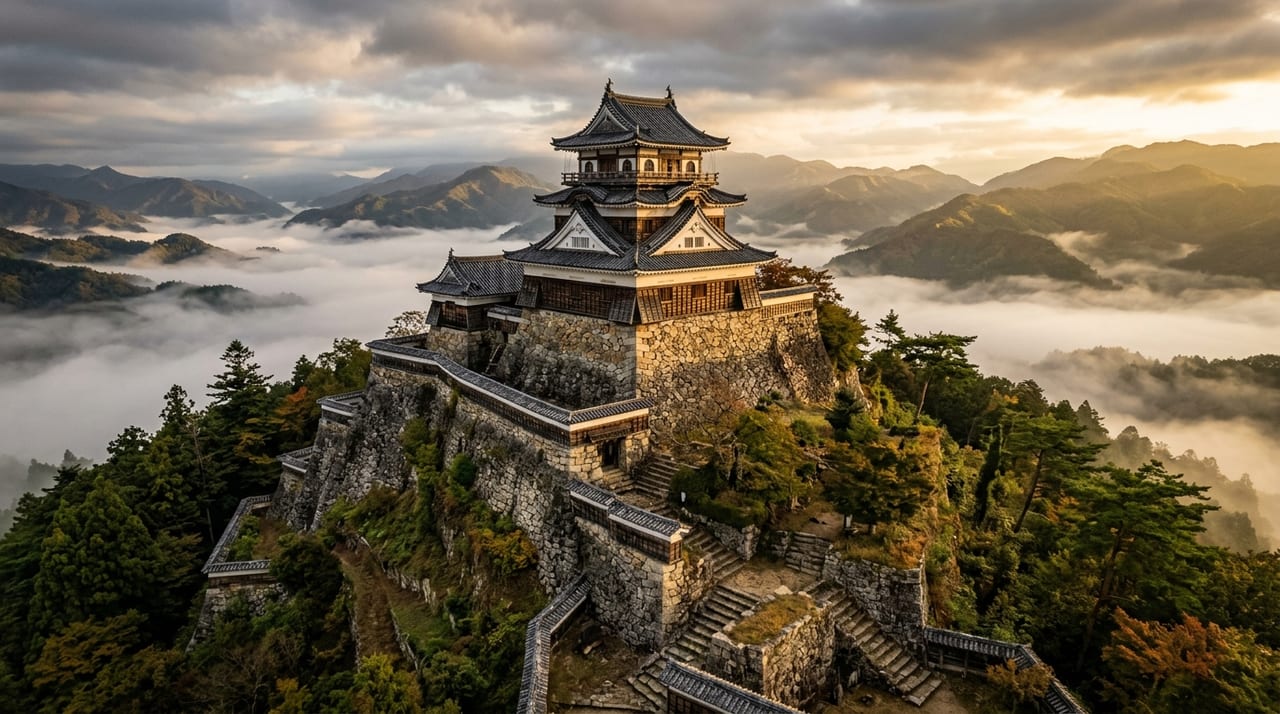
 * Image is for illustrative purposes only.
Iwamura Castle
岩村城
Iwamura Castle is a historic castle in the Chūbu region (Traditionally founded in 1185 (Bunji 1)). Its lord was Katō Kagekado / Tōyama Kagetō / Lady Otsuya.
Overview
About the Castle
Iwamura Castle is a mountain castle located in Ena City, Gifu Prefecture, at an elevation of 717 m. It is counted among Japan's Three Great Mountain Castles, together with Bitchu Matsuyama Castle and Takatori Castle. It is known for having the highest honmaru of any castle of the Edo-period domains, and it is a mysterious presence that bears the nickname 'Castle in the Mist.' According to tradition, it began in Bunji 1 (1185), when Katō Kagekado, a senior retainer of Minamoto no Yoritomo, was appointed jitō of the Tōyama estate. Afterward, as the castle of his descendants, the Iwamura Tōyama clan, it became the central castle of the Tōnō region.
The Legend of the Female Castle Lord
The greatest reason Iwamura Castle became known throughout the nation is the existence of its 'female castle lord.' After the death of castle lord Tōyama Kagetō, his wife Lady Otsuya (Otsuya no Kata, an aunt of Oda Nobunaga) took charge of the castle as female castle lord and governed Tōnō. As Nobunaga's aunt, Lady Otsuya enjoyed his deep trust. However, when the castle was surrounded by the forces of Akiyama Torashige (Nobutomo), a senior retainer of Takeda Shingen, she surrendered on the condition that she marry Akiyama, and she went over to the Takeda side. Enraged by this 'betrayal,' Nobunaga defeated Takeda Katsuyori at the Battle of Nagashino in Tenshō 3 (1575). Later that same year, his eldest son Oda Nobutada retook Iwamura Castle and executed Lady Otsuya and Akiyama Torashige by inverted crucifixion.
A Tragic History
This tragic ending has been passed down as an episode symbolizing the ruthlessness of the Sengoku period, and it etched Iwamura Castle into history as the 'Castle of the Female Lord.' This incident, in which even Nobunaga had the ruthlessness to calmly execute his own aunt, demonstrates the extreme of intrigue and scheming in the Sengoku era. Afterward, during the Edo period, several daimyō, including the Matsudaira and Niwā houses, served as castle lords, and the domain continued as the Iwamura domain until the bakumatsu period. The majestic stone walls, led by the Rokudan-kabe (six-tiered stone wall), create a fantastical landscape floating in the mist.
Architecture and Structure
Iwamura Castle's stone walls have a distinctive structure in which natural cliffs and artificial stone walls form a single unit, and traces of ingenuity in building on steep mountain terrain can be seen throughout. The stone wall called the Rokudan-kabe of the honmaru is especially magnificent, and its scale and precision gather the essence of castle architecture. The castle town is lined with sake breweries such as Iwamura Brewery and long-established merchant houses. Its historic streetscape, designated as an Important Preservation District for Groups of Traditional Buildings, conveys the vestiges of former times to the present day.
Development of the Castle Town
In one corner of the castle town, Tōnō's traditional food culture, such as 'gobei mochi,' is alive. A historical journey that combines a climb to the mountain castle with a stroll through the castle town offers travelers visiting Iwamura a special experience.
Nature and Landscape
The mist at Iwamura is especially deep from autumn into early winter. The sight of the stone walls at the summit floating on a sea of mist is known as a spectacular view on par with Takeda Castle (Hyōgo), which is lauded as the 'Castle in the Sky.' When you stand at the 717 m summit, gaze at the Tōnō mountain ranges spreading below, and reflect on the turbulent life of Lady Otsuya, history presses upon the visitor's heart not as mere knowledge but as a living experience.
Connection to Swords
The Tōnō region, where Iwamura Castle is located, lies at the eastern edge of the Mino-den swordsmiths' cultural sphere and was strongly influenced by Mino swords centered on Seki. Mino-den shines brilliantly in the history of Japanese swords as one of the Five Great Traditions. Numerous master smiths, led by Kanemoto and Kanesada, forged practical blades that 'do not break, do not bend, and cut well,' and these blades were overwhelmingly favored by Sengoku warlords. Of particular note is the role of swords in the story of the female castle lord Lady Otsuya and Akiyama Torashige, the strategist of Takeda Shingen. Akiyama Torashige was a valiant general counted among the Takeda Twenty-Four Generals, and he undertook the conquest of Tōnō leading the Takeda family's elite cavalry corps. However, Kai Province was not a major production center for swords. The famous blades held by the Takeda family, such as Sōza Samonji, were also the work of swordsmiths from other provinces, like the Samonji of Chikuzen, and an independent swordsmithing school known as 'Kōshū-mono' did not take root in Kai. At the Battle of Nagashino (1575), the Takeda cavalry corps suffered devastating losses from the Oda and Tokugawa musketeers. This battle also marked a historic turning point, symbolizing the shift from close combat with cavalry and swords to long-range combat with firearms. After Nobunaga retook Iwamura Castle, the area came under Oda control, and the sword culture of Mino and Owari was brought to Tōnō. Today, the Ena City Iwamura History Museum at the foot of the castle displays castle-related materials, including an illustrated map of Iwamura Castle from Kyōhō 3 (1718). Visitors can learn the castle's history from the era of the female castle lord through the Edo period. Tōnō's sword culture embodies the practicality of Mino-den and the steady spirit of the warriors of the mountain country. Like Iwamura Castle's steep stone walls, it possesses 'unpretentious, genuine strength.'
Highlights
- Rokudan-kabe — an overwhelming array of stone walls extending from the honmaru, the finest of Iwamura Castle's stone walls
- Spectacular view of the Castle in the Mist — a fantastical 'castle in the sky' whose stone walls float on a sea of mist in the early morning of autumn and winter
- Historic sites of Lady Otsuya — castle ruins and castle town history that narrate a Sengoku-era tragedy
- Iwamura castle town (Important Preservation District for Groups of Traditional Buildings) — sake breweries and long-established merchant houses lined up, with traces of the Edo era
- Ena City Iwamura History Museum — exhibits historical materials on the castle, including illustrated maps of Iwamura Castle
* Opening hours and admission fees are subject to change. Please check the official website before visiting.