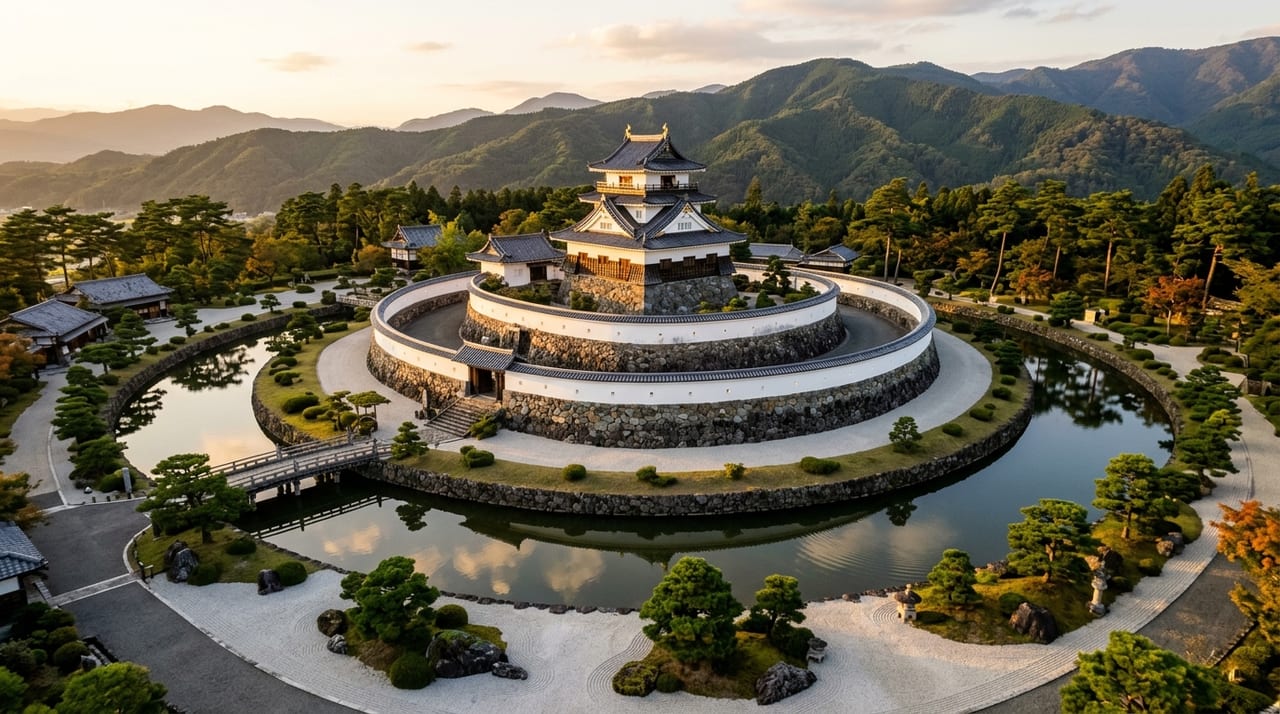
 * Image is for illustrative purposes only.
Tanaka Castle
田中城
Tanaka Castle is a historic castle in the Chūbu region (Built in 1537 (Tenbun 6) by the Imagawa clan as Tokunoisshiki Castle; captured and rebuilt by the Takeda in 1570 (Eiroku 13)). Its lord was Takeda clan / Tokugawa Ieyasu / Honda clan (Tanaka Domain).
Overview
About the Castle
Tanaka Castle, located in Fujieda, Shizuoka Prefecture, is an exceptionally distinctive castle with a highly unique layout that has attracted the attention of castle researchers as one of the most fascinating examples in Japanese castle history. Its most distinctive feature lies in its "concentric circle" (rinkaku-shiki) layout, in which the honmaru, ninomaru, sannomaru, and outer ramparts are arranged in concentric circles, and when viewed from directly above, the entire castle formed a perfect circle—a rare and extraordinary design concept. This perfectly circular layout is called "enkaku-shiki" (circular style), which is extremely rare in Japan, and Tanaka Castle is known as a representative example of it (Tanaka Castle was also known by alternative names such as Kamekō Castle and Kamei Castle).
A Disputed Territory Between the Takeda and Tokugawa
The border region between Suruga and Tōtōmi provinces where Tanaka Castle was located was a strategic strongpoint fiercely contested between Takeda Shingen and Tokugawa Ieyasu. Tanaka Castle was a fortification developed by the Takeda clan to secure their advance route into Tōtōmi, and its importance increased during the three-way struggle among the Takeda, Imagawa, and Tokugawa from the Eiroku to Tenshō periods. Takeda Shingen actively utilized Tanaka Castle as a front-line base to strengthen his control from Suruga into Tōtōmi. After the fall of the Takeda clan in Tenshō 10 (1582), it came under the control of Tokugawa Ieyasu, and throughout the Edo period it continued to serve as a stronghold for controlling Suruga and Tōtōmi while experiencing several changes of daimyo.
Connection to Tokugawa Ieyasu's Later Years
Tanaka Castle maintained a deep connection with the later years of Tokugawa Ieyasu's life. It is recorded that in Genna 2 (1616), Ieyasu, who was in retirement as Ōgosho at Sunpu Castle, stopped by Tanaka Castle while out hawking, and after eating sea bream tempura served by Chaya Shirōjirō, he experienced a decline in his health. There are various theories about the veracity of this anecdote, but it is a historical fact that Ieyasu frequently visited the areas around Tanaka Castle, and the geographical proximity of Sunpu and Tanaka demonstrates Ieyasu's daily range of movement. The story that Ieyasu's health declined due to sea bream tempura is widely known as the origin of the famous popular theory of "Ieyasu died from tempura."
The Honda Clan of Tanaka Domain and Samurai Traditions
In Kyōho 15 (1730), Honda Masanori was enfeoffed in Tanaka with a fief of 40,000 koku, and thereafter the Honda clan ruled Tanaka Domain for seven generations until the Meiji Restoration. This Honda clan was descended from Honda Masashige, brother of Honda Masanobu, a senior retainer of Tokugawa Ieyasu. It should be noted that Honda Shigetsugu (Sakuzaemon), famous as one of Tokugawa Ieyasu's Mikawa hereditary retainers and called the "Oni-Sakuza," was a straightforward warrior, but he was not a lord of Tanaka Castle and belonged to a different lineage from the Honda clan of Tanaka Domain. The letter that Honda Shigetsugu is said to have written to his wife, "Ippitsu keijō: Mind the fire. Don't make Sen cry. Fatten the horse," is famous as the shortest letter in Japan, and as a straightforward expression of affection from a blunt warrior, it continues to capture the hearts of many people today. The "Sen" (お仙) to whom this letter was written later became Honda Narishige, the first daimyo of Maruoka Domain, and in Maruoka-chō, Sakai City, Fukui Prefecture, a competition for "Japan's Shortest Letter" is still held today. This letter is widely cherished as an anecdote conveying the simple and sturdy spirit of Mikawa warriors to the present day.
The Circular Layout and Castle Remains
The concentric circular layout of Tanaka Castle is highly valued by castle researchers as demonstrating the experimental aspects of Sengoku-period castle-building technology. Currently, portions of the castle's remains have been preserved, and the site of the lower residence has been developed as the Tanaka Castle Shimoyashiki Historic Site, to which buildings such as the two-story honmaru turret have been relocated. Tanaka Castle-related historic sites are scattered throughout Fujieda City, and traces of the castle's circular layout are said to remain in the shapes of roads and waterways. This "memory of the castle etched on the map" has become an indispensable element in historical exploration of southern Shizuoka as a unique urban planning legacy of Tanaka Castle.
Suruga's Sword Culture and Tanaka Castle
Suruga Province, where Tanaka Castle was located, was the province of Sunpu Castle, where Tokugawa Ieyasu spent his later years, and throughout the Edo period it was an important region nearly under the direct control of the shogunal house. At Kunōzan Tōshōgū (Shizuoka City), also in Suruga Province, the tachi Sohaya no Tsurugi (Important Cultural Property), famed as Ieyasu's favourite sword and dedicated there according to his will, has been handed down.
Connection to Swords
Tanaka Castle stood on the border between Suruga and Tōtōmi, which the Takeda and Tokugawa fought over. Takeda Shingen captured it in Eiroku 13 (1570) and had Baba Nobuharu rebuild it, and the round umadashi (semicircular gate defences) outside the second and third baileys show features of Takeda-style castle building. Even after the castle surrendered to the Tokugawa side in Tenshō 10 (1582), Ieyasu in his last years still stopped there in Genna 2 (1616). Today the site of the lower residence has been developed as the Tanaka Castle Shimoyashiki Historic Site, where buildings such as the honmaru turret have been relocated and opened to the public, and Edo-period plans of the castle are held by the Fujieda City Museum of Local History and Literature. Neighbouring Shizuoka City is home to the Kunōzan Tōshōgū Museum, which holds swords associated with Tokugawa Ieyasu, so the history and sword culture of Suruga can be explored together with Tanaka Castle.
Highlights
- Concentric circular layout (rare 'enkaku-shiki' design visible in modern streets and waterways)
- Tanaka Castle Shimoyashiki Historic Site (relocated buildings such as the honmaru turret)
- Fujieda City Museum of Local History and Literature (holds Edo-period plans of Tanaka Castle)
- Sites associated with the Honda clan of Tanaka Domain (seven generations of lords from 1730 to the Meiji Restoration)
- Rengejike Park (Fujieda's premier nature park, lotus blossoms)
* Opening hours and admission fees are subject to change. Please check the official website before visiting.