 * Image is for illustrative purposes only.
Kanazawa Castle
金沢城
Kanazawa Castle is a historic castle in the Chūbu region (Built in 1580 (Tenshō 8)). Its lord was Maeda Toshiie / Maeda clan.
Overview
About the Castle
Kanazawa Castle was the seat of the Maeda family, whose Kaga domain was known as Kaga Hyakumangoku ("One Million Koku of Kaga"). It was a grand castle complex that enjoyed unprecedented prosperity throughout the Edo period. Its origins date to 1580 (Tenshō 8), when Sakuma Morimasa captured Oyama Gobō, the stronghold of the Ikkō uprising. In 1583 (Tenshō 11), Maeda Toshiie entered the castle. From then until the Meiji Restoration, it served as the base of the Maeda family's fourteen generations, who governed the three provinces of Kaga, Noto, and Etchū as a massive domain. The Maeda family's assessed yield across Kaga, Noto, and Etchū totaled approximately 1,025,000 koku, by far the largest of any tozama daimyō.
Architecture and Structure
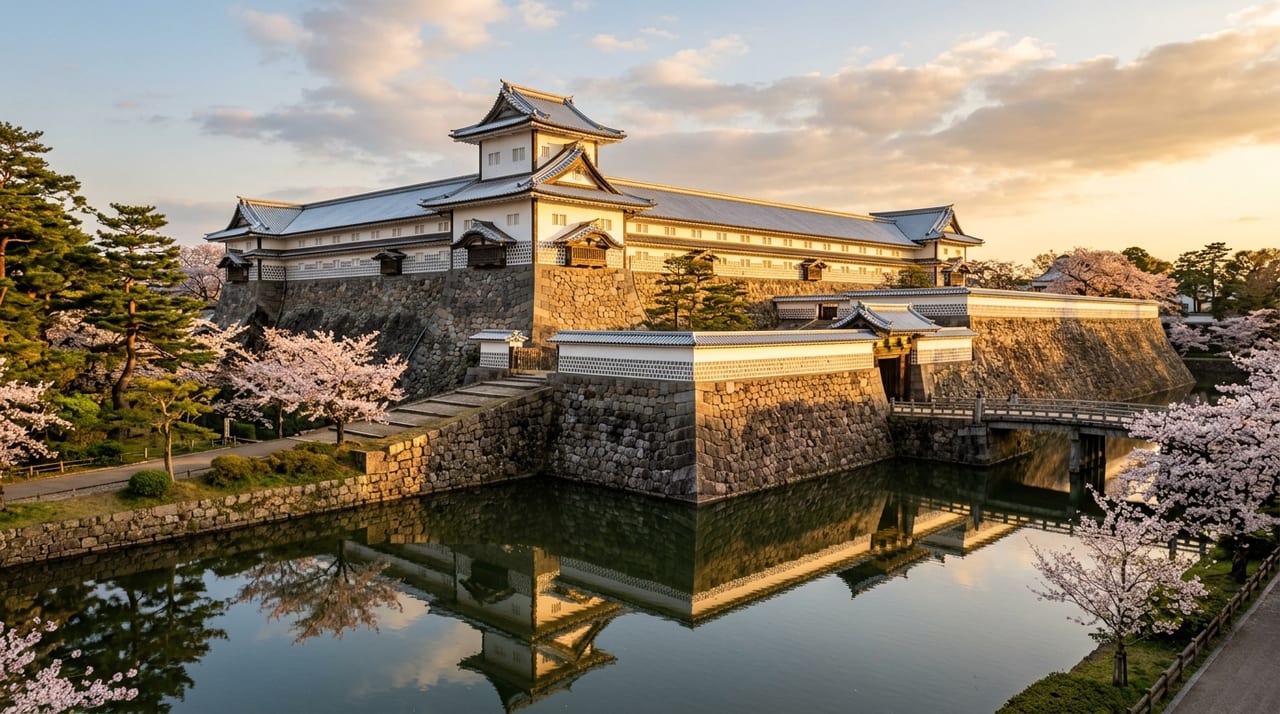
After the main keep (tenshu) was destroyed by lightning in 1602 (Keichō 7), it was not rebuilt. A three-story turret was built in its place instead. Kanazawa Castle's greatest distinction is that a wide variety of stone wall techniques coexist within a single castle, to the extent that it is called a "museum of stone walls." From early natural-stone masonry (nozura-zumi) to roughly dressed stone masonry (uchikomi-hagi) and precisely cut stone masonry (kirikomi-hagi), one can observe the evolution of stone wall techniques across different eras within one castle.
Culture and Crafts
In particular, the shikishi-tanzaku-zumi stone wall of Gyokusen'inmaru is an original design. A V-shaped stone drain is set at the spout, and square (shikishi) and tall rectangular (tanzaku) stones are arranged in staggered rows. It boasts a design beauty found only at Kanazawa Castle. The Hishi-yagura, Gojikken Nagaya, and Hashizume-mon Tsuzuki-yagura, reconstructed in the Heisei era, feature traditional wooden post-and-beam construction and silver roofs of lead roof tiles, evoking the imposing appearance of the past. Adjacent to Kenroku-en, this castle is a symbol of the cultural richness of the Kaga Hyakumangoku. The Maeda family generously encouraged not only warrior culture but the arts in general, including the tea ceremony, Noh theater, Kaga maki-e, Kutani ware, and Kaga Yūzen dyeing. In doing so, they developed Kanazawa into a distinctive cultural city that goes beyond being a "mini-Kyoto."
Development of the Castle Town
Kanazawa's craft culture was nurtured under the domain government of the Edo period, and today a wide range of traditional crafts, including gold leaf, lacquerware, ceramics, and textiles, continue to thrive. The cultural legacy of the Kaga domain overflows in every corner of the city. Centered on its castle and gardens, Kanazawa is the most complete surviving example of Japan's daimyō culture. Because Kanazawa was not subjected to air raids during the Pacific War, the historical townscape of the castle town has been well preserved, and traces of the Edo period remain strong in places such as Higashi Chaya District and the former Nagamachi Samurai District. Since the opening of the Hokuriku Shinkansen, access from the Tokyo metropolitan area has improved dramatically, making it easy to experience the culture of the Kaga Hyakumangoku.
Connection to Swords
A trip that combines a visit to a Kaga zōgan workshop with sword appreciation at the Ishikawa Prefectural Museum of Art is an experience unique to Kanazawa. In winter, Kenroku-en, with its yukitsuri (snow-supporting ropes), shows a fantastical beauty. Together with Kanazawa Castle dusted in snow, it lets visitors enjoy the winter landscape of Hokuriku. The million-koku prosperity of the Kaga domain was a rare example of embodying the ideal of combining martial prowess and culture.
Connection to Swords
Maeda Toshiie, as his nickname "Yari no Mataza" suggests, was known as a master of the spear, but he was also deeply knowledgeable about swords. Toshiie served as one of Oda Nobunaga's Akahoro-shū from a young age, fighting on the battlefield, and cultivated a keen aesthetic eye for arms and armor. Backed by the overwhelming wealth of the Kaga Hyakumangoku, the Maeda family devoted generations to collecting famous swords, forming one of Japan's foremost sword collections. Its greatest treasure is "Ōdenta Mitsuyo." This National Treasure tachi, counted among the Five Swords of the Realm (Tenka Goken), is the work of the master smith Miike Denta Mitsuyo of Chikugo Province, and is said to have been bestowed by Toyotomi Hideyoshi upon Maeda Toshiie. Its broad, majestic form radiates an overwhelming presence worthy of the name of the Five Swords of the Realm. The Maeda family also transmitted many swords of National Treasure and Important Cultural Property caliber, including the "Maeda Tōshirō" (a tanto by Awataguchi Yoshimitsu, an Important Cultural Property). The Kaga domain employed Kashū smiths as domain-retained swordsmiths, and Kanewaka, the foremost smith of the Kaga domain, continued making blades for several generations. Darani Katsukuni is also a smith representing the Kaga domain. What particularly characterizes Kanazawa's sword culture is the technique of Kaga zōgan. This advanced technique, in which metals such as gold, silver, and copper are inlaid into an iron base, was applied to making sword fittings such as tsuba and menuki, producing delicate and dignified designs. Kaga zōgan is still passed down today as a traditional craft of Kanazawa, and the fact that its origins lie in sword fittings is an essential point for sword enthusiasts. At the Ishikawa Prefectural Museum of Art, visitors can view masterpieces of swords and sword fittings associated with the Kaga Maeda family, as well as Kashū blades and Kaga zōgan. Note that the National Treasure Ōdenta Mitsuyo is owned by the Maeda family's foundation, Maeda Ikutokukai (Komaba, Meguro Ward, Tokyo), and is not on permanent display.
Highlights
- Hishi-yagura, Gojikken Nagaya, and Hashizume-mon Tsuzuki-yagura — reconstructed with traditional wooden construction; the silver lead roof tiles are beautiful
- Museum of stone walls — diverse techniques coexist, including nozura-zumi, uchikomi-hagi, kirikomi-hagi, and shikishi-tanzaku-zumi
- Kenroku-en (one of Japan's Three Great Gardens) — a strolling-style daimyō garden symbolizing the culture of the Kaga Hyakumangoku
- Ishikawa Prefectural Museum of Art — displays swords and sword fittings associated with the Maeda family, and masterpieces of Kaga zōgan
- Gyokusen'inmaru Garden — the Maeda family's inner garden, restored; the illumination is also fantastical
- Kaga zōgan workshop visits — a traditional craft that developed from sword fittings, with workshops scattered throughout Kanazawa city
* Opening hours and admission fees are subject to change. Please check the official website before visiting.