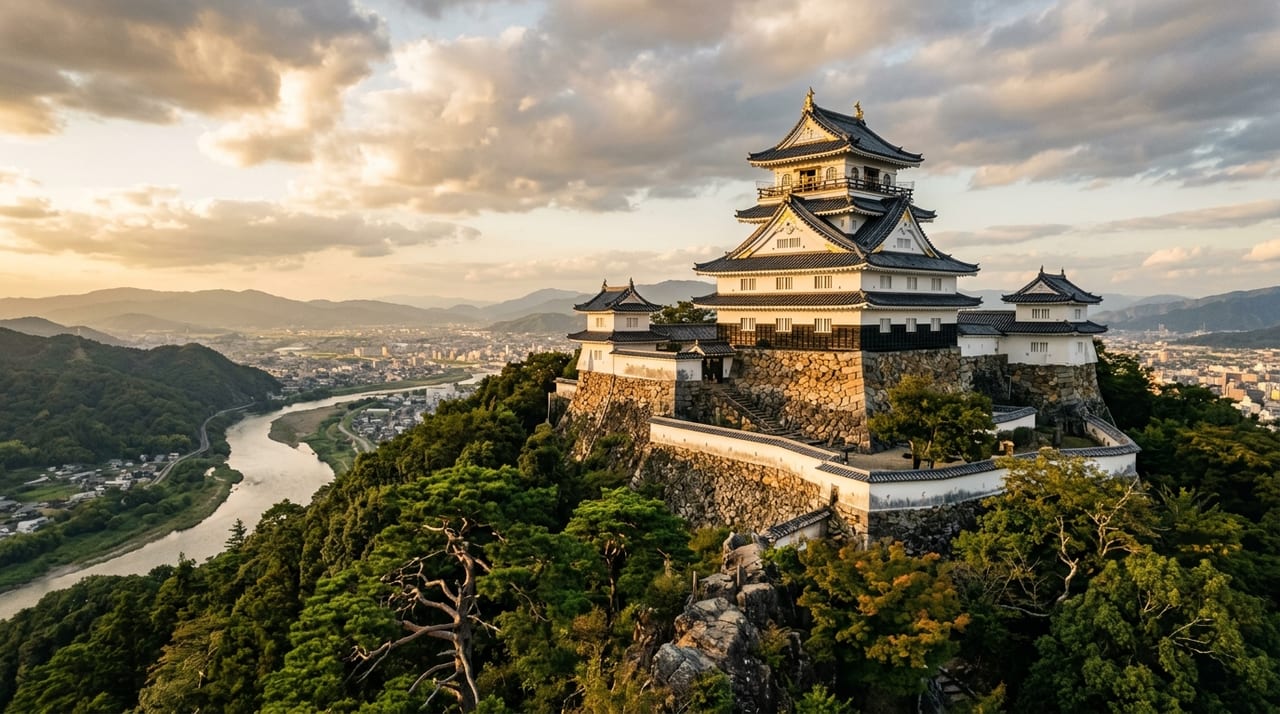
 * Image is for illustrative purposes only.
Gifu Castle
岐阜城
Gifu Castle is a historic castle in the Chūbu region (Originally built c. 1201; renamed and greatly expanded by Nobunaga in 1567). Its lord was Nikaidō clan (Inabayama Castle) / Saitō Dōsan / Oda Nobunaga.
Overview
The Headquarters of Tenka Fubu: Gifu Castle and Oda Nobunaga
Gifu Castle stands atop Mount Kinkasan (329 m above sea level) in the heart of Gifu City. It is renowned as the castle that Oda Nobunaga developed as the base for his unification of the realm. The castle's origins go back to the early Kamakura period (13th century), and it was originally called Inabayama Castle. In the Sengoku period, Saitō Dōsan, a powerful figure in Mino Province, made it his seat, and it became the stronghold of a schemer known as the Viper Dōsan.
Dōsan's son Yoshitatsu killed his father. Then Oda Nobunaga, Dōsan's son-in-law, captured Inabayama Castle in Eiroku 10 (1567), and he renamed the castle Gifu. The place name Gifu is said to have been formed by taking one character each from Mount Qi, where King Wen of Zhou established his base for pacifying the realm, and from Qufu, the birthplace of Confucius. It was a name that embodied Nobunaga's grand aspiration to unify the realm. At around the same time, Nobunaga began using the seal Tenka Fubu (to unify the realm by force), and Gifu Castle began its advance toward supreme power under that banner.
Nobunaga's Sense of Beauty in Gifu: A Magnificent Hilltop Residence and Nanban Culture
Nobunaga developed Gifu Castle not merely as a military base, but as a stage on which to express his own sense of beauty and power. It is said that visitors were overwhelmed by the view from the hilltop castle looking down on the Nagara River. At the foot of the mountain, a residence known as the Goten was built, and there Nobunaga entertained daimyō and foreign missionaries.
Luís Fróis and other Jesuit missionaries visited Gifu and recorded Nobunaga's castle and way of life. Fróis's History of Japan contains a description of the splendor of Gifu Castle, and it conveys the lavish construction of the Goten at the mountain foot. Nobunaga had a strong interest in Nanban culture, and rare imported treasures and famous objects gathered in Gifu.
Nobunaga and Swords: The Deep Connection with Mino Smiths and Seki Smiths
Essential to any discussion of Gifu Castle and swords is its relationship with the Seki smiths, the group of swordsmiths of Mino Province. Seki (present-day Seki City, Gifu Prefecture) has been a town of swordsmiths since the Kamakura period. Many smiths there carried on the Mino-den tradition, which began with Shizu Kaneuji in the Nanboku-chō period. In the late Muromachi period, master smiths of Seki such as Izumi no Kami Kanesada and Magoroku Kanemoto were active.
One of the famous swords Nobunaga possessed is Yagen Tōshirō. This is a tantō made by Awataguchi Yoshimitsu, and in Genki 2 (1571) it was presented to Nobunaga by Matsunaga Hisahide. The name is said to derive from a legend: when Hatakeyama Masanaga attempted to take his own life, the dagger did not pierce his belly, and when he threw it aside, it pierced a yagen (a tool for grinding medicine). It is said to have been destroyed by fire in the Honnō-ji Incident. In the Kyōhō Meibutsuchō it is listed in the section of lost (burned) swords, and it does not exist today.
Nobunaga's sword policy held political meaning that went beyond personal collecting. He took fine swords from across the land and bestowed them on his retainers as rewards, thereby managing the loyalty of his vassal group.
The Flourishing of Seki Smiths: The Sword Industry of Gifu and Mino
Seki, located near Nobunaga's base at Gifu, is still known around the world today as a town of blades. Museums, workshops, and long-established cutlery shops line its streets.
In present-day Seki City there is the Seki Cutlery Festival (October), which has become a major event that draws blade enthusiasts from all over Japan. The Gifu Prefecture Cutlery Hall exhibits and sells blades and swords made in Seki, and it is one of the best places to experience Japan's blade culture. A visit to Gifu Castle combined with the blade and sword culture of Seki City allows one to understand deeply the history of Mino's blade industry, which continues from Nobunaga's era.
Gifu Castle Today: The Tower and Views
The current tower is a reinforced-concrete building rebuilt in Shōwa 31 (1956) through the enthusiasm of citizens. Its figure standing on the mountaintop recalls the grandeur of the past, and it is beloved as a symbol of Gifu City. The interior of the tower is maintained as a museum, with abundant exhibits of items connected to Nobunaga and the history of Gifu Castle. The summit of Mount Kinkasan can be reached both by ropeway and by hiking route, and the view of the Nagara River and the city of Gifu from the tower is breathtakingly beautiful.
Connection to Swords
The relationship between Gifu Castle and swords carries special significance through the sword policy of Nobunaga, the Sengoku-period ruler of the realm. In the history of the Japanese sword, Nobunaga played an important role as a pioneer in the political use of swords.
Nobunaga's collecting of swords was strategic. By confiscating and acquiring famous blades and bestowing them as rewards on his retainers, he managed his retainers' loyalty in the form of swords. The fact that many of the swords called famous treasures of the realm passed through Nobunaga's hands shows that he politically utilized the system of sword values. Hideyoshi and Ieyasu later inherited this method.
The group of Seki smiths of Mino Province is located near Gifu Castle, and it produced large quantities of swords in response to demand during the Sengoku period. The characteristics of Seki smiths are the Mino-den hamon (sanbonsugi, and mainly notare) and practical durability, and they received high evaluation as military swords for Sengoku daimyō. It is thought that many of the generals under Nobunaga wore swords made by Seki smiths at their sides.
The Yagen Tōshirō (made by Awataguchi Yoshimitsu) that Nobunaga possessed is said to have been destroyed by fire in the Honnō-ji Incident (Tenshō 10 (1582)). When the rebellion by Akechi Mitsuhide was discovered, Nobunaga fought back together with a small number of pages, and in the end he set fire to the temple and took his own life. The meaning of the sword in this scene, a sword worn at the side that also served as a tool for ending one's life at the last, is one of the scenes that most dramatically embodies the dual nature of the Japanese sword as a symbol of beauty and a tool of death.
In addition, the lineage of Seki smiths, representative of the Mino-den, continues into the present day, and Seki City in Gifu Prefecture is still known internationally as a city of the blade industry. That Gifu, the base of Nobunaga's Tenka Fubu, still shines today as a center of Japan's blade culture is also interesting from the perspective of the continuity of sword culture.
Highlights
- Gifu Castle tower (reconstructed) — Nobunaga's landmark atop 329-meter Mt. Kinkasan
- Panoramic views from the tower — Nagara River, Gifu city, Mt. Ibuki, and Mt. Ontake
- Ropeway to the mountain — easy access to the summit area
- Nobunaga's palace ruins (mountain foot) — excavations have revealed structures from Nobunaga's era
- Gifu City History Museum — exhibits on Nobunaga, Gifu Castle history, and Mino sword culture
- Seki City (knife town) — the living continuation of Mino blade tradition; annual Seki Blade Festival (October)
* Opening hours and admission fees are subject to change. Please check the official website before visiting.