New Arrivals — Browse our catalog for the latest authentic Japanese sword arrivals. Browse →
May 28, 1556 (Kōji 2, 4th month, 20th day)
Nagara Riverbank, Mino Province (present-day Nagara area, Gifu City, Gifu Prefecture)
Forces
Saitō Yoshitatsu Forces
Saitō Dōsan Forces
About 13 min read
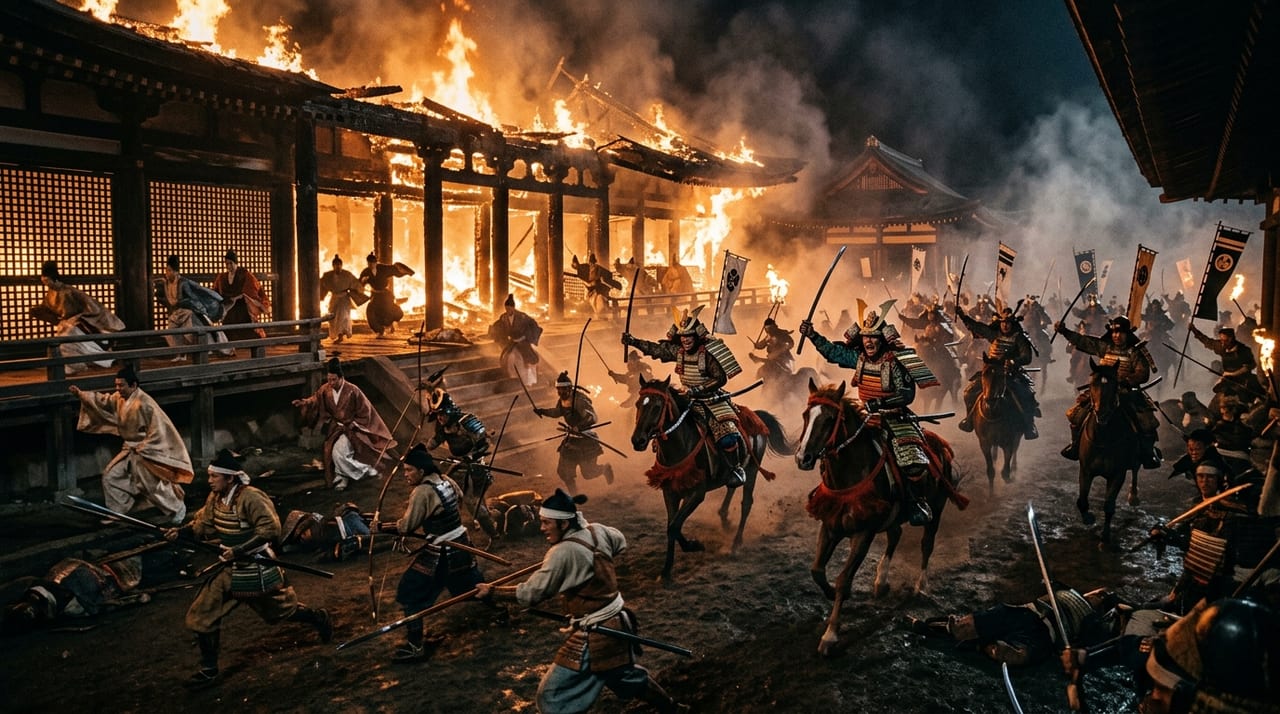
In the 4th month of Kōji 2 (1556), on the bank of the Nagara River in Mino Province (present-day Gifu City), Saitō Dōsan, a major figure of gekokujō known by the nickname "Viper of Mino" (mamushi), was defeated by the large army of his biological son, Saitō Yoshitatsu, and was killed in battle. The Battle of the Nagara River was both the dramatic end of Dōsan, an outstanding Sengoku daimyō, and a shocking event for the young Oda Nobunaga, the "death of his father-in-law." It became a historic turning point that forced Nobunaga into a struggle to conquer Mino that lasted ten years.
Saitō Dōsan is one of the most dramatic figures of the Sengoku period, both in his origins and in the course of his rise. Through the "copy of the Rokkaku Jōtei letter of articles" discovered during the compilation of the History of Gifu Prefecture (Gifu-kenshi), it has become clear that the legend of his rise "from oil merchant to daimyō" compresses into the story of one man the results of two generations of gekokujō, those of his father, Nagai Shinzaemon-no-jō, and his son, Dōsan. In any case, the process by which the father and son rose as vassals of the Toki clan (shugo of Mino), changed their family name from Nishimura to Nagai and then to Saitō, eventually seized real power in Mino, and expelled Toki Yoriaki to become lord of Mino is passed down as a typical example of Sengoku "gekokujō."
Dōsan's cunning and ruthlessness are said to have surpassed those of other Sengoku daimyō. The nickname "Viper of Mino" likens his craftiness and political skill to a poisonous snake, but it was popularized by the novels of Sakaguchi Ango and Shiba Ryōtarō, and no example of Dōsan being called a mamushi before then has been confirmed. At the same time, Dōsan was also an outstanding figure in cultural refinement.
The relationship between Saitō Dōsan and Oda Nobunaga was special, going beyond a mere political marriage. Dōsan gave his own daughter, Kichō (later Nōhime), in marriage to Nobunaga, forming an alliance between Mino and Owari.
In Tenbun 22 (1553), Dōsan and Nobunaga are said to have met at Shōtoku-ji in Tomida (present-day Ichinomiya City). At this meeting, Dōsan saw through the ability of the young Nobunaga, who was scorned as an "utsuke-mono" (fool), and an anecdote survives that he told those around him, "My sons will end up waiting at Nobunaga's gate." About three years after this meeting, the Battle of the Nagara River took place.
In his later years, Dōsan's conflict with his biological son, Yoshitatsu, deepened. Yoshitatsu was dissatisfied with the question of his mother's background (some say she was of the blood of Toki Yoriaki) and with Dōsan's high-handed designation of a successor, and he rose in revolt. It is said that Dōsan wrote the "Letter Ceding Mino Province" (Mino-no-kuni yuzurijō), which would hand Mino over to Nobunaga, but the decisive battle with Yoshitatsu's forces came before reinforcements from his son-in-law Nobunaga arrived.
In the 4th month of Kōji 2 (1556), Saitō Yoshitatsu led a force of about 17,500 men and clashed with Dōsan's army at the Nagara River. Dōsan had only about 2,700 troops, and the disparity in strength was clear.
Dōsan fought fiercely against Yoshitatsu's large army on the bank of the Nagara River, but he suffered defeat in the face of the overwhelming difference in numbers. Dōsan was killed in battle after a valiant fight. His age at death is not fixed, because there are various theories about his year of birth.
Dōsan's head was taken by Yoshitatsu's soldiers, and a head inspection (kubi-jikken) was carried out.
Nobunaga had crossed the Kiso River and advanced as far as Ōra (present-day Hashima City) to rescue Dōsan, but he arrived too late. Upon receiving word of Dōsan's death, he personally served as rearguard and withdrew. Nobunaga, who was to have been "handed" Mino through Dōsan's will, was forced to keep fighting for a long time against the Mino that Yoshitatsu controlled.
Mino Province (present-day Gifu Prefecture), the stage of the Battle of the Nagara River, is an especially important region in the history of the Japanese sword as the production center of a sword school called "Mino-den" (Mino tradition). Seki no Magoroku Kanemoto, known as "Seki no Magoroku," was a leading swordsmith of Mino, and the combat blades he forged were especially renowned for their sharpness.
It is thought that many of the warriors and soldiers of Dōsan and Yoshitatsu carried swords forged by these local Mino swordsmiths. Muramasa was also a sword favored by warlords of the Tōkai region at that time. The sword Dōsan wielded last, whether it was a Bizen blade or a Mino blade, was the final blade swung to defend "the Mino he had seized through gekokujō."
Inabayama Castle in Mino (present-day Gifu Castle) had been the symbolic castle of the Gifu area since Dōsan's time, and it is also known as the castle that Nobunaga later captured and with which the name "Gifu" is associated. In the Battle of the Nagara River, the sword culture sphere of Mino, centered on Inabayama Castle, became the stage for the conflict between father and son.
After Saitō Dōsan's death, Mino was ruled by the "Saitō house after Dōsan," which passed from Saitō Yoshitatsu to Saitō Tatsuoki, but its rule was unstable. After completing the unification of Owari, Nobunaga finally captured Inabayama Castle in Eiroku 10 (1567). The legend of the Sunomata "One-Night Castle" also arose during this process. Nobunaga then fully subdued Mino Province. At this time, he renamed the castle town "Gifu" and began using the "Tenka Fubu" seal.
The "bequest of Mino" that Dōsan left to Nobunaga took eleven years to be realized, but it was ultimately realized by Nobunaga. When Nobunaga gained Inabayama Castle (Gifu Castle), located a few kilometers from the place on the bank of the Nagara River where Dōsan lost his life, Dōsan's "dream" may be said to have been fulfilled in a certain form.
In present-day Gifu City remain Jōzai-ji, a temple that enshrines Saitō Dōsan (Dōsan's family temple), and historic sites developed along the Nagara River. Gifu Castle (formerly Inabayama Castle) attracts many visitors as a tourist attraction. As the place held by two outstanding Sengoku daimyō, Dōsan and Nobunaga, it has become a symbol of Gifu.
Monuments marking specific historic sites have also been erected at the site of the Battle of the Nagara River, where one can remember Dōsan's last moments. For sword enthusiasts, Mino is a sacred place for exploring the sword culture of "Seki no Magoroku" and "Mino-den," and it also holds special meaning as "a historic land where a hero of gekokujō met his final defeat." Gazing at the clear waters of the Nagara River, when one reflects on the mortal struggle between father and son fought on this ground 470 years ago and on the drama of Nobunaga's later conquest of Mino, one cannot help but feel the depth of human karma (gō) in the age of the Japanese sword.
Saitō Dōsan
Saitō Dōsan — the 'Viper of Mino' who was defeated and killed by his own son at the Nagara River
Oda Nobunaga
Oda Nobunaga — Dōsan's son-in-law who received Mino in Dōsan's will but had to spend fourteen years conquering it
Imagawa Yoshimoto
Imagawa Yoshimoto — the great eastern daimyo contemporary with Dōsan's Mino, part of the same regional power balance
Takeda Shingen
Takeda Shingen — the Kai daimyo who was Dōsan's contemporary and neighbor in the regional balance
Inaba-Gō
Inaba-gō — a katana by Gō Yoshihiro (National Treasure) said to have been owned by Inaba Shigemichi, son of Inaba Yoshimichi (Ittetsu) of Mino; a famous blade tied to a Mino warrior house
Yoshimoto Samonji
Sōza Samonji — held by Imagawa Yoshimoto, Dōsan's contemporary rival, representing the blade culture of the same period