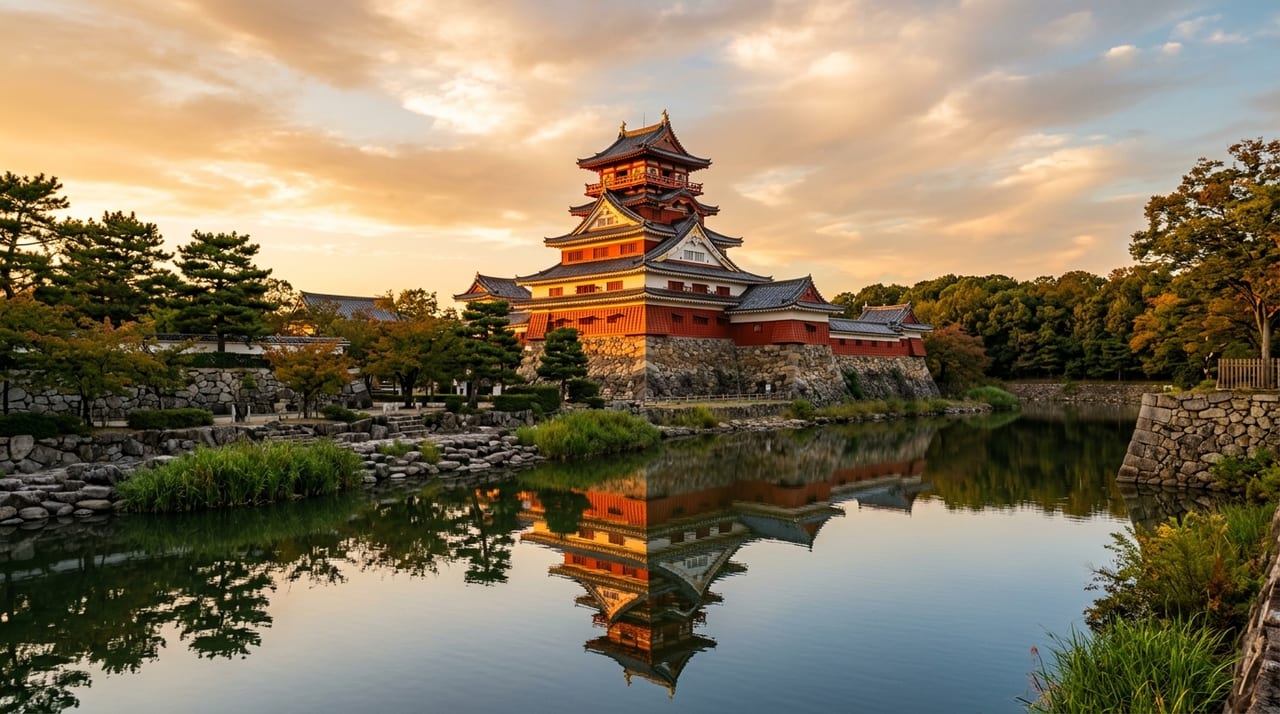
 * Image is for illustrative purposes only.
Kiyosu Castle
清洲城
Kiyosu Castle is a historic castle in the Chūbu region (Built in Ōei 12 (1405)). Its lord was Oda Nobunaga (during unification of Owari).
Overview
The Starting Point Toward Rule of the Realm—Kiyosu Castle and Oda Nobunaga
Kiyosu Castle (Kiyosujō) is a castle located in Kiyosu City (Kiyosushi), Aichi Prefecture. As the place where Oda Nobunaga, who raised the banner of “tenka fubu,” unified Owari and took his first steps toward the unification of the realm, it counts as one of the most dramatic castles in Japanese history. The present keep is a reinforced-concrete mock keep built in Heisei 1 (1989) on a site adjacent to the ruins of Kiyosu Castle, but the keep crowned with golden shachihoko and the vermilion-lacquered Ōte Bridge reflect beautifully on the flow of the Gojō River, forming a distinctive landscape.
The history of Kiyosu Castle dates back to Ōei 12 (1405), and it is said to have been built in the Muromachi period as a base of the Shiba clan (Shibashi). Afterward it became the residence of the deputy constable (shugo-dai) Oda Yamato-no-kami family, functioning as the political center of Owari Province during the Sengoku period. Nobunaga succeeded his father Nobuhide around Tenbun 20 (1551), and the young Nobunaga, who moved from Nagoya (Nagono) Castle to Kiyosu Castle in Kōji 1 (1555), fought his battles to unify Owari from here as his base.
The Eve of Okehazama—From Kiyosu Castle to the Imagawa Army
Kiyosu Castle became the stage of its most glorious historical moment on the 19th day of the 5th month of Eiroku 3 (1560)—the morning of the Battle of Okehazama. A great army, said to number as many as 25,000, led by Imagawa Yoshimoto, had invaded Owari and was attacking the Oda-side Washizu Fort and Marune Fort. Receiving this news at Kiyosu Castle, Nobunaga sallied out of the castle at the head of a force said to be only 2,000, or even 3,000.
Amid an overwhelming disparity in forces, Nobunaga danced the dance of Atsumori and set out to battle. This “departure from Kiyosu Castle” is one of the most famous departure scenes in Japanese history, and it has been passed down as a crystallization of Nobunaga’s boldness, decisiveness, and willingness to face even death. Kiyosu Castle is etched forever into Japanese history as the stage of this historic moment.
Nobunaga, who succeeded in killing Imagawa Yoshimoto in the surprise attack at Okehazama, used Kiyosu Castle as a foothold to complete the unification of Owari. In Eiroku 6 (1563) he moved his base to Komakiyama Castle, and further in Eiroku 10 (1567) he captured Inabayama Castle (later Gifu Castle) and moved to Gifu. Kiyosu Castle continued to play an important role as the center of Owari, functioning as a rear-support base for Nobunaga’s strategy for unifying the realm.
The Kiyosu Conference—One Night That Decided the Fate of the Realm
Kiyosu Castle returned to center stage of history in the 6th month of Tenshō 10 (1582). Over the succession to Nobunaga’s household—Nobunaga having been killed by Akechi Mitsuhide in the Honnōji Incident on the 2nd day of the 6th month—the four senior retainers (jūshin) Hashiba Hideyoshi, Shibata Katsuie, Niwa Nagahide, and Ikeda Tsuneoki gathered at Kiyosu Castle to deliberate. This “Kiyosu Conference (Kiyosu kaigi)” is one of the most important political conferences in Japanese history, and its conclusion led directly to the establishment of the later Toyotomi regime.
Hideyoshi insisted on installing Sanbōshi (later Oda Hidenobu), the heir of Nobutada, Nobunaga’s eldest son, while Katsuie backed Nobutaka, the third son. In the end Hideyoshi’s position prevailed, and Sanbōshi came to inherit the Oda household headship. Hideyoshi, who emerged as the victor of this conference, went on to defeat Katsuie in the subsequent power struggle (Battle of Shizugatake, Tenshō 11), and began his path toward the unification of the realm. Kiyosu Castle is remembered as the stage of this historical turning point, an indispensable place in the history of the Sengoku period.
Kiyosu and Nagoya Castle—The Tragedy of Castle Dismantling
Kiyosu Castle was effectively abandoned in Keichō 15 (1610) through the “Kiyosu-goshi (Kiyosu relocation)” carried out at the command of Tokugawa Ieyasu. The Kiyosu relocation was a massive construction project that moved the castle and the castle town of Kiyosu, in their entirety, to the site of the Nagoya Castle then being newly built; Kiyosu’s buildings, stone, and residents all moved to Nagoya en masse. As a result of this thorough relocation work, almost no keep or stone walls remained at the former site of Kiyosu Castle, and the surviving remains today are limited.
The history of this “Kiyosu-goshi” vividly shows that a castle is not merely a building but a living community united with the residents of its castle town. When the castle moved, the people moved with it, and culture and economy moved too—the Kiyosu relocation was a historical event that most dramatically demonstrated this dynamism. The present mock keep of Kiyosu Castle stands within Kiyosu Regional Culture Plaza, adjacent to the former castle site, and only part of an earthen rampart remains in one corner of the old site as a relic of the past.
Oda Family Swords—Nobunaga’s Beloved Blades and Sword Culture
Kiyosu Castle, as the base of Oda Nobunaga, is deeply connected with the sword culture of the blades Nobunaga possessed. Nobunaga was a Sengoku daimyō who actively used Japanese swords not only as weapons but also as political and artistic symbols, and his sword collection was regarded as an important proof of the qualities of a ruler of the realm.
Among Nobunaga’s beloved swords, the most famous is the “Yoshimoto Samonji (Yoshimoto Samonji).” It is a famous blade said to have been taken from Imagawa Yoshimoto, whom he slew at the Battle of Okehazama. Samonji is said to be the work of Chikushū Sa (Samonji), a master smith active in Chikuzen Province (present-day Fukuoka Prefecture) in the Nanboku-chō period. Nobunaga had this blade shortened (suriage) and had a gold-inlaid inscription placed on the tang (nakago) recording that he had slain Yoshimoto. This sword is said to have passed from Nobunaga to Hideyoshi and then to the Tokugawa family; it is now held by Kenkun Shrine (Kita Ward, Kyoto City) and is on deposit at the Kyoto National Museum.
Nobunaga also possessed the famous tantō “Yagen Tōshirō (Yagen Tōshirō),” a celebrated short sword by Awataguchi Yoshimitsu. This short sword, presented to Nobunaga by Matsunaga Hisahide in Genki 2 (1571), is said to have been lost in the fire of the Honnōji Incident. As the castle that was the starting point of these tales of Nobunaga’s swords, Kiyosu Castle is also a pilgrimage site of special significance for sword enthusiasts.
Kiyosu Castle and TOUKENZA
Date Masamune of Sendai, where TOUKENZA is based, was a warlord of a generation about 30 years after Nobunaga of the Kiyosu Castle era.
When Nobunaga set out from Kiyosu Castle toward Okehazama with a sword at his waist, that blade must have been a masterpiece by the hand of a master craftsman. Masamune, too, as a warlord who lived in the same era as Nobunaga, belongs to a spiritual lineage that cherished fine swords, fine armor, and fine works of art. Kiyosu Castle, at the center of the Sengoku period when Japanese swords shone as crystallizations of authority and aesthetics, is one of the places that embodies the historical layering of Japanese sword culture conveyed by TOUKENZA.
Connection to Swords
As the base of Oda Nobunaga, Kiyosu Castle is deeply connected with the sword world of one of the most important warlords in the history of Japanese sword culture. Nobunaga did not handle swords merely as weapons; he actively used them as tools of power, aesthetics, and diplomacy. As a practitioner of “tool politics” alongside tea utensils, Nobunaga used famous swords as gifts to bestow on retainers and allies, drawing out the political and diplomatic value of swords to the fullest.
The most famous of the swords that Nobunaga is said to have possessed during the Kiyosu Castle period is the “Yoshimoto Samonji (Yoshimoto Samonji).” It is a famous blade that Nobunaga is said to have obtained as a relic of Imagawa Yoshimoto after slaying him at the Battle of Okehazama in Eiroku 3 (1560). Samonji (Chikushū Sa) was a master smith of Chikuzen Province in the Nanboku-chō period, and the blades made by his school are known for their lively, refined style with undulating hamon. Nobunaga had this blade shortened (suriage) and a gold-inlaid inscription placed on the tang (nakago), and kept it at hand as proof of his victory at Okehazama until the Honnōji Incident. It is now held by Kenkun Shrine (Kita Ward, Kyoto City) and is on deposit at the Kyoto National Museum.
Nobunaga is also known for the anecdote that he possessed “Yagen Tōshirō (Yagen Tōshirō),” a tantō made by Awataguchi Yoshimitsu. This famous tantō was presented to Nobunaga by Matsunaga Hisahide in Genki 2 (1571), and is said to have been lost in the fire of the Honnōji Incident.
The senior retainers of the Oda family who gathered at the Kiyosu Conference (Tenshō 10 (1582))—Shibata Katsuie, Niwa Nagahide, Hashiba Hideyoshi, and Ikeda Tsuneoki—must each also have worn a sword at the waist. What sword did Hideyoshi bring with him? Whose work was the sword that Katsuie wore? Such imaginings are an endless pleasure for history enthusiasts, and they make one newly aware that the space of Kiyosu Castle was a living stage of Sengoku sword culture.
Visiting Kiyosu Castle while contemplating Nobunaga’s world of swords is one of the experiences that most vividly conveys the historical layering of the culture of the Japanese sword.
Highlights
- Mock keep (mock tenshukaku) — the symbol of Kiyosu Castle, standing on the banks of the Gojō River, built in Heisei 1 (1989)
- Permanent exhibition in the Kiyosu Castle keep (tenshukaku) — introduces the history of Kiyosu and of the castle and castle town, and also displays spears and short swords by swordsmiths with ties to Owari
- Kiyosu Old Castle Site Park — the former honmaru site of old Kiyosu Castle, where part of the honmaru earthen rampart and the Kiyosu Castle site memorial stone remain
- Cherry trees along the Gojō River — the cherry-tree avenue continuing along the Gojō River around Kiyosu Castle is a spring landmark beloved by locals
- Kiyosu Park — a park developed on the Kiyosu Castle site; a statue of Nobunaga recreates the imposing presence of that era
- Okehazama Battlefield (nearby) — the site of the decisive battle where Nobunaga defeated Imagawa Yoshimoto, an extant historic site in Midori Ward, Nagoya City
* Opening hours and admission fees are subject to change. Please check the official website before visiting.