New Arrivals — Browse our catalog for the latest authentic Japanese sword arrivals. Browse →
June 12, 1560 (Eiroku 3, 5th month, 19th day)
Okehazama, Chita District, Owari Province (present-day Midori Ward, Nagoya, and Toyoake, Aichi Prefecture)
Forces
Oda Forces
Imagawa Forces
About 9 min read
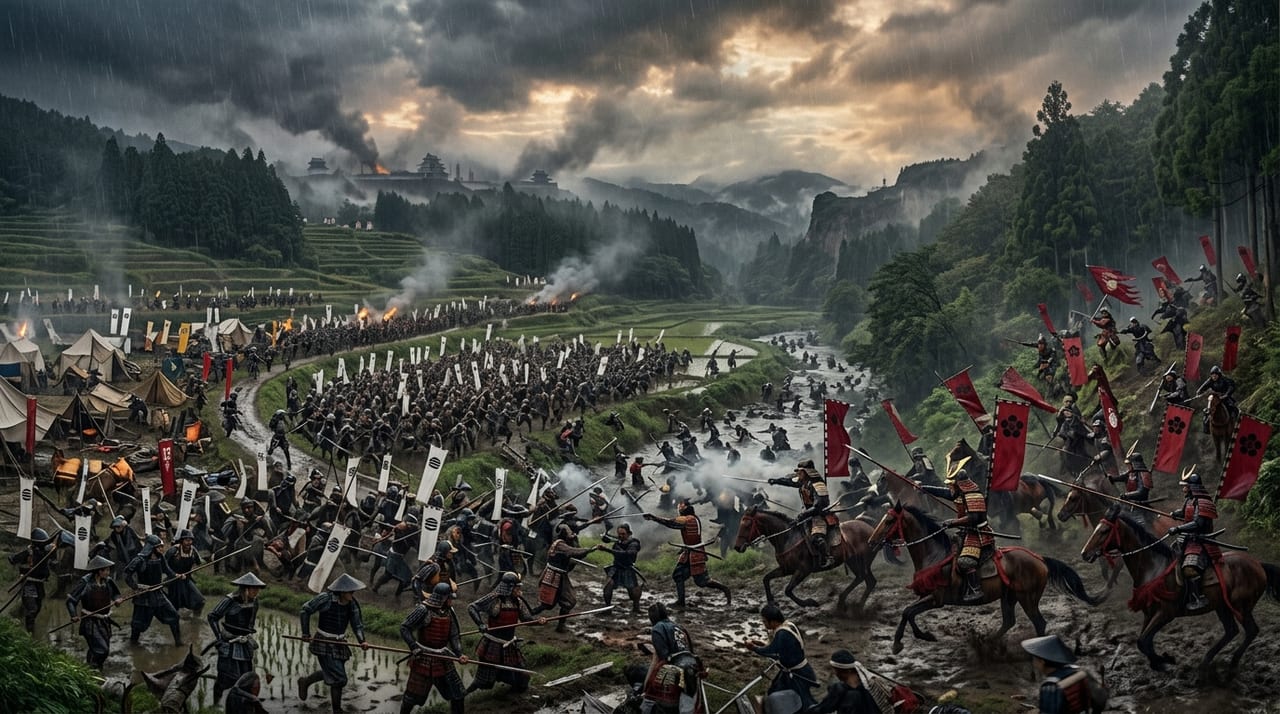
On June 12, 1560 (Eiroku 3/5/19), the gears of history turned sharply. Oda Nobunaga, a minor daimyō of Owari, launched a surprise attack on the headquarters of Imagawa Yoshimoto, who had invaded Owari at the head of a large army, and killed Yoshimoto. This is the Battle of Okehazama.
Imagawa Yoshimoto was not simply a Sengoku daimyō. He was a man of learning who blended courtier and warrior culture to a high degree, and he was also an able statesman who enacted the Imagawa Kana Mokuroku (a domain law code). The sword said to have been favored by Yoshimoto is a famous blade also called Sōsan Samonji. It is now designated an Important Cultural Property under the name Yoshimoto Samonji.
This sword is a masterpiece of the Nanboku-chō period, said to be the work of the Samonji school of Hakata in Chikuzen (its founder, Samonji, is counted among the Ten Great Disciples of Masamune). Because it is unsigned, the name of the individual maker is not known. The name "Sōsan" comes from the Buddhist name of Miyoshi Masanaga, who once owned this sword. In Tenbun 5 (1536), it was presented by Miyoshi Sōsan to Takeda Nobutora of Kai. In the following year, Tenbun 6 (1537), it is said to have been passed from Nobutora to Yoshimoto when Nobutora's daughter married Yoshimoto (some question this transmission). Yoshimoto made this sword his favorite, and it is said he wore it even in his camp at Okehazama.
After Yoshimoto's death at Okehazama, it was Oda Nobunaga who obtained this sword. Nobunaga had the blade shortened by suriage (shortening) from 2 shaku 6 sun to 2 shaku 2 sun 1 bu. He also had a gold-inlaid inscription added to the nakago (tang). One reads: "On the 19th day of the 5th month of Eiroku 3, Yoshimoto was struck down and taken; engraved from the sword he carried." The other reads: "Oda Owari no Kami Nobunaga." Adding an inscription to a spoil of war was not merely a commemoration; it also expressed Nobunaga's political intent. The fact that he had slain and taken the great Imagawa Yoshimoto and seized his worn sword proved to the realm both his military strength and his good luck.
On the morning of the battle, Yoshimoto had entered Owari Province at the head of some 25,000 troops. Nobunaga's forces numbered at most two to three thousand, a militarily hopeless situation. Yet Nobunaga decided to charge, and he launched a surprise attack on Yoshimoto's headquarters amid the heavy rain that happened to be falling at the time.
Nobunaga's forces struck at the moment when the guard around the headquarters had grown thin, and they closed in on Yoshimoto amid the confusion. Yoshimoto is said to have drawn his long sword himself and fought fiercely, cutting the knee of Hattori Koheita (Kazutada), who had made the first spear thrust. In the end, however, he was pinned down by a retainer of Nobunaga, Mōri Shinsuke (Yoshikatsu), and his head was taken.
After passing into Nobunaga's hands, the Yoshimoto Samonji changed hands several more times. After Nobunaga's death in the Honnō-ji Incident, it passed to Toyotomi Hideyoshi, and then on to Tokugawa Ieyasu. Today it is dedicated at Takeisao Shrine in Kita Ward, Kyoto, and it is designated an Important Cultural Property.
The sword's provenance fully mirrors the broad current of Japanese history, running from Okehazama through the Honnō-ji Incident to the establishment of the Edo shogunate. Each time a holder of supreme power over the realm took up this sword, Yoshimoto Samonji became, quite literally, a "sign of the realm" (tenka no shirushi). As a typical example of the distinctively Japanese sword culture in which famous blades move in step with the transfer of national power, Yoshimoto Samonji is still talked about today.
Having secured Owari through his victory at Okehazama, Nobunaga went on to collect and seize many famous swords during his subsequent territorial expansion, forming a distinctive sword culture of his own. After he took control of Kyoto, celebrated swords once held by the Ashikaga shogunal house and by courtiers gathered around Nobunaga, laying the foundation for his "sword politics."
Nobunaga's innovative tactics, namely the organized use of teppō (matchlock firearms) and the making of ashigaru (foot soldiers) into an effective fighting force, also brought changes to the role of swords. As firearms spread, the sword shifted in emphasis from the main weapon to a symbolic role as the "soul of the warrior." Okehazama was the battle that marked the opening of that turning point.
The Okehazama area (today's Midori Ward, Nagoya, and Toyoake) still has old battlefield sites, and historical landmarks such as Yoshimoto's grave marker are scattered about. From the perspective of sword history, it is a sacred site of special significance as the starting point of the famous blade Yoshimoto Samonji.
2026-08-27
2026-09-06
京都には日本刀にゆかりの深い神社・寺院が数多く点在する。粟田神社(鍛冶神社・三日月宗近/小狐丸ゆかり)・藤森神社(鶴丸写し・刀剣御朱印)・建勲神社(宗三左文字)・北野天満宮(髭切/鬼切丸)・豊国神社(骨喰藤四郎)・大覚寺(膝丸/薄緑)の来歴と拝観情報を一挙解説する。
2026-06-04
合戦出陣の際に大将が用いた陣太刀の形態的特徴、儀礼的意義、拵えの格式、そして現代に残る名品を詳説する。
2026-05-17