New Arrivals — Browse our catalog for the latest authentic Japanese sword arrivals. Browse →
6th–10th month of Tenshō 9 (1581)
Tottori Castle, Inaba Province (present-day Tottori City, Tottori Prefecture)
Forces
Hashiba Forces
Mōri Faction / Tottori Castle Garrison
About 19 min read
From summer through autumn of Tenshō 9 (1581), Tottori Castle in Inaba Province (present-day Tottori City, Tottori Prefecture) became the scene of what is considered the most horrific siege of food supplies in the Sengoku period. Later known as the "Tottori katsue-goroshi," this siege was deeply inscribed in Japanese history by the brilliant strategic vision of Hashiba Hideyoshi (later Toyotomi Hideyoshi) and the tragic self-sacrifice of the castle commander, Kikkawa Tsuneie. Hideyoshi's cunning, which took the castle without drawing a sword, and Tsuneie's bushidō, in which he pressed a blade to his own belly to complete the surrender, show the essence of warfare at the close of the Sengoku period through this contrast.
During the Tenshō era (1570s–1580s), Oda Nobunaga was preparing a decisive battle with the Mōri clan of the Chūgoku region as the final stage of his unification of the realm. Nobunaga dispatched Hashiba Hideyoshi to the west as commander-in-chief of the Chūgoku campaign army and gave him the task of conquering, one after another, the provinces of the San'in and San'yō regions held by the Mōri.
Tottori Castle (Inaba Province, present-day Tottori City) was a key stronghold controlling the eastern part of the San'in region. Yamana Toyokuni, the lord of Inaba Province, submitted to Hideyoshi in Tenshō 8 (1580), but he was driven out of Tottori Castle by Morishita Dōyo and Nakamura Harutsugu, retainers who favored the Mōri side. In this way Tottori Castle returned to Mōri control, and in the 3rd month of Tenshō 9 (1581), Kikkawa Tsuneie, a member of the Kikkawa family, entered the castle as its commander and took on the task of its defense.
Kikkawa Tsuneie was the eldest son of Kikkawa Tsuneyasu, head of the Iwami Kikkawa house, and belonged to the same family as the main Kikkawa line (sōryō-ke) inherited by Kikkawa Motoharu, who was known as "a commander never defeated in his lifetime." He shared a firm bond with Motoharu's eldest son, Motonaga, and Tsuneie embodied loyalty to the Mōri family. It is said that Tsuneie was chosen for the post after a long search for someone willing to take on the defense of Tottori Castle.
The tactics Hideyoshi used to take Tottori Castle were innovative and went beyond the conventional wisdom of warfare at the time.
Before the siege of Tenshō 9 (1581) began, Hideyoshi sent merchants into Inaba Province to buy up rice, wheat, beans, and other foodstuffs circulating in the markets at high prices. Farmers and merchants eagerly sold at these high prices, and the food disappeared from the markets before it could be stockpiled inside the castle. This method can be called a forerunner of "economic warfare" and "information warfare," and its success was a victory of strategy that went beyond a simple military advantage.
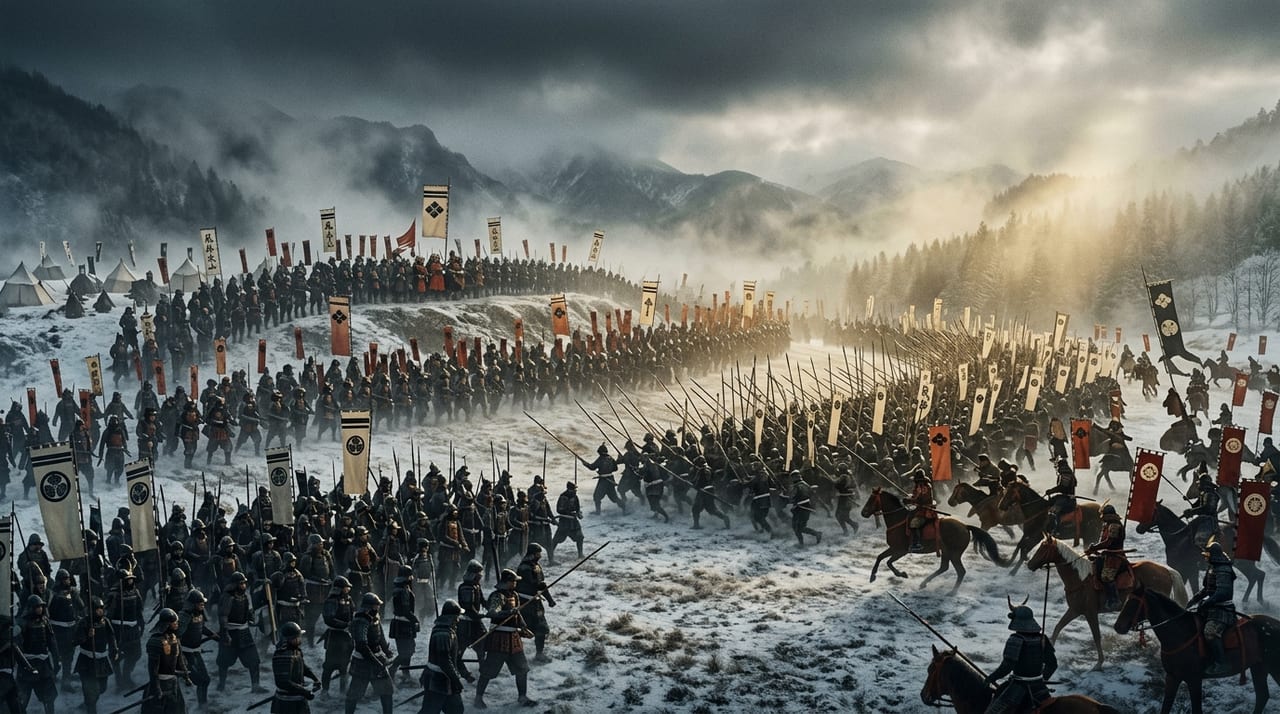
In the 6th month of Tenshō 9 (1581), Hideyoshi invaded Inaba at the head of some 20,000 troops, and in the 7th month he surrounded Tottori Castle. The siege lines, built around his headquarters, Taikōgadaira, and other satellite castles and field fortifications, encircled the mountain and sealed every route into the castle. To cut off supplies arriving by sea along the San'in coast, he also imposed a naval blockade against Mōri naval forces. The encirclement was complete, cutting off both land and sea routes.
Some 4,000 people were inside the castle, including the garrison and commoners who had fled there from the castle town, but because of Hideyoshi's food-buying scheme, there was almost no provision left. By the time the fighting began, the conditions for defeat were already in place.
As the siege dragged on, conditions inside the castle grew rapidly more miserable.
Less than a month after the siege began, ordinary food was completely exhausted. The garrison slaughtered animals, including horses, dogs, and cats, and then ate grass, tree bark, and leather goods, including leather armor. When even these were gone, the bodies of those who had starved to death began to pile up within the castle.
Later sources, such as war chronicles like the Taikōki, record that there was a scene of human flesh-eating within the castle. Opinions differ on whether this is historical fact, but it is certain that many people died of starvation inside the castle and that the disposal of the bodies could not keep pace. Corpses piling up in the summer heat, the spread of disease, and people losing their sanity from hunger: conditions inside Tottori Castle had become like hell.
Even in this terrible situation, the commander Kikkawa Tsuneie did not lose the discipline and pride of a warrior. Tsuneie shared his own food with his soldiers and tried to maintain order within the castle. He kept waiting, trusting that reinforcements from the Mōri main house would come, but the army of Kikkawa Motonaga, which had advanced as far as Hōki, was blocked by Nanjō Mototsugu, and no relief force ever reached Tottori Castle.
In the extreme conditions inside Tottori Castle, the sword that Kikkawa Tsuneie wore carried meaning beyond that of a mere weapon.
As a senior retainer of the Mōri, the Kikkawa family was deeply involved in the sword culture that developed across the Chūgoku region. The Mōri-controlled Chūgoku region and its surroundings were home to major centers of Japanese swordmaking, including Bizen (present-day Okayama Prefecture), Bitchū (same), and eastern Suō (present-day eastern Yamaguchi Prefecture). In particular, tachi in the "Bizen tradition" made by smiths of Bizen Osafune combined elegant chōji-midare hamon with practical cutting ability, and they were prized by Mōri and Kikkawa warriors.
In a last testament that Tsuneie addressed to Kikkawa Tsunenobu (later Hiroie) on the day before his ritual suicide, there is a passage asking that a sword by "Nagamitsu" be given to his eldest son, Kameju. This suggests that a Bizen Osafune sword was also among Tsuneie's possessions.
As starvation advanced within the castle, the sword Tsuneie wore could not be exchanged for food. Yet, as the embodiment of his final identity as a warrior, it remained at his waist. In the end, that sword would fulfill its final role in "the self-determined death of the warrior."
In the 10th month of Tenshō 9 (1581), after four months of siege, the survivors within the castle had become so weakened by starvation and disease that they could barely stand. Kikkawa Tsuneie, the castle commander, judged that continuing the siege would mean the annihilation of everyone inside, and he resolved to begin surrender negotiations.
Tsuneie asked that the lives of the garrison be spared in exchange for his own ritual suicide. Hideyoshi praised Tsuneie's courageous defense and conveyed his intention that only Morishita Dōyo and Nakamura Harutsugu, who had driven out Yamana Toyokuni, should take responsibility by committing seppuku, and that Tsuneie would be allowed to return home. Tsuneie refused this, however, and did not change his resolve to take responsibility himself. Hideyoshi consulted Nobunaga, and permission was granted for Tsuneie's ritual suicide.
On the 25th day of the 10th month of Tenshō 9 (1581), Tsuneie performed seppuku after leaving a death poem.
"Mononofu no / toritsutaetaru / azusayumi / kaeru ya moto no / sumika naruran"
Age at death: 35.
Because of Tsuneie's suicide, the lives of the survivors remaining within the castle were preserved. Hideyoshi kept his promise and did not massacre the garrison or the townspeople. Those who had survived the grueling four-month siege left the castle looking as thin as skeletons. It is said that even some of Hideyoshi's soldiers wept at the sight of such misery.
Kikkawa Tsuneie's death has been passed down to later generations as the purest embodiment of the bushidō ideal, in which a commander gives up his own life to save the lives of those under him. Tsuneie was 35 years old when he committed seppuku in a distant castle.
The katsue-goroshi of Tottori Castle is known, along with the hoshi-goroshi at Miki Castle and the water siege at Bitchū Takamatsu Castle, as one of the representative castle sieges of Hideyoshi's Chūgoku campaign.
What these three operations—the hoshi-goroshi at Miki Castle (Tenshō 6–8, 1578–1580), the katsue-goroshi at Tottori Castle, and the water siege at Bitchū Takamatsu Castle (Tenshō 10, 1582)—have in common is Hideyoshi's strategic philosophy of "avoiding direct combat with swords or spears and neutralizing the enemy through intelligence, logistics, and engineering." Hideyoshi may have been inferior to the fierce generals of his era in personal martial prowess, but his strategic talent has been recorded in history as that of one of the military geniuses of the Sengoku period.
From the perspective of sword culture history, the katsue-goroshi of Tottori Castle holds a special place as a battle fought without swinging a sword. The warriors inside the castle carried swords. But those swords could not produce food, could not break the siege, and could not fill their starving stomachs. In the transitional period when Sengoku warfare was moving from the "age of martial prowess (swords, spears, and bows)" to the "age of logistics, information, and engineering," the Tottori katsue-goroshi was an incident that demonstrated the overwhelming superiority of the latter.
At the same time, Tsuneie's final moments show that a sword can be something other than a weapon. As a form of surrender, as a means of death, and as a symbol of bushidō, the sword used in Kikkawa Tsuneie's self-determined death did not function as a pure weapon but as something "cultural and spiritual" that embodied a warrior's pride and ethics.
The wisdom of Hideyoshi, who took the castle without swinging a sword, and the bushidō of Tsuneie, who pressed a blade to his belly to complete the surrender: this contrast vividly illustrates the two aspects of the sword in the late Sengoku period, the sword as a physical weapon and the sword as a spiritual and cultural symbol.
Today, stone walls remain at the Tottori Castle ruins (Tottori City), and from the site of the former tenshu-dai (main keep foundation), one can look out over the city of Tottori. The death poem of Kikkawa Tsuneie is still told as the story of a tragic hero of the Sengoku period and has become an important part of the history and culture of Tottori.
Toyotomi Hideyoshi
Commander of the siege and architect of the starvation strategy
Kikkawa Motoharu
Uncle of castle commander Kikkawa Tsuneie; Mōri general who attempted to relieve the siege
Mōri Terumoto
Mōri clan head who supported Tottori Castle but could not break Hideyoshi's blockade
Kuroda Kanbei
Hideyoshi's military strategist, involved in planning the Tottori siege logistics