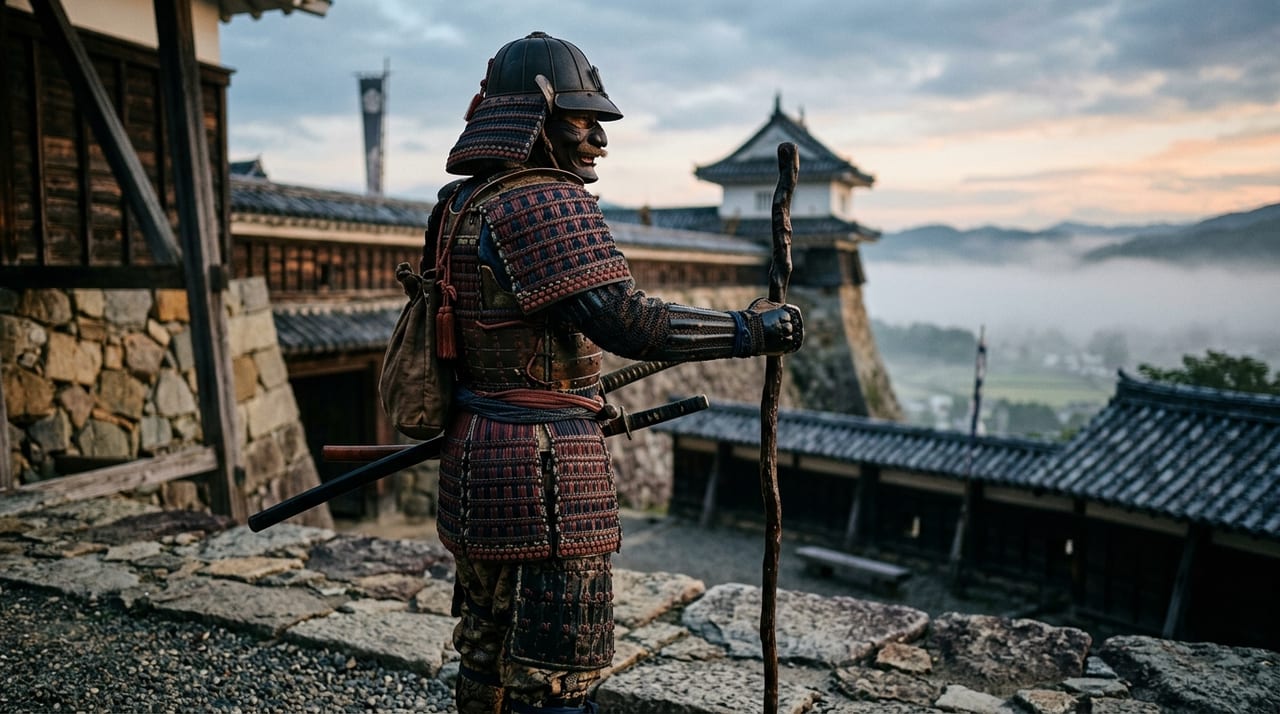
 * Image is for illustrative purposes only.
Kuroda Kanbei
黒田官兵衛
Kuroda Josui, The Strategist
Description
Birth of a Master Strategist
Kuroda Kanbei (also known as Yoshitaka and Josui) was born in Himeji, Harima Province, in Tenbun 15 (1546). He supported Toyotomi Hideyoshi's unification of the realm as a military strategist, and Hideyoshi feared him as "a man fit to take the realm." He was one of the foremost strategists of the Sengoku period. Kanbei's strategic wisdom was decisive to Hideyoshi's bid for supremacy, yet because of that same talent Hideyoshi remained wary of him, and his life was marked by unusual twists.
As Hideyoshi's Strategist
Kanbei's strategic brilliance shone most clearly during the Great Return from Chūgoku in Tenshō 10 (1582). When Hideyoshi received the news of the Honnō-ji Incident, Kanbei immediately told him, "Your fortunes have opened up, have they not?" He proposed a lightning-fast truce with the Mōri clan and a rapid march to Kyoto. Hideyoshi is said to have been struck with fear at these words and thought, "This man is one fit to take the realm!" However, the accounts that attribute the Great Return from Chūgoku to Kanbei's proposal appear in works such as the Rōjin Zatsuwa, which were compiled in the Edo period.
Confinement at Arioka Castle
An essential episode in Kanbei's life is his confinement at Arioka Castle during Araki Murashige's rebellion. In Tenshō 6 (1578), Kanbei went alone into Arioka Castle to persuade Araki Murashige to change his mind. Instead, he was seized and confined for about a year in appalling conditions. The confinement left him lame, but his resolve never wavered. This unbending spirit symbolizes the iron-like conviction that runs through his entire life.
Heshikiri Hasebe
The most famous sword in Kanbei's possession was the "Heshikiri Hasebe." Originally a beloved sword of Oda Nobunaga, it is said to have been given to Kanbei in Tenshō 3 (1575) as a reward for presenting a strategy for the Chūgoku campaign when he had an audience with Nobunaga at Gifu Castle. Some hold that it passed through Hideyoshi and was later bestowed on his son Kuroda Nagamasa. It was made by Hasebe Kunishige and displays a striking hitatsura blade pattern of the Sōshū-den style across its entire length, a fearsome beauty. This sword is known for the anecdote in which Nobunaga killed a tea attendant hiding beneath a tray shelf by pressing the blade down on him (heshi-kiri). The tradition that Nobunaga gave it to Kanbei shows how highly Nobunaga valued Kanbei's talent. Heshikiri Hasebe has been designated a National Treasure and is now held by the Fukuoka City Museum.
Nikkō Ichimonji
The other National Treasure, the "Nikkō Ichimonji," is also a famous sword handed down in the Kuroda family. It was made in the Fukuoka Ichimonji school and is a masterpiece of Bizen swords, with a splendid ō-chōji midare temper pattern. The name Nikkō is said to derive from its having been dedicated at Nikkō Futarasan Shrine. In Tenshō 18 (1590), this tachi was presented by Hōjō Ujinao to Kuroda Josui (Kanbei) as a gift of thanks for the truce that ended the Odawara Campaign, and it was passed down as a treasure of the Kuroda family.
Later Life as Josui
In Bunroku 2 (1593), Kanbei shaved his head and adopted the name Josuiken Ensei. "Josui" is said to mean "like water" and to be taken from Laozi's "The highest good is like water." Like water, which changes shape freely and nourishes all things even as it flows to low places, this name condenses Kanbei's flexible strategic mind and his deep view of life.
Sekigahara and Final Years
During the Battle of Sekigahara in Keichō 5 (1600), Kanbei launched his own independent military campaign in Kyushu and subdued northern Kyushu within a short time. This movement is the basis for the interpretation that "Josui was also aiming at the realm." However, the Battle of Sekigahara was decided so quickly that Kanbei's ambitions bore no fruit.
Kanbei died in Kyoto in Keichō 9 (1604), aged fifty-nine. His son Kuroda Nagamasa received 523,000 koku in Fukuoka, Chikuzen, for his merit at Sekigahara and laid the foundation of the Fukuoka domain. The Heshikiri Hasebe and Nikkō Ichimonji, closely tied to Kanbei, were carefully handed down in the Kuroda family. In 1978 they were donated by the Kuroda family to the city of Fukuoka, and they are now housed in the Fukuoka City Museum.
Notable Swords
- Heshikiri Hasebe (National Treasure)
- Nikkō Ichimonji (National Treasure)