Tea and Swords in the Azuchi-Momoyama Period: The Refined Taste of Sen no Rikyū and Toyotomi Hideyoshi
 * Image is for illustrative purposes only.
Table of Contents
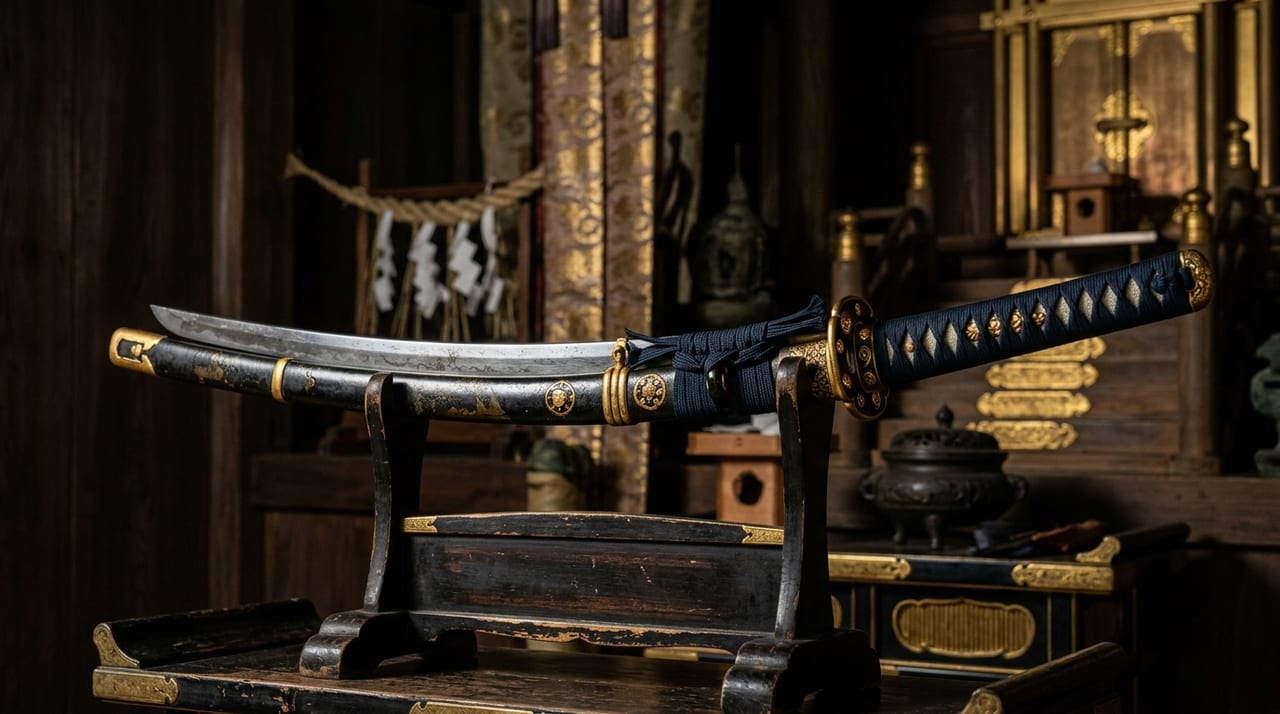
Azuchi-Momoyama: The Age of Fusion Between Sword and Tea
The Azuchi-Momoyama period (approximately 1568–1615) represents one of the greatest ages of cultural fusion in Japanese history. It was an era when Oda Nobunaga, Toyotomi Hideyoshi, and Tokugawa Ieyasu—who unified the realm through military might—simultaneously cultivated tea ceremony, Noh theater, painting, and other arts both as matters of political strategy and personal passion.
Though swords and tea ceremony might appear to be opposites, during this period they were profoundly connected through the spirit of "suki"—a refined appreciation of beauty for its own sake.
The Aesthetics of Sen no Rikyū and Swords
Sen no Rikyū (1522–1591) was the sage of tea who perfected Japanese tea ceremony as "wabi-cha"—tea in the spirit of rusticity and restraint. Rikyū's aesthetics centered on "wabi" (quiet simplicity), "sabi" (the beauty of age), and the appreciation of beauty in incompleteness.
Rikyū's Connection to Swords
As a master of tea serving Nobunaga and Hideyoshi, Rikyū's influence extended beyond the evaluation of tea implements to the appreciation of swords.
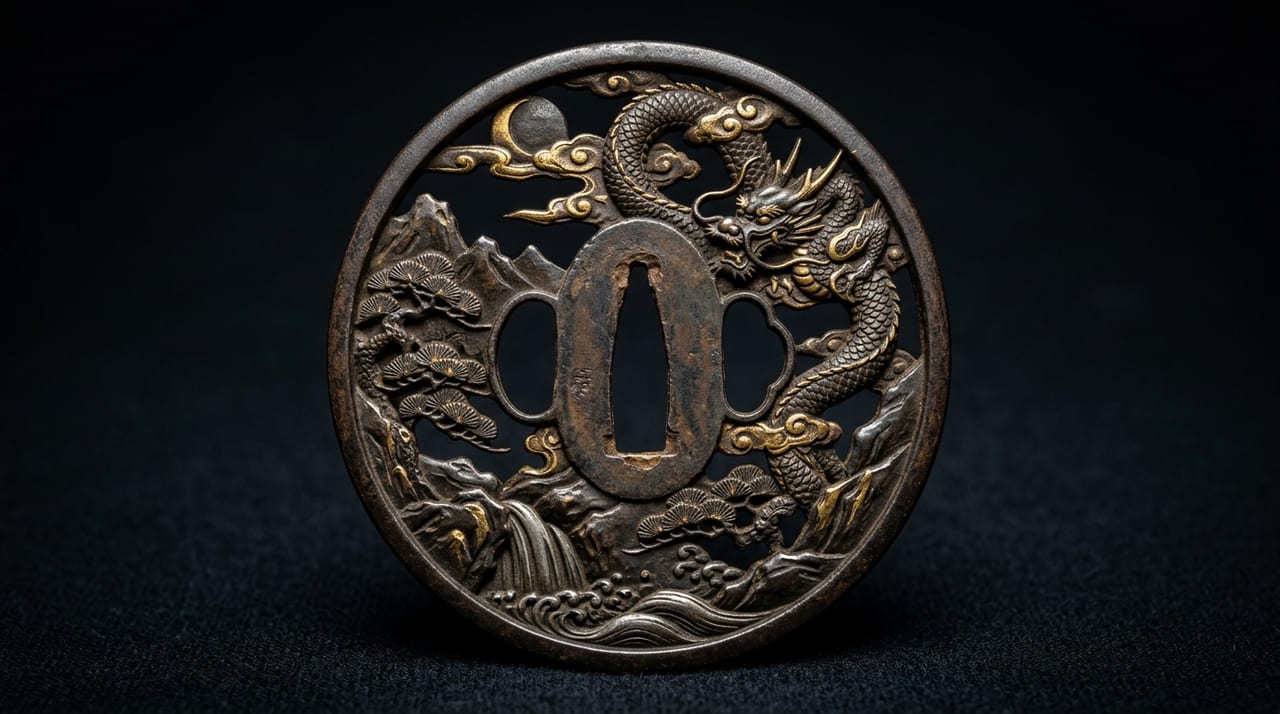
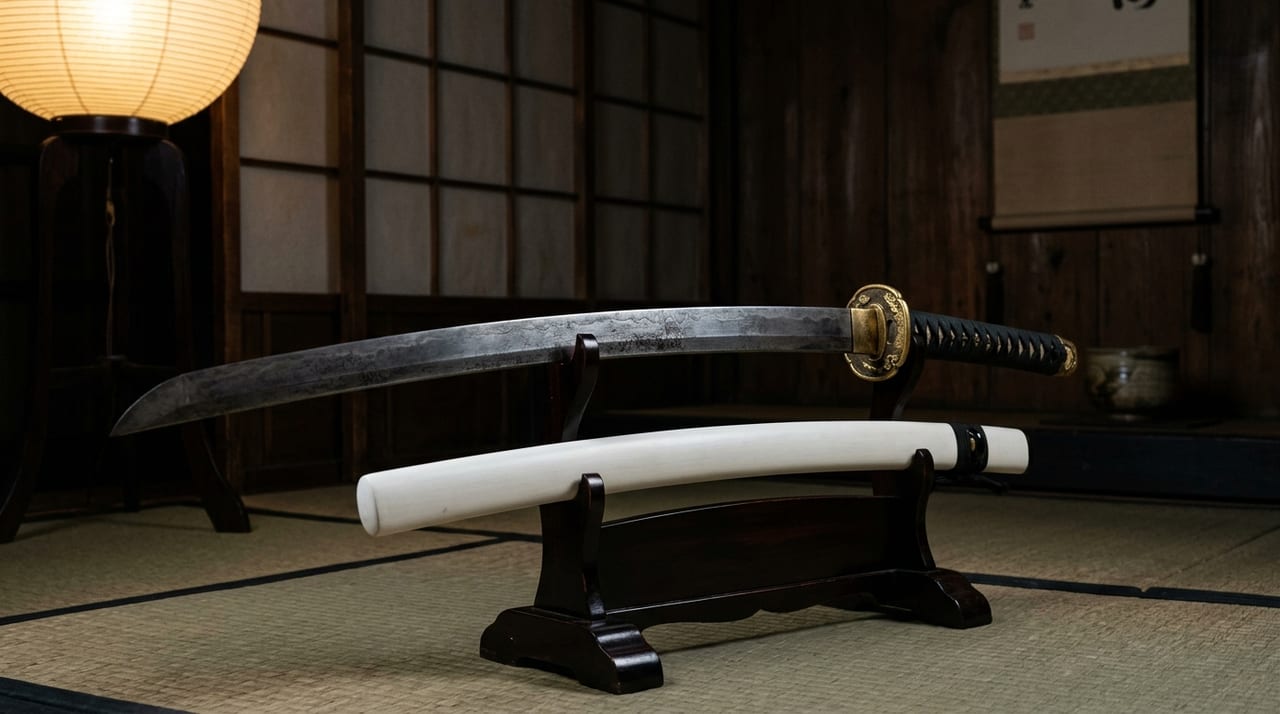
Rikyū's Philosophy of Swords: Rikyū was known to favor "old swords with an antique, austere beauty." He preferred the unadorned beauty of a blade sheathed in white wood over elaborate handles with gold and silver decorations. This perfectly aligned with the wabi aesthetic of tea—valuing depth in quietude over outward magnificence.
The Shared Aesthetics of Tea and Sword: The principle Rikyū employed when selecting tea implements—"mitate" (recontextualization), the ability to discover beauty by viewing an object outside its original context—parallels the sword connoisseur's appreciation of the natural patterns in the blade's steel.
Sword Etiquette in Tea Gatherings
Samurai participating in tea gatherings observed strict protocols regarding the handling of swords:
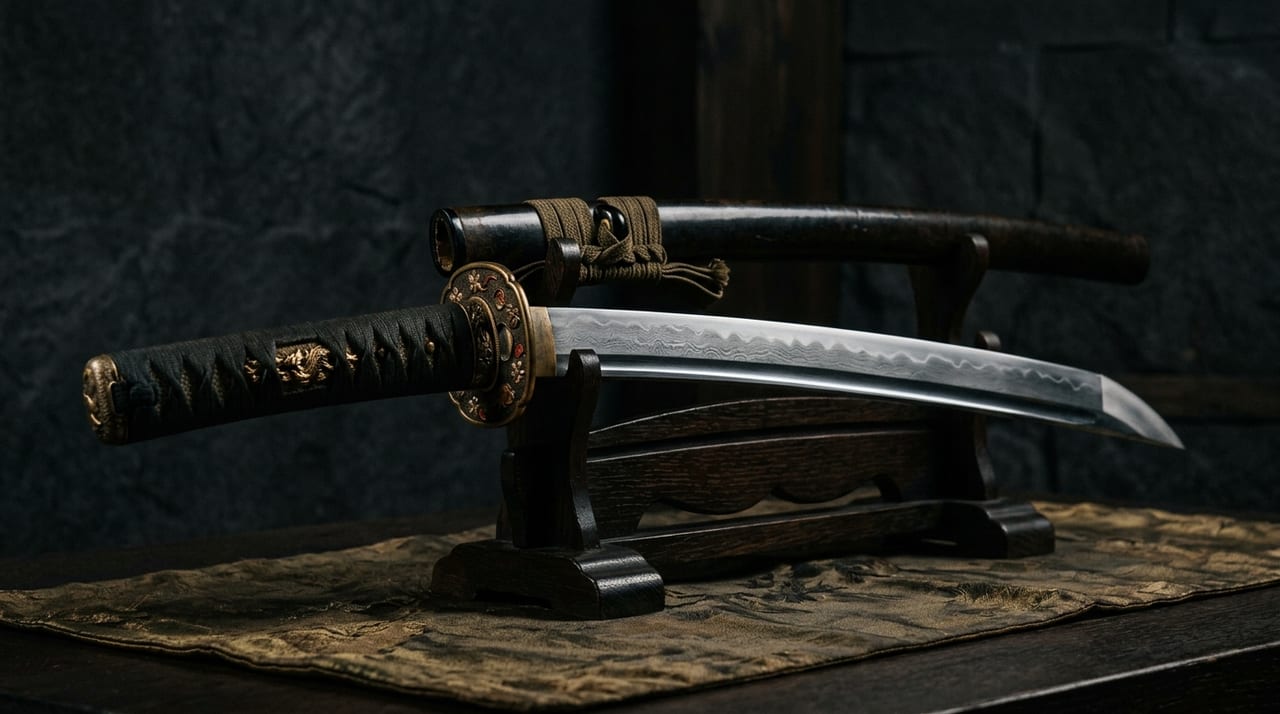
1. Removal of the Sword (Dattō): Upon entering the tea room, the long sword (katana) was left at a sword stand. Only the shorter sword (wakizashi) was worn at the waist—the sole weapon permitted in the tea room.
2. The Crawling Entrance (Nijiriguchi): The low entrance of the tea room required guests to bow their heads as they entered, making it impossible to draw a sword. This architectural feature symbolized the leaving behind of the warrior's world upon entering the tea room.
3. Sword Placement: Inside the tea room, the wakizashi was carefully placed on a sword stand or on the tatami mat, with prescribed rules governing how the blade should face.
Toyotomi Hideyoshi's Sword Collection
Toyotomi Hideyoshi (1537–1598) was one of the greatest patrons of the Japanese sword. For Hideyoshi, who rose from peasant origins to rule all Japan, collecting famous swords was a powerful symbol of political authority.
Famous Swords Favored by Hideyoshi
Swords in Hideyoshi's collection include:
Sōza Samonji: A masterwork by Samonji, a swordsmith from Chikuzen in Kyushu, which became known by this name after Hideyoshi owned it. It is now held at Kenkun Shrine (Kyoto).
Heshikiri Hasebe: A great sword owned by Nobunaga, who bestowed it on Kuroda Kanbei (Yoshitaka); it then passed down through the Kuroda family. Its name comes from a tale that it once cut through a food cabinet when used to strike a person. It is now housed in the Fukuoka City Museum (National Treasure).
Political Performance Through Swords
Hideyoshi wielded famous swords as tools of political action. The gift of a renowned blade as a seal of alliance or mark of favor was a standard diplomatic practice of the era.
Possessing a famous sword was proof of authority itself, functioning as a political symbol declaring "the rightful ruler holds the greatest blades."
Oda Nobunaga and Swords: Sword Policy Under "Rule Through Force"
Oda Nobunaga (1534–1582), Hideyoshi's predecessor, also brought revolutionary changes to sword policy.
Precursor to the Great Sword Hunt
Before Hideyoshi's Great Sword Hunt of 1588, Nobunaga had incrementally disarmed peasants in conquered territories to suppress peasant uprisings (ikki) that plagued the Warring States period. This ultimately became a precursor to the Edo-period idea that "swords belong to samurai alone."
The Fusion of Chinese and European Influences
While Nobunaga showed keen interest in European weapons—firearms and armor—he also prized Chinese and Korean tea utensils known as "karamono" (foreign objects). The contrast between his refined appreciation of imported goods (karamono suki) and his valuation of the native beauty of the Japanese sword reveals the duality of his aesthetic sensibility.
The Tea Room and Swords: The Philosophy of Spatial Design
Tea room architecture of the Azuchi-Momoyama period incorporated special spatial designs in relation to swords.
The Handling of Swords in the Waiting Room
The "machiai" (waiting room) where guests gathered before the tea gathering was equipped with a "katanakake" (sword stand). The long sword was deposited here, and guests proceeded to the tea room carrying only the wakizashi. The sword stand was not merely a practical item but a symbolic apparatus marking the transition from the world of martial conflict to the world of tea.
The Tea Gathering Culture of Displaying Swords
During tea gatherings, the host might display a famous sword in the "tokonoma" (alcove) for guests to appreciate. The act of displaying a sword in this place of honor—like precious tea utensils—demonstrates that swords were regarded as works of art.
Conclusion: The Beauty of the Azuchi-Momoyama Age Created by Swords and Tea
The Azuchi-Momoyama period stands as the age in which the fusion of swords and tea most vividly expressed the uniqueness of Japanese culture. Weapons of the battlefield came to be valued as works of art, appreciated in the quietude of the tea room through the same spirit of refined taste.
The coexistence and mutual influence of two seemingly opposing views of swords—Rikyū's austere wabi aesthetic and Hideyoshi's magnificent collecting—created the richness of the Azuchi-Momoyama sword culture. The fact that we today can so naturally declare "the Japanese sword is both weapon and work of art" is the legacy of this era's cultural fusion.