New Arrivals — Browse our catalog for the latest authentic Japanese sword arrivals. Browse →
April–August 1590 (3rd–7th month, Tenshō 18)
Odawara, Sagami Province (present-day Odawara City, Kanagawa Prefecture)
Forces
Toyotomi Forces
Hojo Forces
About 12 min read
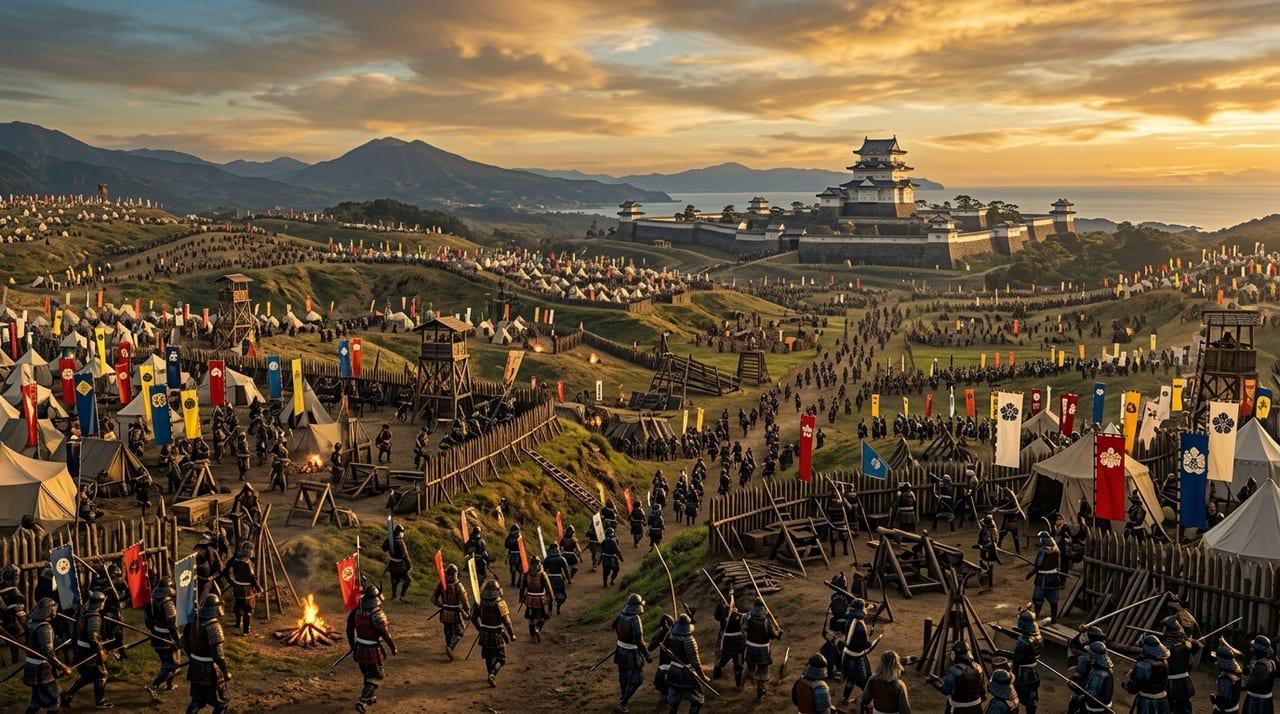
In Tenshō 18 (1590), Toyotomi Hideyoshi mobilized an unprecedented army of more than 200,000 men and besieged Odawara Castle (present-day Odawara City, Kanagawa Prefecture), the stronghold of the Later Hōjō clan, the overlords of the Kantō region. This "Siege of Odawara" is known as a historic event that ended with the Hōjō clan's surrender after a siege of more than three months, which completed Hideyoshi's unification of the realm.
The Later Hōjō clan (Odawara Hōjō clan) began when its first head, Ise Sōzui (commonly known as Hōjō Sōun), seized Izu in Meiō 2 (1493). Thereafter, over roughly 100 years under its second head, Ujitsuna, its third, Ujiyasu, its fourth, Hōjō Ujimasa, and its fifth, Hōjō Ujinao, the clan built a powerful system of control across the Kantō region, including Sagami, Musashi, Izu, Kazusa, and Shimōsa.
Following the Honnō-ji Incident in Tenshō 10 (1582), Hōjō Ujinao (son of Ujimasa) contested the former Takeda territories with Tokugawa Ieyasu (the Tenshō-Jingo War). Later, however, the two reached a settlement and formed an alliance, with Ujinao taking Ieyasu's daughter, Toku-hime, as his principal wife. However, as Hideyoshi rose to power, the Hōjō family's position became increasingly difficult.
In Tenshō 17 (1589), the Hōjō clan seized Nagurumi Castle, which Hideyoshi's ruling had placed under Sanada territory. This incident is known as the "Nagurumi Castle Incident." Using it as a pretext, Hideyoshi decided on the Odawara campaign, and in the following year, Tenshō 18 (1590), he dispatched a large army to the eastern provinces.
Odawara Castle was known as one of the strongest castles of the Sengoku period. The Odawara sōgamae (outer enclosure), which encircled the entire castle town with earthen ramparts and dry moats, was one of the largest castle defense systems in Japan at the time. Its perimeter is said to have extended approximately 9 kilometers.
Rather than storming this impregnable castle by force, Hideyoshi chose a protracted siege. With an army of more than 200,000, he completely encircled Odawara, creating a situation in which the Hōjō forces could neither summon reinforcements nor leave the castle.
Furthermore, Hideyoshi successively captured the Hōjō branch castles in the rear. He secretly built Ishigakiyama "One-Night Castle" on a mountaintop adjacent to Odawara Castle. On the day it was completed, his men cut down trees all at once to reveal the castle, dealing a psychological blow to the Hōjō forces (the anecdote of Ishigakiyama "One-Night Castle"). This psychological warfare was also one of Hideyoshi's skillful tactics.
What is particularly noteworthy about the Siege of Odawara is the atmosphere within the camp, which has been described as "a festival rather than a war." During the prolonged siege, Hideyoshi summoned his wives and other women, including Chacha (Lady Yodo), to the camp and held grand tea gatherings, hosted by Sen no Rikyū, among other events, every day.
As the Hōjō troops suffered under siege inside the castle, the sight of the besieging Toyotomi forces enjoying banquets and entertainment signified that victory or defeat had already been decided in terms of morale and provisions. This dealt a serious psychological blow to the Hōjō forces.
Tenshō 18 (1590) was a distinctive period in the history of the Japanese sword. In Tenshō 16 (1588), Toyotomi Hideyoshi issued the "Sword Hunt edict," ordering the confiscation of swords, bows, spears, firearms, and other weapons from farmers, temples and shrines, and other commoners. The stated purposes of the Sword Hunt edict were "the prevention of uprisings" and "using the recast weapons for the construction of the Great Buddha." In practice, however, its aim was to separate the armed peasantry from the samurai and to "fix the status of samurai and farmers."
As a result, by the time of the Siege of Odawara, the possession of swords was becoming established as a symbol of samurai status.
Among swords associated with the warlords who took part in the Siege of Odawara, one example is the "Ishida Masamune." According to the Kyōhō Meibutsuchō, this sword was purchased by Ukita Hideie and presented to Ishida Mitsunari, and it is said to be a work of Sōshū Masamune (Important Cultural Property, held by the Tokyo National Museum). During the Siege of Odawara, Mitsunari commanded the attack on Oshi Castle.
Tokugawa Ieyasu also took part in this campaign as one of Toyotomi's commanders. At this point, he was fighting alongside men who would later become his opponents at the Battle of Sekigahara and the Osaka Campaigns. Details about the sword Ieyasu carried during the Siege of Odawara are unknown, but his sword collection included many famous blades that later became treasures of the shogunate.
On the 5th day of the 7th month of Tenshō 18 (1590), Hōjō Ujinao, unable to endure a siege of more than three months, offered to surrender in exchange for his own seppuku, asking that the lives of the castle's garrison be spared. Hideyoshi spared the life of Ujinao, Ieyasu's son-in-law, but ordered Ujimasa and his younger brother, Ujiteru, to commit seppuku. On the 11th day of the 7th month, Ujimasa committed seppuku, and the Later Hōjō clan, which had lasted a century, was thus destroyed.
Ujinao was sent to Mount Kōya and died of illness the following year, Tenshō 19 (1591). The retainers of the Later Hōjō clan were subsequently compelled either to serve daimyō in various regions or to return to farming. It is also said that some of the Hōjō clan's administrative systems (taxation, land surveys, legal codes, and so on) were referenced in the governance system of the later Edo shogunate.
With the Siege of Odawara, Hideyoshi's unification of the realm was completed. At the same time, in Tenshō 18 (1590), Hideyoshi also ordered Date Masamune of Ōshū (Tōhoku) to join the campaign and pacified the daimyō of the Ōu region. For the first time, the whole of Japan was placed under a single authority. However, this unification led to the reckless foreign military campaign known as the "Bunroku campaign (Imjin War)," which began two years later, in Bunroku 1 (1592). This campaign, the invasion of Korea, eventually brought about the collapse of the Toyotomi regime after Hideyoshi's death.
The sword unified the realm, and the sword once again called forth an age of turmoil. In both senses, the Siege of Odawara was a major turning point in Japanese history.
Toyotomi Hideyoshi
Toyotomi commander-in-chief, completed Japan's unification at Odawara
Tokugawa Ieyasu
Participated as Toyotomi vassal, subsequently relocated to Kanto region
Ishida Mitsunari
Managed logistics and supply for the siege as Toyotomi's administrative general
Maeda Toshiie
One of Hideyoshi's Five Elders, participated in the Odawara campaign
Sanada Masayuki
Sanada Masayuki participated in the campaign and received rewards from Hideyoshi
Kuroda Kanbei
Hideyoshi's chief strategist, involved in planning the Odawara operation