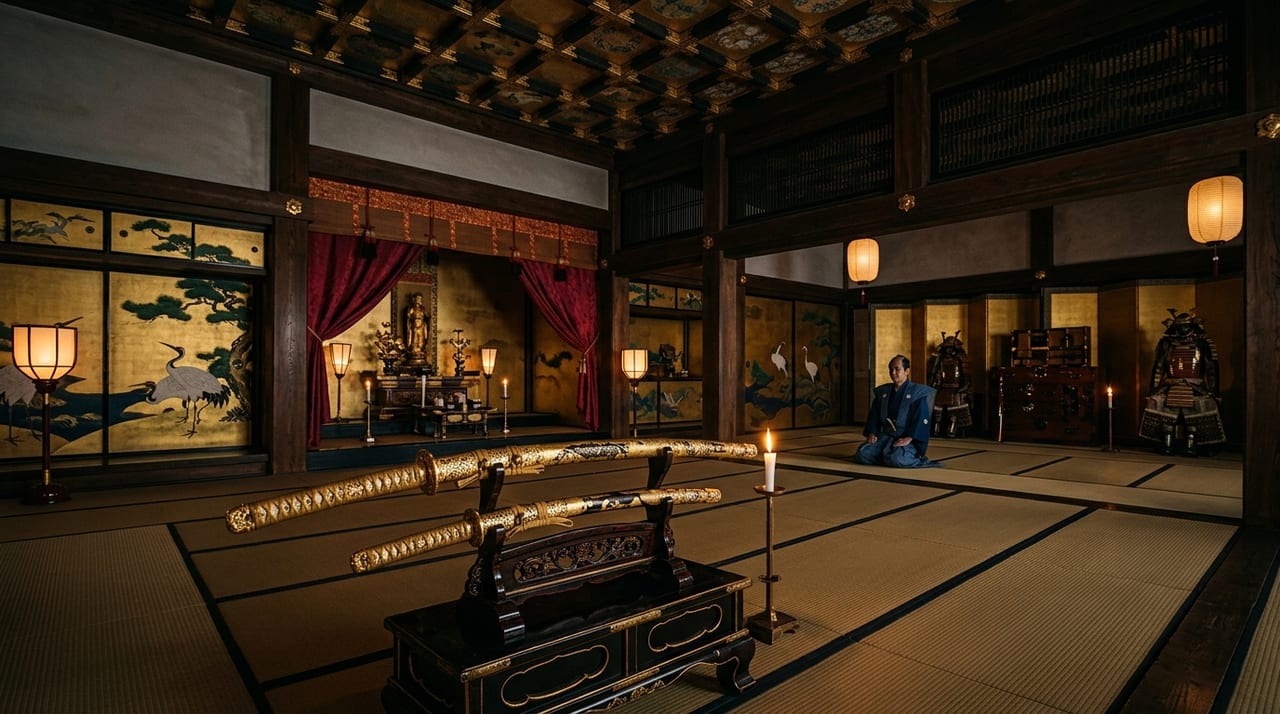
 * Image is for illustrative purposes only.
Tenshō–Momoyama Sword Culture
天正・桃山の刀剣文化
The Tenshō and Momoyama periods, when Oda Nobunaga and Toyotomi Hideyoshi dominated the realm, marked a revolutionary era for Japanese sword culture. The formation of evaluations of meibutsu (famous swords), the flourishing of ornate tsuba and sword-mounting decoration, and the political upheaval of national unification fundamentally transformed how swords were produced, distributed, and appreciated. During this transition from koto to shinto, Japanese swords established their value as works of art.
Description
Warlords and Swords — Famous Blades as Political Instruments
The Tenshō period (1573–1593) and Bunroku-Keichō period (1593–1615) were an era of upheaval when three successive hegemons—Oda Nobunaga, Toyotomi Hideyoshi, and Tokugawa Ieyasu—emerged and achieved the unification of Japan. This political transformation exerted incalculable influence on sword culture. Famous swords evolved from mere weapons into "political gifts"—symbols of power, wealth, and cultural refinement.
Oda Nobunaga was particularly passionate about collecting swords, and his aesthetic judgment is recorded in historical sources such as the Shinchō Kōki. The number of famous swords that Nobunaga possessed, bestowed upon retainers, and presented as gifts was enormous. The collection of treasures held by the Ashikaga shogunate demonstrates the crucial role that famous swords played in political diplomacy. Hideyoshi likewise displayed extraordinary interest in swords, and alongside the tea ceremony, the appreciation of fine swords came to be regarded as the highest cultural refinement in daimyo society.
Meibutsu and the Meibutsu Registers
The Tenshō–Momoyama period was the era in which the evaluation of "Meibutsu" (celebrated swords) took shape, leading to the later Meibutsu registers. These records were organized and compiled primarily by the Hon'ami family, listing swords that had achieved the highest evaluation of their time.
To be included in a Meibutsu register, a sword needed not only exceptional craftsmanship, but also the distinguished provenance of celebrated previous owners (denrai), high monetary valuation recorded in origami documents, and evidence of appreciation or bestowal by a hegemon. Attaining Meibutsu status represented the supreme honor for any blade. A prime example is the Kyōhō Meibutsu register (compiled by Hon'ami Mitsutada during the Kyōhō era). The designation recorded there—"Meibutsu [name]"—became the canonical standard for Japanese sword appraisal from the Edo period onward.
Many of the swords certified as Meibutsu during this era had passed through the direct possession of Nobunaga, Hideyoshi, or Ieyasu, and their political provenance greatly enhanced their value as cultural property. Famous blades such as Sōza-Samonji and Fudo-Yukimitsu transmitted to the present day had all passed through the hands of these hegemons during this age.
Momoyama Culture and Lavish Sword Furnishings
The defining aesthetic of Momoyama culture lay in its sumptuous, resplendent beauty achieved through the liberal use of gold. This spirit pervaded the sword furnishings (koshirae)—the ensemble of metalwork and lacquerwork accompanying the blade—producing works of unprecedented elegance and splendor.
In tsuba (sword guards), the austere beauty of iron guards from the Heian and Muromachi periods was superseded by sophisticated metalwork employing a diverse palette of materials: gold, silver, shakudō (copper-gold alloy), plain copper, and shibuichi (silver-copper alloy). The Gotō family established itself as the preeminent metalwork artisans in service to the shogunate and the great daimyo, creating fittings that depicted birds, flowers, dragons, tigers, and historical figures using refined techniques such as tsubu-bori (grain-carving) and ke-bori (hair-line carving). The upper three generations of the Gotō family—Jōshin, Sōjō, and Jōshin II—were venerated as the founders of house-style carving. During the Momoyama period, the fifth generation Tokujo and sixth generation Eijō served the shogunate and major daimyo, producing supreme masterpieces of sword furnishing arts.
Sheaths finished in cinnabar or black lacquer with gold maki-e decoration epitomize the bold aesthetic spirit of Momoyama culture. Furnishings in kin-tame-nuri (gold-base lacquer) and nashiji-maki-e (pear-skin lacquer with gold decoration) styles, made as gifts from Hideyoshi to his inner circle and regional lords, are displayed in museums today as representative works of Momoyama craftsmanship.
The Invasions of Korea and Sword Culture
Hideyoshi's Bunroku-Keichō invasions of Korea (1592–1598) had complex effects on sword culture. Large quantities of Japanese swords were brought to the Korean peninsula, while Korean and Chinese swords were repatriated to Japan as war trophies. Just as the abduction of skilled Korean ceramic artisans contributed to the later development of Arita and Hagi ware, the influence of continental techniques on sword-smithing and metalwork has also been noted by historians.
Furthermore, wartime demand stimulated large-scale sword production, bringing changes to the existing system centered on individual smiths. In particular, the sword-smithing community of Mino (Seki, Gifu Prefecture) established systematic, large-scale production operations and supplied vast quantities of practical swords during the turbulent Tenshō period.
From Old Swords to New Swords — The Turning Point
The Keichō era (1596–1615) is conventionally regarded as the boundary in sword history between kotō (old swords) and shintō (new swords). The quality of iron, quenching and hardening technique, blade profile, and hamon (temper line) style underwent significant changes before and after this period.
Specifically, the Keichō shintō style—characterized by wider blades, extended kissaki (point), and reduced differentiation between the width at the base and the width at the tip—became established during this period. With the transition to the peaceful society of the Edo period, the uchigatana (practical hip sword) became the standard sidearm for samurai, while the tachi (long sword) became specialized for ceremonial use. This transformation was not merely a stylistic shift but a reflection of the fundamental transformation of samurai society. The sword culture of the Tenshō–Momoyama period, where the practicality of the Warring States era and the aesthetic refinement of the Edo period intersected most dramatically, represents one of the richest and most complex epochs in the history of the Japanese sword.
Characteristics of This Era
- The era that shaped the evaluation of meibutsu (famous swords), leading to the later meibutsu catalogs. Linked with the Honami family's origami certification system, the value of swords came to be objectively ranked and articulated.
- Master metalworkers of the Gotō line established the bold and resplendent Momoyama style of sword mountings, combining diverse materials—gold, silver, shakudō, copper, and shibuichi—with refined chasing techniques.
- Mountings with vermillion and black lacquer and gold maki-e reached their zenith, with lacquerware craftsmanship on scabbards attaining Japan's highest standards. Momoyama-period mountings remain the pinnacle of sword art today.
- The transition period from koto to shinto. From the Keichō era onward, a new style featuring wider blades and extended points became established, and the practical uchigatana became the standard blade worn by samurai.
- The Korean campaigns (Bunroku–Keichō wars) generated massive demand for swords, and Mino smith groups established organized production systems. After the wars, skilled smiths dispersed across the country, leading to the diversification of schools in the shintō period.
- Famous swords functioned as paramount diplomatic gifts, and their transformation into fine art accelerated rapidly. Sword economic value became explicitly documented through authentication certificates, and blades circulated as assets within daimyo economies.