New Arrivals — Browse our catalog for the latest authentic Japanese sword arrivals. Browse →
August 29, 1588 (8th day, 7th month, Tenshō 16)
Nationwide
Forces
Toyotomi Administration
Farmers and Temples (targets of confiscation)
About 15 min read
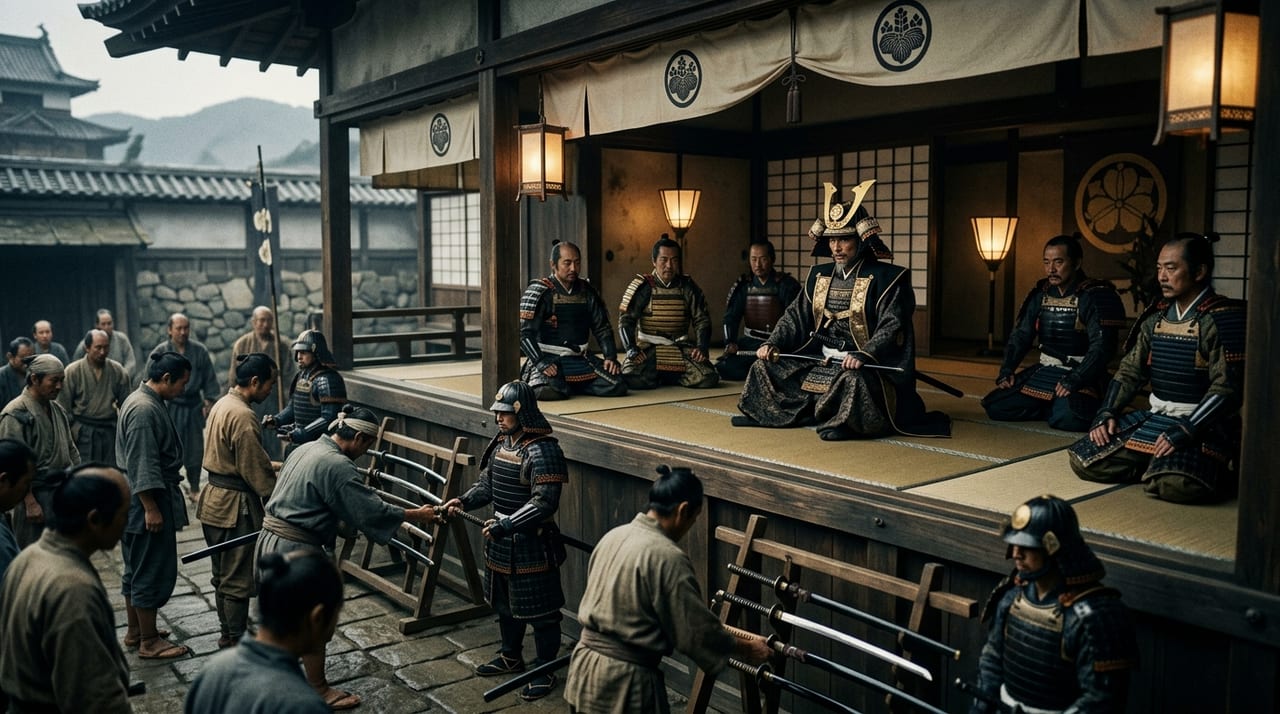
On the 8th day of the 7th month of Tenshō 16 (1588), the 'Katanagari (Sword Hunt) Edict' issued by Toyotomi Hideyoshi was one of the most fundamental government ordinances, both in the history of Japanese swords and in Japanese social history. By this edict, farmers and temple communities were forbidden to possess weapons, and the 'status of warriors and farmers (hyakushō)' was legally separated. The foundations of early modern Japan's status-based society of warriors, farmers, artisans, and merchants (shinō kōshō) were laid here.
The purposes for which the Katanagari Edict was issued can be broadly organized into three. First, the 'completion of heinō bunri (separation of warriors and farmers).' By clearly dividing the status of warriors and farmers and taking weapons away from farmers, the aim was to institutionally separate those who fight (warriors) from those who farm (farmers). Second, the 'prevention of uprisings (ikki).' The aim was to dismantle the military base of the Ikkō ikki and tsuchi ikki that occurred frequently in the Sengoku period, so that farmers could not oppose daimyō authority by force. Third, the 'making visible of the authority of the Toyotomi regime.' By limiting the right to carry swords to warriors alone, Hideyoshi showed the new status order he had built, and his absolute power, to the whole country in a visible form.
The pretext that the confiscated swords would be used to build the Great Buddha of Hōkōji was a clever expedient to soften farmers' resistance. The way the original aim of disarmament was replaced with the religious value of 'the merit of the Buddha' shows well Hideyoshi's political skill.
To understand the Katanagari Edict, it is necessary to grasp the political situation in which Toyotomi Hideyoshi found himself. As of 1588, Hideyoshi was already kanpaku (the highest-ranking court noble) and was moving toward control of the whole country, but unstable elements still existed in various regions.
First, throughout the Sengoku period, farmers and temples armed themselves for self-defense. The Ikkō ikki (armed uprisings centered on followers of Jōdo Shinshū) and the kokujin and dogō strata (armed farmers of the regions) had military strength to oppose daimyō authority. To complete the heinō bunri (division of labor between warriors and farmers) policy advanced by Nobunaga and Hideyoshi, the disarmament of farmers was indispensable.
Second, Hideyoshi was planning the Korean campaigns (Bunroku-Keichō war, 1592-1598), and maintaining domestic order in preparation for war was required.
The third motive was its significance as a 'symbol of national unification.' Establishing the principle that only warriors carry swords was also a visualization of Hideyoshi's absolute power.
The original text of the Katanagari Edict consists of three articles. Their summary is as follows:
Article 1: Farmers (hyakushō) of the provinces are strictly forbidden to possess swords, wakizashi, bows, spears, muskets, and other arms. Farmers who hold unnecessary weapons neglect nengu and miscellaneous levies and are people who plan uprisings, so their weapons should be confiscated.
Article 2: The confiscated swords and wakizashi shall not be wasted. They shall be converted into nails and kasugai (clamps) for the Great Buddha to be built (the Great Buddha of Hōkōji). In this way, farmers will be saved both in this world (agriculture) and in the next (the merit of the Buddha).
Article 3: If farmers hold only farm tools and devote themselves to agriculture, their descendants will be secure for a long time. This is also for the farmers' own sake.
This clever logic, which justifies weapon confiscation as 'the merit of the Buddha that benefits farmers,' shows Hideyoshi's political sense. Under the attractive pretext that 'swords become a Great Buddha,' substantive disarmament was carried out.
How far the notice that swords would be converted into nails and kasugai for the Great Buddha to be built at Hōkōji (present-day Higashiyama Ward, Kyoto City) was actually carried out is debated among researchers. However, it is said that nails made by reusing confiscated weapons were in fact used.
In reality, however, for superior swords (meitō and wazamono), commanders and regional lords often diverted them for resale. It is presumed that the swords said to have 'become nails of the Great Buddha' were mainly crude swords owned by farmers and iron tools for farm use. Hideyoshi himself was enthusiastic about collecting famous swords and kept many famous blades in his possession, including the 'Taikō Samonji' and the 'Yoshimoto Samonji.'
The greatest influence the Katanagari Edict had on the history of Japanese swords was the institutional establishment of the concept that 'swords belong exclusively to warriors.'
Before the Sengoku period, Japanese swords were sometimes possessed not only by warriors but also by farmers, monks, and merchants. Armament for self-defense was to a certain extent tolerated regardless of status. However, after the Katanagari Edict, farmers were legally forbidden to hold swords, and swords came to carry strong spiritual and symbolic meaning as the 'soul of the samurai (bushi no tamashii)' and the 'proof of the samurai (bushi no akashi).'
The 'privilege of wearing swords (taitō)' of the Edo period (1603-1868) originates directly in the Katanagari Edict. Only warriors could wear the paired long and short swords (daishō nihonzashi), namely the long sword (tachi and uchigatana) and the short sword (wakizashi), on public roads, and this became a visible proof of samurai status. Swords rose from mere weapons to become 'symbols of the samurai code' and 'markers of the status system.'
The Katanagari Edict also had a large influence on sword making in the Edo period. Because the main demand came from the warrior class alone instead of from farmers and the general public, requirements for the quality and artistry of swords grew, and the refined sword culture of the Edo shintō (new swords) period developed. The transformation from 'consumables of the battlefield' to 'treasured swords handed down in the samurai household' has its institutional origin in the Katanagari Edict.
The Katanagari Edict is a policy paired with the Taikō kenchi (1582-1598). The kenchi determined land ownership relationships and the amount of nengu, and had the effect of binding farmers to the land so that they could not become warriors.
By taking away swords (Katanagari Edict) and binding people to the land (Taikō kenchi), the boundary between warriors and farmers, which had been fluid in the Sengoku period, was fixed through these two policies. The dichotomy of 'farmers who cannot hold swords' and 'warriors who hold swords' became the foundation of the status-based society of the Edo period, which lasted more than 200 years.
The paradox that Hideyoshi himself, though born to a poor farming family, rose to rule the realm, and that it was precisely such a person who ordered the 'fixing of the boundary between warriors and farmers,' vividly illuminates the contradictions of early modern Japanese society.
The Katanagari Edict was not fully enforced throughout the country. In mountain villages and border regions where daimyō control was hard to reach, farmers often hid their swords. There were also cases where farmers of a certain standing (influential farmers and gōshi) were tacitly permitted to keep swords.
Furthermore, regarding wakizashi (short swords), there was a tendency to tacitly permit farmers 'in effect' to carry them for protection while traveling. The original purpose of the Katanagari Edict was the 'suppression of armed uprisings' and the 'establishment of heinō bunri,' not the confiscation of every cutting implement from farmers.
Even so, there is no doubt that the Katanagari Edict fundamentally changed the state of swords in Japanese society. Together with the Haitōrei (Sword Abolition Edict, 1876, Meiji 9), the 'two great ordinances that changed the social status of swords,' the Katanagari Edict continues to be deeply inscribed in the history of Japanese swords.
Toyotomi Hideyoshi
Issuer of the Sword Hunt Edict; central figure of the national unification policy
Oda Nobunaga
Predecessor of the warrior-farmer separation policy; Hideyoshi's policy built on his foundations
Tokugawa Ieyasu
Inherited Hideyoshi's policies and established the Edo period system of sword-bearing privileges