New Arrivals — Browse our catalog for the latest authentic Japanese sword arrivals. Browse →
Seventh month (14th–27th), Tenshō 14 (1586)
Iwaya Castle, Chikuzen Province (present-day Dazaifu, Fukuoka)
Forces
Ōtomo forces (Iwaya garrison)
Shimazu forces
About 7 min read
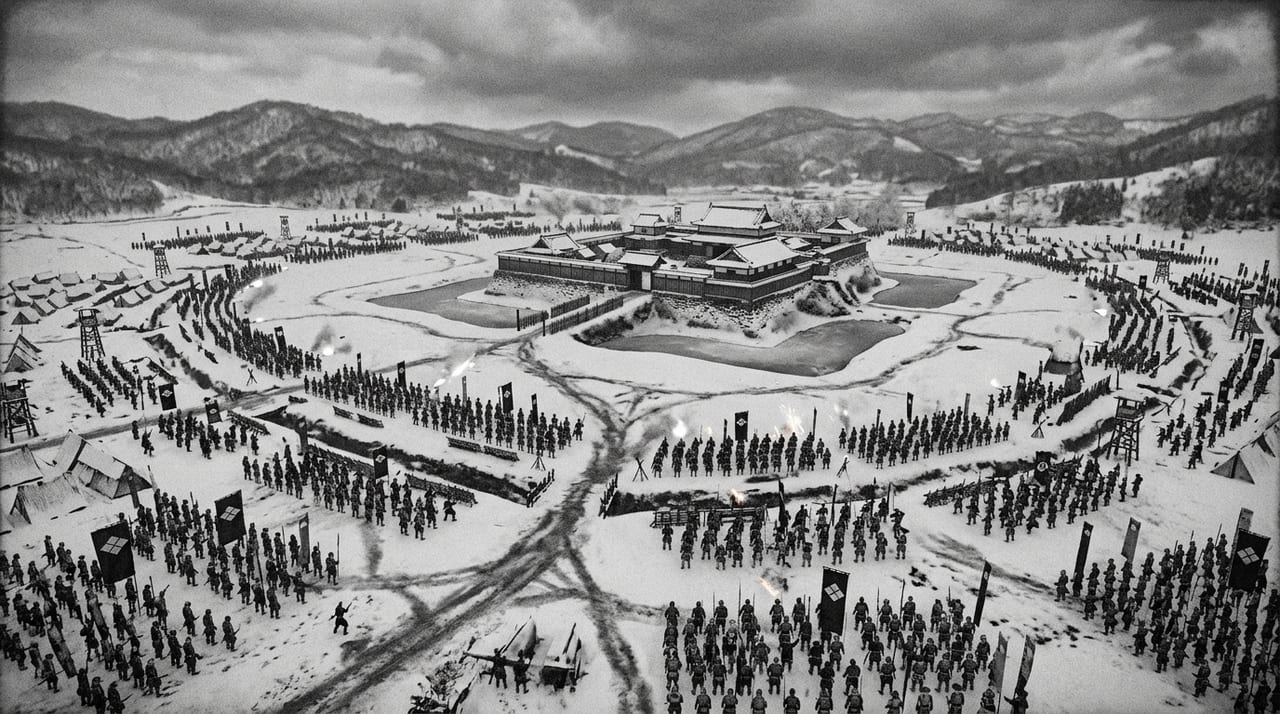
In the 7th month of Tenshō 14 (1586), the Battle of Iwaya Castle was fought at Iwaya Castle in Chikuzen Province (present-day Dazaifu, Fukuoka Prefecture). It was a struggle between the Shimazu clan, on the verge of unifying Kyushu, and Takahashi Jōun, a commander on the Ōtomo side who stood in their way. It is renowned as one of the most famous fight-to-the-death battles of the Sengoku period.
During the Tenshō era, the Shimazu clan of Satsuma defeated Ōtomo Sōrin at the Battle of Mimikawa in Hyūga (Tenshō 6). Since then they had swept across Kyushu with unstoppable momentum and driven the Ōtomo clan of Bungo to the brink. The only Ōtomo forces still holding out in northern Kyushu were Takahashi Jōun, who held Hōman and Iwaya castles, and his eldest son, Tachibana Muneshige, who defended Tachibana Castle. In Tenshō 14, the Shimazu army led by Shimazu Tadanaga and Ijūin Tadamune, said to number anywhere from 20,000 to 50,000, advanced into Chikuzen and captured Ōtomo strongholds one after another. Standing in their path was Iwaya Castle, held by Takahashi Jōun.
Takahashi Jōun chose to hold Iwaya Castle even though it was disadvantageous for defense. Some urged him to abandon it and withdraw, but Jōun rejected this advice. Iwaya Castle would serve as a shield to draw in the Shimazu army, so they would not bypass it and attack Tachibana Castle or Hōman Castle, where his wife, children, and non-combatants had taken refuge. It is said to have been a desperate decision. The garrison that gathered numbered just 763 men.
On the 12th day of the 7th month, the Shimazu side sent an envoy urging surrender, but Jōun firmly refused. From the 14th day of the 7th month, the attack began. Against an army of tens of thousands, Jōun and his garrison fought a fierce defense for nearly half a month. In hand-to-hand combat with swords and spears, they inflicted heavy losses on the Shimazu side as well, but the garrison fell one after another. Then, on the 27th day of the 7th month, the 14th day after the attack had begun, Jōun and every man of the garrison died in battle, and Iwaya Castle finally fell.
After the fall of the castle, Shimazu Tadanaga and the others inspected Jōun's head. They then stepped away from their camp stools, sat on the ground, and are said to have wept, saying: "We have killed a rare, outstanding commander. Had we been friends with Jōun, we would have become the best of friends." For warriors of this era, the sword worn at the hip was a symbol of martial valor and pride. The fierce end of a renowned commander was passed down, regardless of whether he was friend or foe, as a model for all warriors.
Because of Jōun's unrelenting resistance, the Shimazu army suffered considerable losses and was forced to spend valuable time. During this interval, the advance force of the Kyushu campaign dispatched by Toyotomi Hideyoshi began to move, and before long a large army led by Hideyoshi himself was approaching Kyushu. The Shimazu clan was compelled to withdraw, and its dream of unifying Kyushu came to nothing. The time Jōun bought at Iwaya Castle led to a result that decided the balance of power in Kyushu.
Jōun's son, Tachibana Muneshige, carried on his father's will and fought valiantly on the Ōtomo side. He later survived the Toyotomi and Tokugawa eras and became a rare outstanding commander who left his name as a daimyō. The loyalty and martial valor of father and son across two generations are still told today, both as a story that colors the Sengoku history of Kyushu and as an anecdote embodying the pride of the warrior.