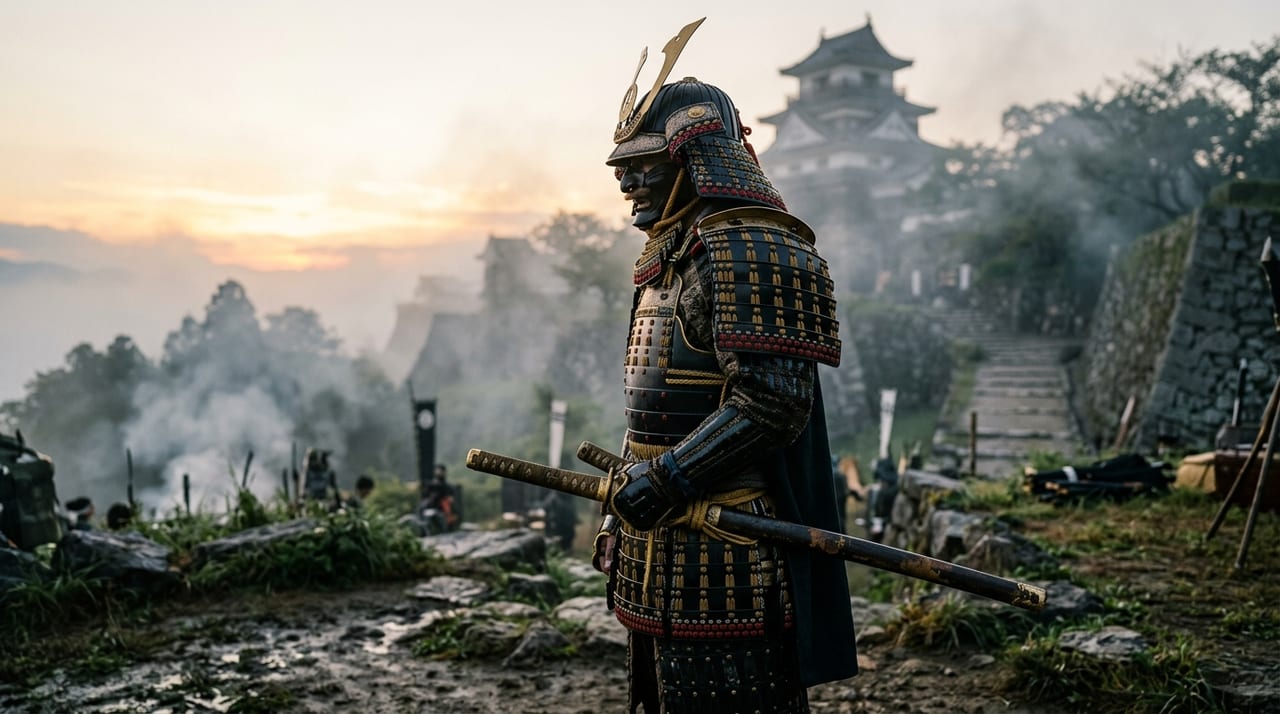
 * Image is for illustrative purposes only.
Tachibana Muneshige
立花宗茂
The Peerless Warrior of Western Japan
Description
The Birth of Saigoku Musō
Born in 1567 (Eiroku 10) in Bungo Province (present-day Ōita Prefecture) as the eldest son of Takahashi Jōun, Tachibana Muneshige later became one of the strongest warlords of the Sengoku period, celebrated as “Saigoku Musō” (Peerless in the West). Muneshige was adopted by Tachibana Dōsetsu, a senior retainer of Ōtomo Sōrin, and his talents blossomed under him. Dōsetsu is said to have been left with an impaired left leg after being struck by lightning, yet he went into battle riding in a palanquin, a legendary warrior. Muneshige received his training as a warrior under this great adoptive father.
The Tachibana Family and Swordcraft Tradition
As one of the foremost warrior houses of Kyushu, the Tachibana family held fine swords for generations. Raikiri, a sword said to have been held by Dōsetsu, takes its name from the legend that Dōsetsu cut down a lightning strike with his tachi. It shows discoloration running from the tip toward the back of the blade. Muneshige inherited Raikiri as a family treasure. The sword bears a gold inlay inscription reading “Tachibana Hida-no-kami shoji” (in the possession of Tachibana Hida-no-kami), and it is now preserved at the Tachibana Museum (Tachibana-ke Shiryōkan). The name Raikiri symbolises the superhuman martial prowess of a warrior, and the sword also embodied the source of the military might that earned Muneshige the title Saigoku Musō. Muneshige also treasured many famous swords and, in actual combat, displayed outstanding skill in handling the blade.
Campaigns in Korea
In the Bunroku campaign of Tenshō 20 (1592), Muneshige crossed to Korea with 2,500 troops and achieved a string of victories. His hard fighting at the Battle of Byeokjegwan in particular made his name known throughout the land. Muneshige's forces matched, and at times surpassed, the combined armies of Ming and Joseon. Kobayakawa Takakage praised them, saying, “The 3,000 of the Tachibana house are equal to 10,000 of any other house.” Hideyoshi awarded Muneshige a commendation letter (kanjō) reading “nihon musō no yūshō tarubeshi” (“Be a brave general peerless in Japan”). In the Keichō campaign (1597), too, Muneshige commanded at the front, and in the retreat he took the rearguard role, keeping losses to his own side to a minimum. These achievements in Korea decisively raised his reputation as a commander and secured the fame of “Saigoku Musō.”
Sekigahara and Wandering
At the Battle of Sekigahara in Keichō 5 (1600), Muneshige fought on the Western Army side under Ishida Mitsunari. Because he was engaged in the siege of Ōtsu Castle in Ōmi, he could not take part in the main battle. After the defeat of the Western Army, he returned to Yanagawa and fought against the Nabeshima forces, but on the persuasion of Kuroda Josui and Katō Kiyomasa he surrendered Yanagawa Castle. This decision led to the dispossession of Muneshige's domain, and he became a wanderer. Nevertheless, through his sincerity and his ability as a warrior, he continued to win the trust of daimyō across the country. Finally, in Genna 6 (1620), he regained his former domain of Yanagawa, about 110,000 koku. This was the only case among the daimyō dispossessed after Sekigahara who regained their former domains, an extremely rare event in Japanese history.
The Miracle of Restoration to His Former Domain
The greatest reason Muneshige was able to return to his former domain lay in his personal character and his ability as a warrior. After his wandering, in Keichō 11 (1606), Muneshige returned to the ranks of the daimyō with a domain of 10,000 koku at Tanagura in Mutsu. He won deep trust from the two shōguns, Tokugawa Hidetada and Iemitsu. In the Siege of Osaka (1615), he served on the Tokugawa side, and his achievements were recognised. Muneshige was also known for his honest character: he kept faith with his former lords and bore no grudge over the defeat at Sekigahara. His reputation as a “warrior who values righteousness” was high among friend and foe alike, and Tokugawa Ieyasu is said to have acknowledged Muneshige's standing as a warrior.
Swords and the Warrior's Pride
Muneshige's attitude toward swords was an expression of his commitment to fulfilling the warrior's duty. Even during his wandering, Muneshige never parted with his famous family swords, and he continued to guard them as the soul of a warrior. After returning to his former domain, Muneshige devoted himself to governing Yanagawa as its lord. Kyushu swordsmiths had their own distinct schools in Chikuzen, Chikugo, Higo and other regions, and in Muneshige's time too, outstanding swordsmiths were active. Muneshige died on Kan'ei 19/11/25 (15 January 1643) at the age of 76. The fame of “Saigoku Musō” and the miracle of his return to his former domain are passed down to later generations as a story symbolising the life of a warrior who valued righteousness.
Notable Swords
- Raikiri (inherited from Tachibana Dōsetsu. A legendary sword said to have cut down a lightning strike. It bears discoloration marks and, as a treasure of the Tachibana house, symbolises the superhuman martial prowess of Dōsetsu and Muneshige, father and son.)