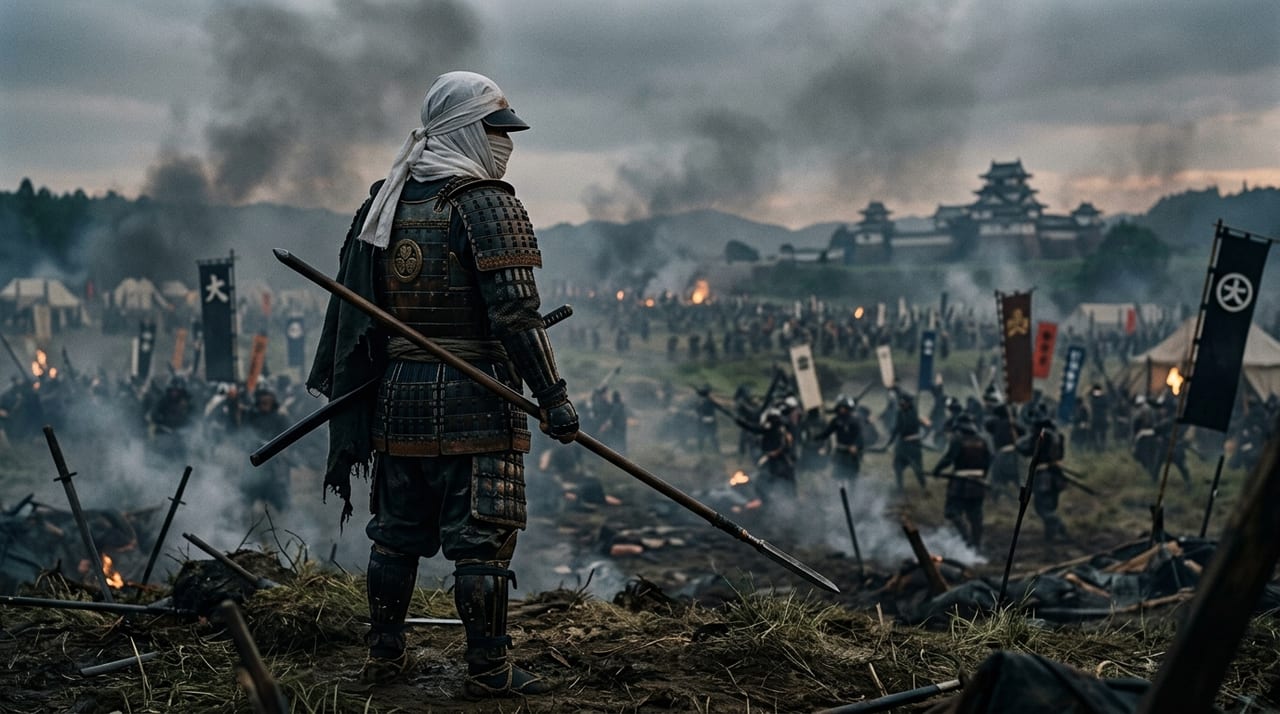
 * Image is for illustrative purposes only.
Ōtani Yoshitsugu
大谷吉継
The White-Veiled General — The Brilliant Commander Who Died for Friendship at Sekigahara
Description
A Renowned General in a White Hood
Ōtani Yoshitsugu, said to have been born in Eiroku 2 (1559) or Eiroku 8 (1565), is known as a strategist who, together with Ishida Mitsunari, was one of Hideyoshi's close aides in the Toyotomi regime. Taking the name “Hakutō,” Yoshitsugu is said to have had his appearance changed by a chronic illness (some hold it was Hansen's disease), and in later works he is often depicted with his face covered by a white hood. Yet in wisdom and sense of chivalry he was among the most outstanding figures of the Toyotomi regime. As the de facto chief strategist of the Western Army at the Battle of Sekigahara, Yoshitsugu kept his friendship and loyalty to Ishida Mitsunari to the very end, even in a desperate situation. His way of life is passed down to later generations as the finest flower of bushidō.
The Deep Bond with Ishida Mitsunari
The friendship between Ōtani Yoshitsugu and Ishida Mitsunari is known as one of the most beautiful friendships in the history of the Toyotomi regime. When Yoshitsugu was ill, at a tea gathering at Osaka Castle a bowl of tea was passed around. While the lords, fearing infection, pretended to drink after Yoshitsugu had sipped from it, Mitsunari alone drank it all without changing his expression. This anecdote is widely known. Although the details of its truth are unclear, the story is passed down as an episode symbolizing the depth of the two men's friendship and Mitsunari's sincere consideration for Yoshitsugu. Before Sekigahara, Yoshitsugu is said to have stated plainly to Mitsunari, “This battle cannot be won,” yet he chose to die for his friend's act of righteousness. That decision is the purest embodiment of friendship and righteousness in the warrior's way.
Fighting at Sekigahara
At the main battle of Sekigahara on the 15th day of the 9th month of Keichō 5 (1600), Ōtani Yoshitsugu deployed at the Fujikawa heights in Yamanaka village, at the western edge of Sekigahara, and also bore the difficult duty of guarding against the movements of Kobayakawa Hideaki on Mount Matsuo. Yoshitsugu's position came under fierce attack from the Eastern Army even before the Kobayakawa forces turned, but he held off the enemy through skillful command. When Kobayakawa Hideaki turned against the Western Army with 15,000 men and joined the Eastern Army, Yoshitsugu repelled them several times with his reserve troops. However, the units of his attached retainer Wakisaka Yasuharu and others also turned, and the battle was decided. Yoshitsugu took his own life. His retainer Yuasa Gosuke performed kaishaku, and then secretly buried his lord's head so that it would not fall into enemy hands. He died at the age of 42 (or 36 if born in Eiroku 8). His final moment embodied the ideal of the warrior, both pure and tragic.
Ōtani Yoshitsugu's Swords and Martial Arts
Although illness made it difficult for Ōtani Yoshitsugu to wield a sword himself, his respect for swords as a warrior and his possession of them never changed throughout his life. Yoshitsugu's determination to march to Sekigahara despite his illness was inseparable from his tenacity in never letting go of the sword, the soul of a warrior. Yoshitsugu's swords carry the pride of a man who lived as a warrior while fighting illness, and they eloquently speak to the significance of the sword as a spiritual pillar beyond a mere weapon.
Strategy of a Wise Commander
Ōtani Yoshitsugu's true brilliance lay in strategy rather than martial strength. In the Toyotomi regime he was active as an administrative official, and during the invasions of Korea he displayed his competence as commissioner of ships and military inspector, handling the procurement of vessels and the transport of supplies. At Sekigahara too, Yoshitsugu's judgment is said to have played a major role in the Western Army's deployment and strategy. His choice to march out even though he knew that the battle could not be won was a fight for righteousness rather than for victory, and that spirit still resonates deeply with many people today.
The Legacy of a Tragic Hero
Ōtani Yoshitsugu's grave remains near the Fujiko River in Sekigahara town, and many worshippers still visit it today. Yoshitsugu's reputation as “a wise strategist who died for righteousness” rose from the Edo period onward, and his figure has been taken up in many works of kabuki, novels, and television dramas. The spirit Yoshitsugu showed, “fighting for friendship and righteousness even while knowing one cannot win,” lives on in people's hearts across the ages as one of the most sublime values Japanese find in bushidō.