New Arrivals — Browse our catalog for the latest authentic Japanese sword arrivals. Browse →
6th–7th month of Tenshō 18 (1590)
Oshi, Saitama-gun, Musashi Province (present-day Gyōda City, Saitama Prefecture)
Forces
Toyotomi Forces (Besiegers)
Narita Clan Forces (Defenders)
About 10 min read
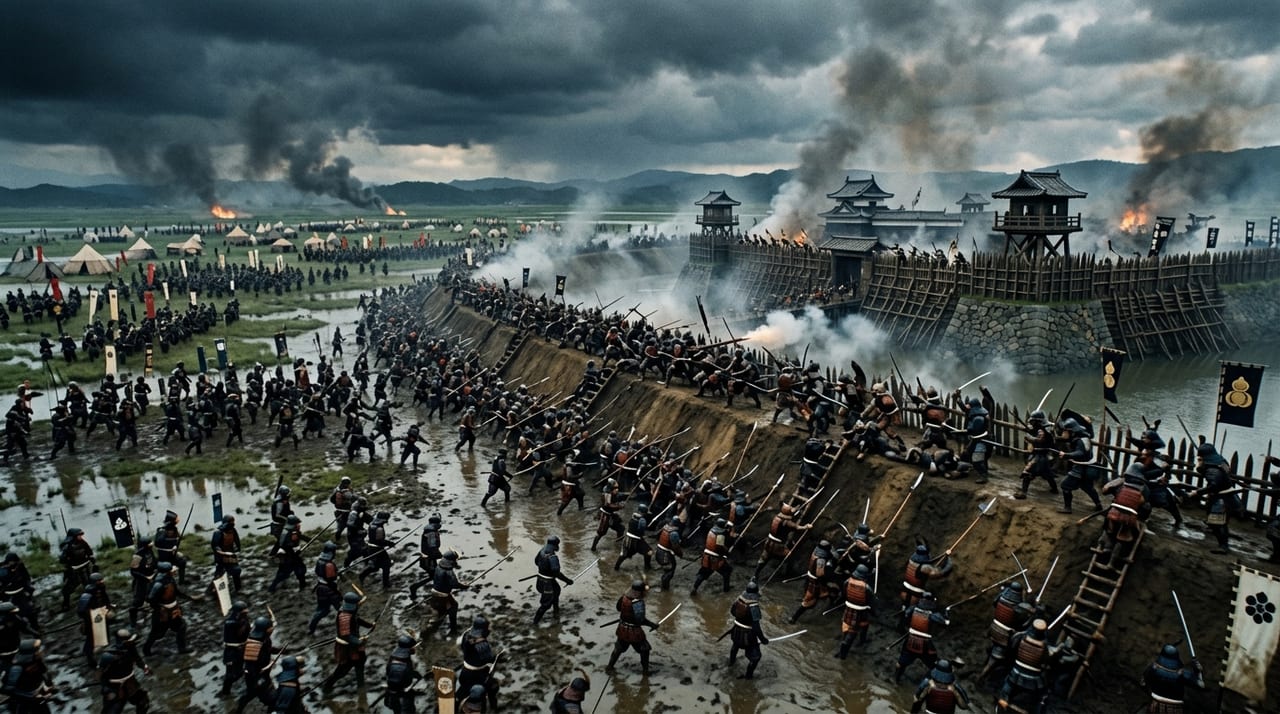
In Tenshō 18 (1590), during Toyotomi Hideyoshi's Odawara campaign, a fierce battle was fought at Oshi Castle in Musashi Province (present-day Gyōda City, Saitama Prefecture) between Toyotomi forces led by Ishida Mitsunari and the defenders of the Narita clan who held the castle. The Siege of Oshi Castle is noted in Japanese history as a siege in which only about 500 defenders held out to the very end against tens of thousands of troops, even though Mitsunari adopted a bold strategy of building a large embankment called the Ishida Embankment (Ishida-zutsumi) to flood the castle with water.
Oshi Castle was located on low-lying land in the Tone River and Ara River system, surrounded by marshes, lakes, and rice paddies, and it was a natural stronghold. Because the honmaru (main enclosure) appeared to float rather than sink even during the later water siege, it is also called the “Floating Castle” (Ukishiro). Because the castle sat on low ground surrounded by water, ordinary direct assaults were difficult, and Hideyoshi turned this terrain to his advantage by ordering a water siege. However, the floodplain terrain of the Tone River was also a difficult landscape for the side conducting the water siege.
The Narita clan was a powerful kokujin (local lord) based in northern Musashi Province, and Oshi Castle had functioned as the clan's main castle throughout the Sengoku period. The castle lord, Narita Ujinaga, served under Hōjō Ujimasa at Odawara Castle and held one of the most powerful positions in the Kantō region. However, during Hideyoshi's Odawara campaign of Tenshō 18, Ujinaga himself was stationed at Odawara Castle, so the defense of Oshi Castle was carried by castle warden Narita Yasusue and, after his death, by his son Narita Nagachika as commander-in-chief. Masaki Toshihide and Kai-hime also supported the defense.
Kai-hime is said to have been the daughter of Narita Ujinaga, and her martial prowess has been passed down through later generations. She is often depicted as a female warrior skilled with the bow and naginata, and she is said to have played a leading role in rallying the defenders during the siege. However, most historical sources were compiled in later periods, and primary sources on Kai-hime's specific exploits are limited. Even so, Kai-hime's presence has been widely known since the Edo period as a symbol of the Siege of Oshi Castle.
In the 6th month of Tenshō 18 (1590), about 23,000 Toyotomi troops led by Ishida Mitsunari, Ōtani Yoshitsugu, and Natsuka Masaie surrounded Oshi Castle. Mitsunari, who was ordered by Hideyoshi to carry out a water siege, began work on a large embankment, the Ishida Embankment (Ishida-zutsumi), spanning roughly 28 km in total length around the castle. The purpose of this embankment was to draw in water from the Tone and Ara rivers and submerge the castle.
The work was completed in a short period, and Mitsunari let water into the area around the castle. However, contrary to expectations, the honmaru (main enclosure) did not sink. Then, on the 18th day of the 6th month of Tenshō 18 (1590), the embankment broke, causing many deaths on the Toyotomi side, and the operation did not proceed as intended.
The roughly 500 defenders who held the castle fought a desperate defense using bows, muskets, swords, and spears, even though they faced a force dozens of times larger than their own. The direct assault that Mitsunari's army carried out in parallel with the water siege was also repulsed by the defenders' fierce counterattacks.
After Oshi Castle surrendered without being taken by force, it is said that Kai-hime was summoned by Hideyoshi and became his concubine. After Hideyoshi's death, Kai-hime's whereabouts disappear from the historical stage, but the legend of her valor at Oshi Castle was passed down among the common people of the Kantō region throughout the Edo period.
In modern times, Oshi Castle is widely known as the setting of Nobō no Shiro (a 2012 film), and the exploits of Narita Nagachika (Nobō-sama) and Kai-hime drew renewed attention. The film's popularity increased tourism to Oshi Castle and Gyōda City and became an opportunity for the Siege of Oshi Castle to be rediscovered in the present day.
The historical significance of the Siege of Oshi Castle is understood as one aspect of the subjugation of the Kantō in the final stage of Toyotomi Hideyoshi's unification of the realm. With the surrender of Odawara Castle (the 7th month of Tenshō 18 (1590)), the Later Hōjō clan was destroyed, and Hideyoshi's unification of the country was completed. Oshi Castle occupies a special place as a castle that did not fall until the very end, in the sense that it was the first to surrender after the opening of Odawara.
Also, Ishida Mitsunari's failure of the water siege is sometimes cited as one of the grounds for critical assessments of his military ability. While his administrative ability to direct a large-scale civil engineering project in a short period is valued, the fact that he ultimately failed to take the castle has been discussed as showing the limits of Mitsunari as a military commander. However, contemporary letters show that it was Hideyoshi who led the water siege, and that Mitsunari in fact sought a more aggressive attack.
Toyotomi Hideyoshi
Led the Odawara campaign of which the Oshi siege was part
Ishida Mitsunari
Commanded the flood assault on Oshi Castle and built the Ishida embankment
Ōtani Yoshitsugu
Participated in the siege of Oshi Castle alongside Mitsunari
Tokugawa Ieyasu
Mediated Kai-hime's introduction to Toyotomi Hideyoshi's household