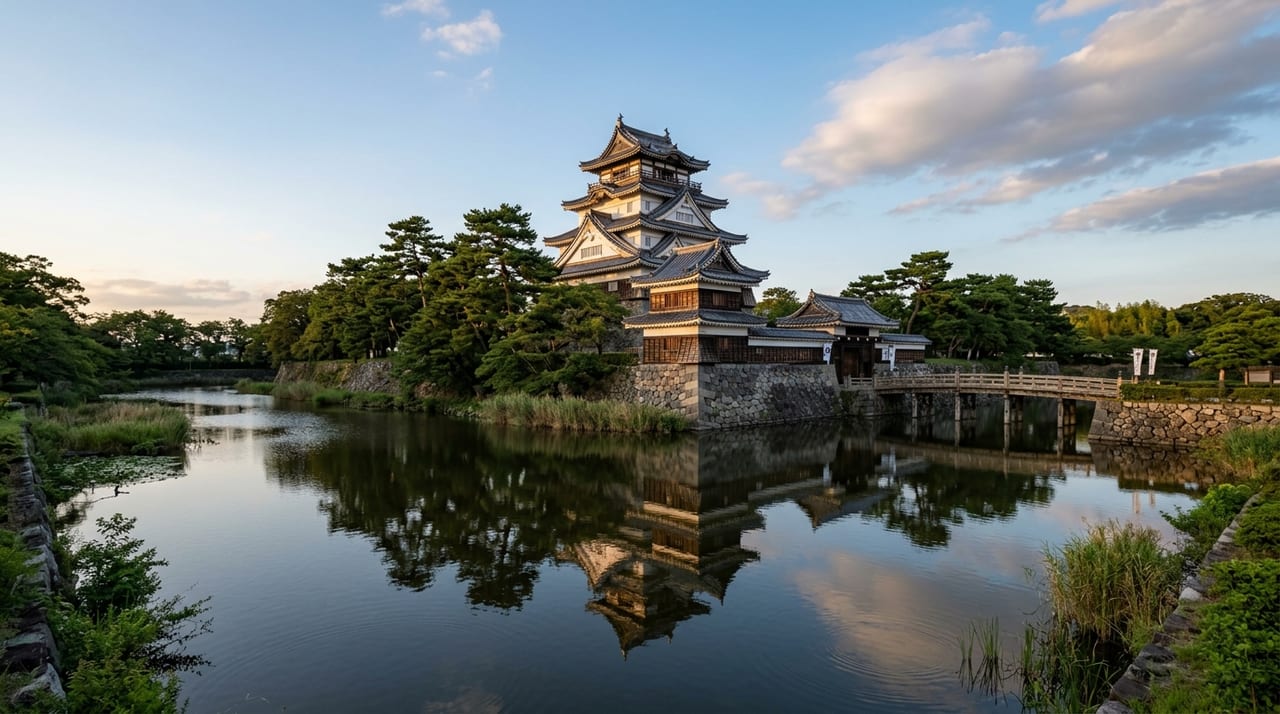
 * Image is for illustrative purposes only.
Oshi Castle
忍城
Oshi Castle is a historic castle in the Kantō region (Founded ca. 1478 (Bunmei 10)). Its lord was Narita Ujinaga.
Overview
About the Castle
Oshi Castle is a castle in Gyōda, Saitama Prefecture, built on low-lying wetland and marshland where the Oshi River, Motoarakawa River, and Hoshikawa River intertwine. It is a typical "water castle" (mizujiro). Built by the Narita clan around Bunmei 10 (1478), it was known for a defensive system that skillfully made use of the natural lowland terrain. It is famous for the "water siege of Oshi Castle." In the campaign against the castles of the Kantō region linked to Toyotomi Hideyoshi's siege of Odawara, Ishida Mitsunari led a large army to besiege Oshi Castle with water, yet failed to take it. It remains widely known today as the setting of "Nobō no Shiro." The present Gosangai Yagura (three-story turret) was restored in its exterior in Shōwa 63 (1988) as part of the Gyōda City Local Museum, and its location and scale differ from the historical facts.
Ishida Mitsunari's Water Siege and “Nobō no Shiro”
In Tenshō 18 (1590), when Toyotomi Hideyoshi attacked Odawara, Ishida Mitsunari besieged Oshi Castle with about 20,000 troops. He built an embankment (Ishida Embankment) with a total length of about 28 kilometers around the castle, and sought to submerge Oshi Castle by channeling water from the Tone and Arakawa rivers during the rainy season. However, under castellan Narita Yasusue and his son Nagachika, about 500 samurai and foot soldiers, including Kai-hime and Masaki Tanba-no-kami, together with farmers, townspeople, and others, about 3,000 people in all, held the castle. They resisted for about one month without yielding to the water siege of the large army. Even after Odawara Castle fell, Oshi Castle did not open its gates. It was finally surrendered voluntarily after its lord, Narita Ujinaga, surrendered at Odawara, yet it had never fallen to a direct assault. This "water siege of Oshi Castle" is famous as a historical incident in which Ishida Mitsunari's stratagem failed. It became widely known through the film “Nobō no Shiro” (Heisei 24 (2012), directed by Inudō Isshin and Higuchi Shinji, starring Nomura Mansai).
Kai-hime's Legend
The most legendary figure in the siege of Oshi Castle is Kai-hime. Kai-hime, daughter of Narita Ujinaga, is known as a female warrior skilled in martial arts, and a legend holds that during the siege she took up a spear herself to defend the castle. Kai-hime's beauty and martial prowess were also known to Ishida Mitsunari's side, and there is a tradition that after the castle's fall she was summoned to Osaka Castle as a concubine of Toyotomi Hideyoshi. Today she is popular as a symbol of female warriors, and Gyōda promotes tourism centered on Kai-hime.
The Oshi Domain and the Edo Period
In the Edo period, as the castle of Oshi Domain, the castle was held by figures who served as senior councilors (rōjū), including Matsudaira Nobutsuna and Abe Tadaaki. From Bunsei 6 (1823), the Okudaira-Matsudaira family became domain lords, and the castle became associated with senior shogunal retainers. In the Edo period, Oshi Castle was known as a typical water castle of the Kantō region, and its surrounding water moats and natural marshland created a beautiful castle landscape. Gyōda is also known today for a distinctive B-class gourmet food called zerī-furai, which adds to the enjoyment of strolling through the castle town.
Historical Characteristics of Gyōda
In addition to Oshi Castle, Gyōda is a historic city that has the Sakitama Kofun Group, one of Japan's largest clusters of keyhole-shaped burial mounds (zenpō-kōen-fun) dating from the 5th to 7th centuries. At Sakitama Kodai-Hasu no Sato, ancient lotus flowers bloom (July–August), preserving the ancient landscape to this day. Gyōda is also known as a production center for tabi (split-toe socks), and its streetscape of tabi storehouses (tabi-gura) has been certified as part of the Japan Heritage designation “Gyōda, a Town of Tabi Storehouses Supporting the Foundations of Japanese Clothing Culture.”
Connection to Swords
The connection between Oshi Castle and Japanese swords can be discussed through the special siege known as the "water siege" and through episodes concerning the swordsmanship and martial prowess of figures such as the Narita clan and Kai-hime. The Narita clan was a Kantō warrior group that served under Uesugi Kenshin and the Hōjō clan, and it played a part in the sword culture of the Kantō region during the Sengoku period. The legend that Kai-hime fought while wearing armor herself is known as an anecdote about women and martial arts in the Sengoku period. Abe Bungo-no-kami Tadaaki, who served as a senior councilor and held the lordship of Oshi Domain in the Edo period, is known as a renowned senior councilor who served shoguns Iemitsu and Ietsuna. The Gyōda City Local Museum (including the Gosangai Yagura) presents the history of Oshi Castle and Oshi Domain, where visitors can learn the historical facts of the setting of “Nobō no Shiro.” The gold-inlaid inscribed iron sword (Kinsakumei Tekken, National Treasure) excavated from Inariyama Kofun in the Sakitama Kofun Group is displayed at the nearby Saitama Prefectural Sakitama Historic Site Museum.
Highlights
- Gosangai Yagura and Gyōda City Local Museum — Displays historical materials on Oshi Castle and Oshi Domain. Learn the historical facts behind “Nobō no Shiro”
- Ishida Embankment — Remains of the 28 km embankment built by Ishida Mitsunari. The scale of the water siege is overwhelming
- Sites associated with Kai-hime — Stroll through the castle town and follow the legend of the female warrior Kai-hime
- Sakitama Kofun Group — One of Japan's leading concentrations of keyhole-shaped burial mounds dating from the 5th to 7th centuries. A National Special Historic Site
- Sakitama Kodai-Hasu no Sato — A fantastic landscape where lotus flowers grown from seeds about 1,400 years old bloom (July–August)
- Gyōda's zerī-furai and furai — Okara-based B-class gourmet foods. The "furai" (a type of okonomiyaki) is a Gyōda specialty
* Opening hours and admission fees are subject to change. Please check the official website before visiting.