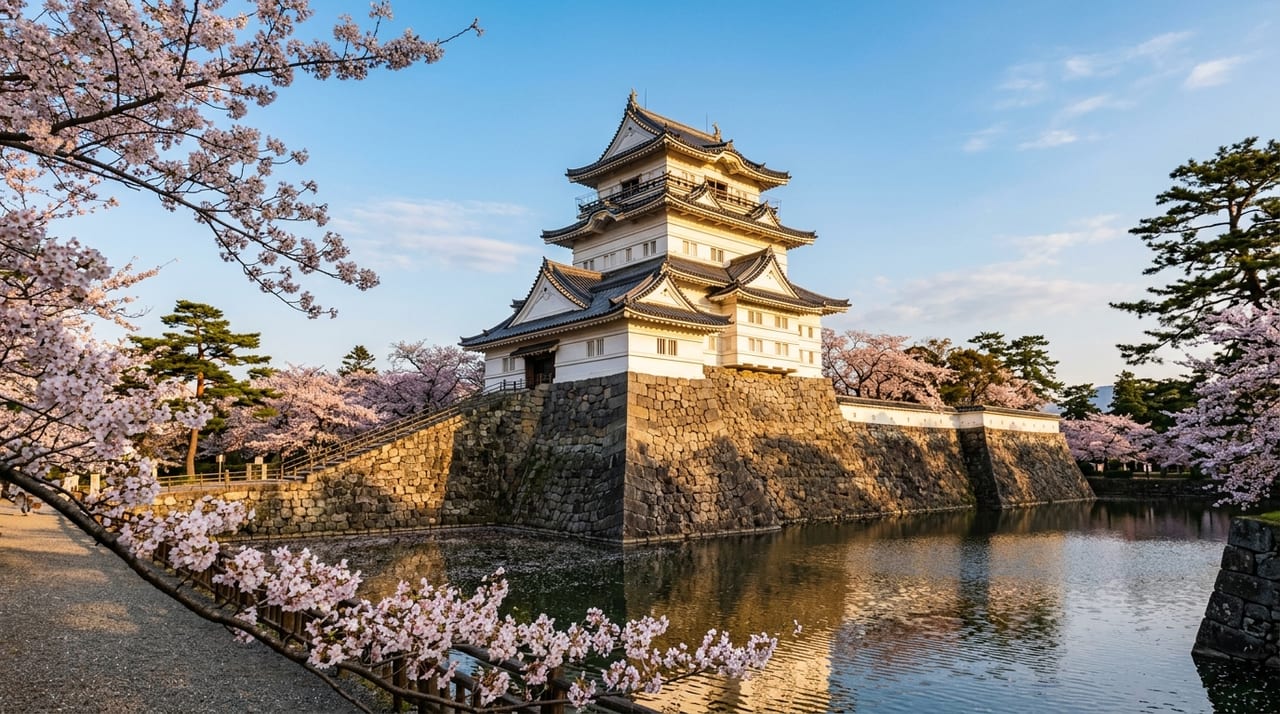
 * Image is for illustrative purposes only.
Odawara Castle
小田原城
Odawara Castle is a historic castle in the Kantō region (Said to have been built by the Ōmori clan in the mid-15th century). Its lord was Hōjō Ujiyasu / Ōkubo clan.
Overview
About the Castle
Odawara Castle was the seat of the five generations of the Later Hōjō clan, who controlled most of the Kantō region during the Sengoku period. It was the largest castle in the Kantō region and enjoyed an unrivaled reputation as “impregnable.” Its origins are traced to a castle built by the Ōmori clan in the mid-15th century. In a period said to be either 1495 (Meiō 4) or around 1500, Hōjō Sōun (Ise Sōzui) is said to have seized the castle from the Ōmori clan through stratagem. Thereafter, it served as the main base of the Hōjō clan across five generations (Sōun, Ujitsuna, Ujiyasu, Ujimasa, and Ujinao) and functioned as the center of political and military affairs in the Kantō region. In 1561 (Eiroku 4), Uesugi Kenshin laid siege to Odawara with an army said to exceed 100,000 men, but Hōjō Ujiyasu adopted a defensive strategy of holding the castle, forcing the attackers to withdraw.
Growth of the Castle Town
In 1569 (Eiroku 12), Takeda Shingen also attacked, but withdrew after a siege of several days. The fact that the castle repelled two of the strongest warlords of the Sengoku period cemented Odawara Castle's reputation as “impregnable.” In preparation for an attack by Toyotomi Hideyoshi, during the reigns of Ujimasa and Ujinao, the sōgamae (outer defensive works), an earthen rampart and moat enclosing the castle and castle town over a total length of about 9 km, was constructed. This concept of incorporating the entire castle town within the fortifications was on a scale that surpassed even the outer defenses of Hideyoshi's Ōsaka Castle.
Battles and Campaigns
However, in 1590 (Tenshō 18), Toyotomi Hideyoshi besieged Odawara with an army of about 210,000 men and built the Ishigakiyama “One-Night Castle” on Mount Ishigaki, breaking the Hōjō clan's will to fight. After a siege of about three months, Hōjō Ujinao surrendered, and the Hōjō clan's century-long rule over Kantō, spanning five generations, came to an end. With this Odawara campaign, Hideyoshi completed the unification of the realm, and the Sengoku period effectively came to an end. The present main tower was rebuilt in 1960 (Shōwa 35), and its interior is a well-developed museum introducing the history of the Hōjō clan and Odawara. The castle park overlooking Sagami Bay is also a beloved spot for cherry blossoms and wisteria.
Sightseeing and Experiences
Odawara Castle is a castle where two historical themes intersect: the “impregnability” of the Sengoku period and the “completion of national unification” by Hideyoshi. It is a symbol of the end of Japan's Sengoku period. It is also close to the Hakone Barrier, and its historical importance as a key point on the Tōkaidō is high. The Hōjō clan is said to have worked to keep their domain stable during the Sengoku era, and Odawara Castle is also a symbol of that governance. Odawara is also known for seafood products such as kamaboko (fish cake) and himono (dried fish), and together with the rich seafood of Sagami Bay, it offers a wide range of travel pleasures.
Culture and Crafts
It is also the gateway to the Hakone hot springs, and a trip that combines the castle, the hot springs, and seafood is especially rewarding. Odawara's “uirō,” a renowned confection, is said to have been made since the Hōjō era. Odawara Castle is one of the most historically important castles that can be visited on a day trip from Tokyo, and it is the gateway to the sacred site of Sōshū-den.
Connection to Swords
Sagami Province, where Odawara Castle is located, is the birthplace of the Sōshū-den, one of the Gokaden (Five Traditions), and is one of the most important sacred sites in the history of the Japanese sword. The Sōshū-den is said to have originated when, with the establishment of the Kamakura shogunate, the fifth regent Hōjō Tokiyori invited master smiths such as Awataguchi Kunitsuna of Kyoto and Kunimune of Bizen to Kamakura. The techniques of these master smiths merged, passing through Shintōgo Kunimitsu, and gave birth to Gorō Nyūdō Masamune, the one who perfected the Sōshū-den and the greatest master in the history of the Japanese sword. Masamune's style is known for the brilliance of its hardened edge (nie) and the bright clarity of its steel (jigane). Through his disciples from various regions, known as Masamune Juttetsu (Ten Disciples of Masamune), he had a decisive influence on sword culture throughout Japan. Sadamune, said to have been Masamune's eldest son or adopted son, is considered to have further refined his father's style. Even today, descendants of Masamune Kōgei operate bladesmithing workshops in Kamakura, and the lineage of the Sōshū-den has not been broken. The Later Hōjō, as a warrior house, also placed great value on swords, and bestowing famous blades on their retainers was an important political act to confirm the lord-vassal relationship and secure loyalty. In the era when Hōjō Ujiyasu made a name for himself as the “hegemon of Kantō,” many craftsmen connected with armor and arms also gathered in the castle town of Odawara. The Sagami region, from Odawara to Kamakura, is one of the most important pilgrimage routes for sword enthusiasts, as the birthplace and center of development of the Sōshū-den. Visiting the Masamune Kōgei Bijutsu Seisakusho in Kamakura together with the treasure hall of Tsurugaoka Hachimangū allows one to deeply experience the world of the Sōshū-den. Few of Masamune's swords survive, and many are unsigned, yet the beauty of their hardened edge and the brightness of their steel possess an overwhelming dignity that identifies them at a glance as the pinnacle of the Sōshū-den.
Highlights
- Reconstructed Main Tower — a museum introducing the history of the five Hōjō generations and Odawara, with views of Sagami Bay from the top floor
- Akagane-mon and Tokiwagi-mon — reconstructed castle gates that evoke the scale of the castle in its heyday
- Remains of the sōgamae — an outer defensive line of about 9 km, one of the largest in Japan, enclosing the entire castle town
- Cherry blossoms and wisteria in the castle park — a citizens' place of rest, with beautiful spring cherry blossoms and early-summer wisteria trellises
- Ishigakiyama “One-Night Castle” site — a field fortress built by Hideyoshi during the Odawara campaign, with a scenic view overlooking Sagami Bay
- Kamakura, Masamune Kōgei (about 40 minutes by car) — a sacred site of Sōshū-den, a bladesmithing workshop run by Masamune's descendants
* Opening hours and admission fees are subject to change. Please check the official website before visiting.