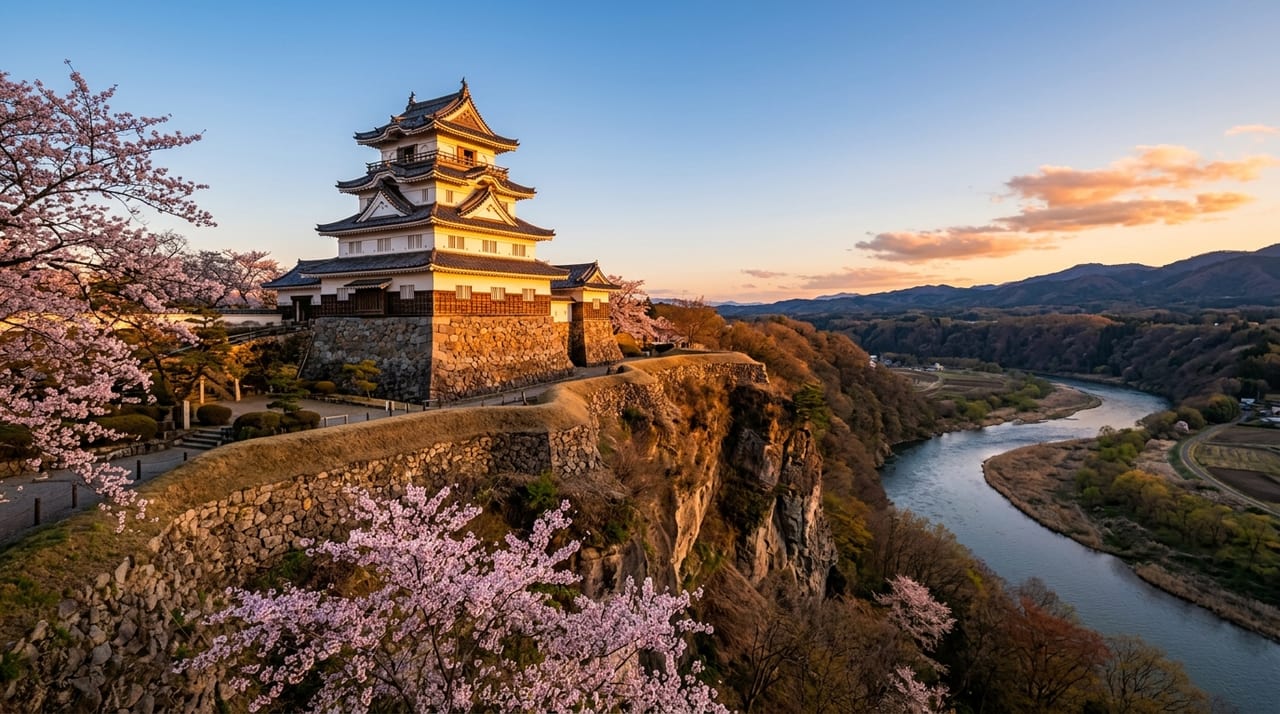
 * Image is for illustrative purposes only.
Numata Castle
沼田城
Numata Castle is a historic castle in the Kantō region (Tenmon 1 (1532): built by Numata Akiyasu; Tenshō 8 (1580): captured by Sanada Masayuki and made the base for control of Kōzuke Province). Its lord was Sanada Masayuki → Sanada Nobuyuki (Nobuyuki) → Honda clan → Toki clan.
Overview
Numata Castle is a castle built on a fluvial terrace in Numata City, Gunma Prefecture. It is a stronghold that uses natural cliffs formed at the confluence of the Tone River and the Usune River. On the sides facing the two rivers, the cliffs are about 70 meters high. As a natural stronghold protected by cliffs carved by river erosion, it was one of the most important castles in Kōzuke Province (Gunma Prefecture) during the Sengoku period.
Numata Castle is known for its deep connection with the Sanada clan. Sanada Masayuki was a minor daimyo from Shinano (Nagano Prefecture), yet during the turmoil after the fall of the Takeda clan he dealt with both the Hōjō clan and the Uesugi clan, great powers of the east. He was a wise strategist who achieved control of Kōzuke Province, with Numata Castle as one of his main bases. Masayuki was so known for his elusive diplomacy and strategy that Toyotomi Hideyoshi described him as “hyōri hikyō no mono” (a double-dealing, cunning man). In the First Battle of Ueda (1585) and the Second Battle of Ueda (1600), he twice repelled large Tokugawa forces, and he made a name for himself in later generations as a famous general.
Masayuki's son Sanada Nobuyuki (later renamed Nobuyuki, written with a different character) parted from his father and younger brother Yukimura at the Battle of Sekigahara to join the Tokugawa Eastern Army. After the battle he sought to keep the Sanada family intact, and he governed the Numata domain lands with Numata Castle as his base. Numata Castle, said to have had a five-story keep built, functioned as the government office of the Numata domain. However, in Tenna 1 (1681) the Sanada clan was stripped of its domain, and the castle was demolished the following year, in Tenna 2 (1682). (Afterward, in Genroku 16 [1703], the Honda clan was enfeoffed and the Numata domain was revived, but the castle was not substantially rebuilt.) It is now developed as Numata Park, and parts of its earthen ramparts, dry moats, and stone walls remain.
Connection to Swords
The relationship between Numata Castle and Japanese swords is discussed from two angles: the sword culture of the Sanada clan, an exceptional group of warriors, and the geographic conditions of its location at a key transport junction linking Kōzuke, Shinano, and Echigo.
Sanada Masayuki and his sons Nobuyuki and Yukimura (Nobushige), the Sanada father and sons, are a renowned family of warriors who were active from the Sengoku period into the early Edo period. In particular, Sanada Yukimura (Nobushige) is called “Nihon ichi no tsuwamono” (the finest warrior in Japan) for his superhuman fighting and honorable last stand in the Ōsaka Campaign (1615), and many anecdotes about his beloved sword have been handed down. Swords and armor bearing the Sanada name are cultural artifacts that still attract considerable interest today.
Kōzuke Province (Gunma Prefecture), where Sanada Masayuki was active, was a key transport junction bordering Echigo (Niigata), Shinano (Nagano), Musashi (Saitama), and Shimotsuke (Tochigi). Echigo in particular was the base of Uesugi Kenshin and Kagekatsu, and masterpieces of “tachi” and “uchigatana” associated with Kenshin have been passed down in the Uesugi family. The Sanada clan, having gone through rivalry and alliance with the Uesugi clan, also had deep ties with the Echigo region.
Highlights
- Numata Park (castle ruins) — Numata City designated historic site, a castle-ruin park where earthen ramparts, dry moats, and stone walls developed by the Sanada clan survive
- Honmaru site — the site of the main compound where Sanada Nobuyuki is said to have built a five-story keep; a bell tower has been reconstructed
- Riverside terrace stronghold terrain — experience the natural fortress terrain protected by the cliffs of the Tone River and the Usune River
- Shōkaku-ji — temple with the grave (partial interment) of Komatsu-hime, the wife of Sanada Nobuyuki
- Sites associated with the rokumonsen — the Sanada family crest, the “rokumonsen” (six coins), is said to represent the fare for crossing the Sanzu River, and is regarded as a symbol of resolve
- Gateway to Oze and Mount Tanigawa — a base for nature tourism
* Opening hours and admission fees are subject to change. Please check the official website before visiting.