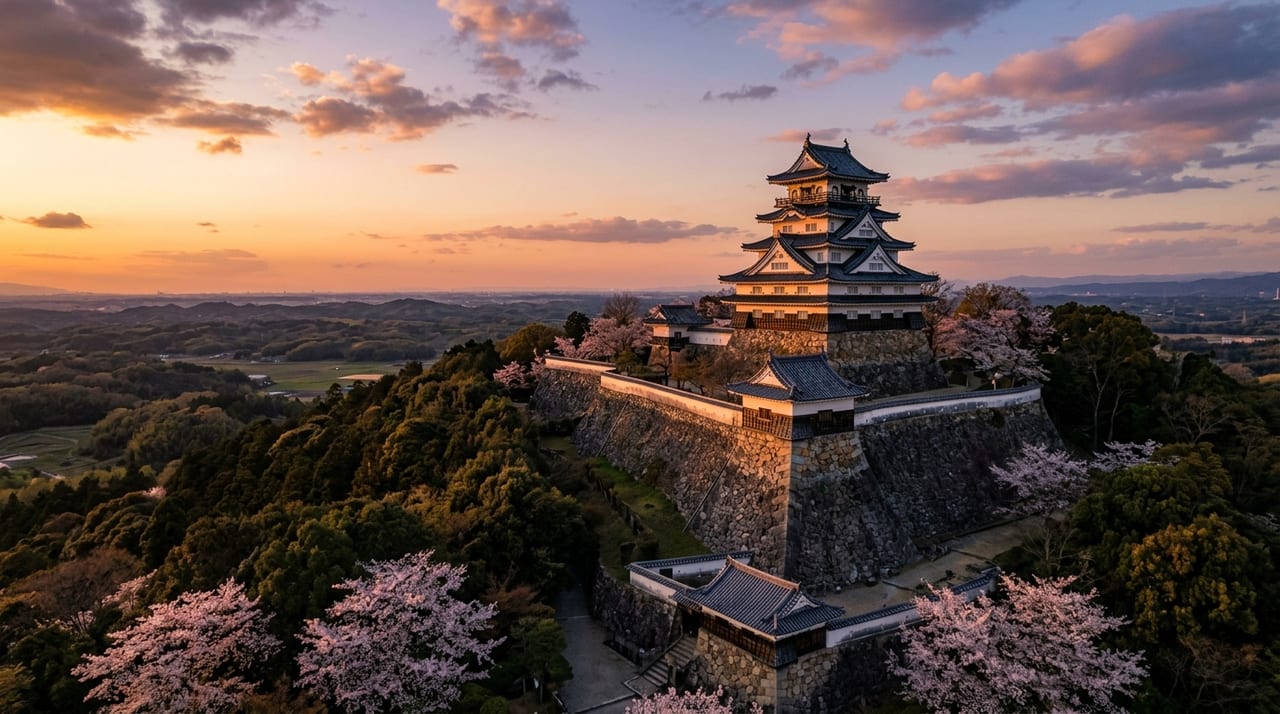
 * Image is for illustrative purposes only.
Motosakura Castle
本佐倉城
Motosakura Castle is a historic castle in the Kantō region (Traditionally said to have been built during the Bunmei era (1469–1487); abandoned in 1615 (Genna 1)). Its lord was The Chiba clan (including Chiba Takatane and successive heads).
Overview
Overview
Motosakura Castle is a medieval hirayama-jiro (hilltop castle) built on Masakado-yama, straddling Ōsakura in Sakura City and Motosakura in Shisui Town, Inba District, Chiba Prefecture. It was the late-period headquarters of the Chiba clan as a Sengoku daimyo.
Background of Construction
It is traditionally said that the castle was built during the Bunmei era (1469–1487) as the seat of the Shimōsa Chiba clan, and records state that Chiba Takatane moved his base here in Bunmei 16 (1484). From then until the fall of the Chiba clan in Tensho 18 (1590), for about a century, it functioned as the residence castle of successive Chiba clan heads.
Scale and Structure
Built on a peninsula-shaped hill with a valley to the south, it is a renkaku-shiki (linked-enclosure) hirayama-jiro consisting of an inner enclosure and an outer enclosure. The inner enclosure formed a natural stronghold surrounded on the remaining three sides by marshland, and no tenshu (keep) was built.
Abandonment
In 1615 (Genna 1), the castle was abandoned due to the transfer of the domain seat to Sakura Castle and the one-castle-per-domain policy (ikkoku ikkajō-rei).
Present Condition
Remains such as earthworks and dry moats survive in almost complete form, and the castle is known for its excellent state of preservation.
Cultural Property Designation
On September 11, 1998, it was designated a National Historic Site as “Motosakura Castle Ruins.” In 2017 it was selected as No. 121 of the Continuation of the 100 Fine Castles of Japan.
Highlights
- The late-period headquarters of the Chiba clan; Chiba Takatane is recorded as having moved his base there in 1484
- Served as the seat of successive Chiba clan lords for about a century, until the clan's fall in 1590
- A renkaku-shiki hirayama-jiro with an inner and outer bailey, its inner bailey a natural stronghold surrounded on three sides by marshland
- Earthworks and dry moats survive in near-complete condition
- A National Historic Site and No. 121 in the Continuation of the 100 Fine Castles of Japan
* Opening hours and admission fees are subject to change. Please check the official website before visiting.