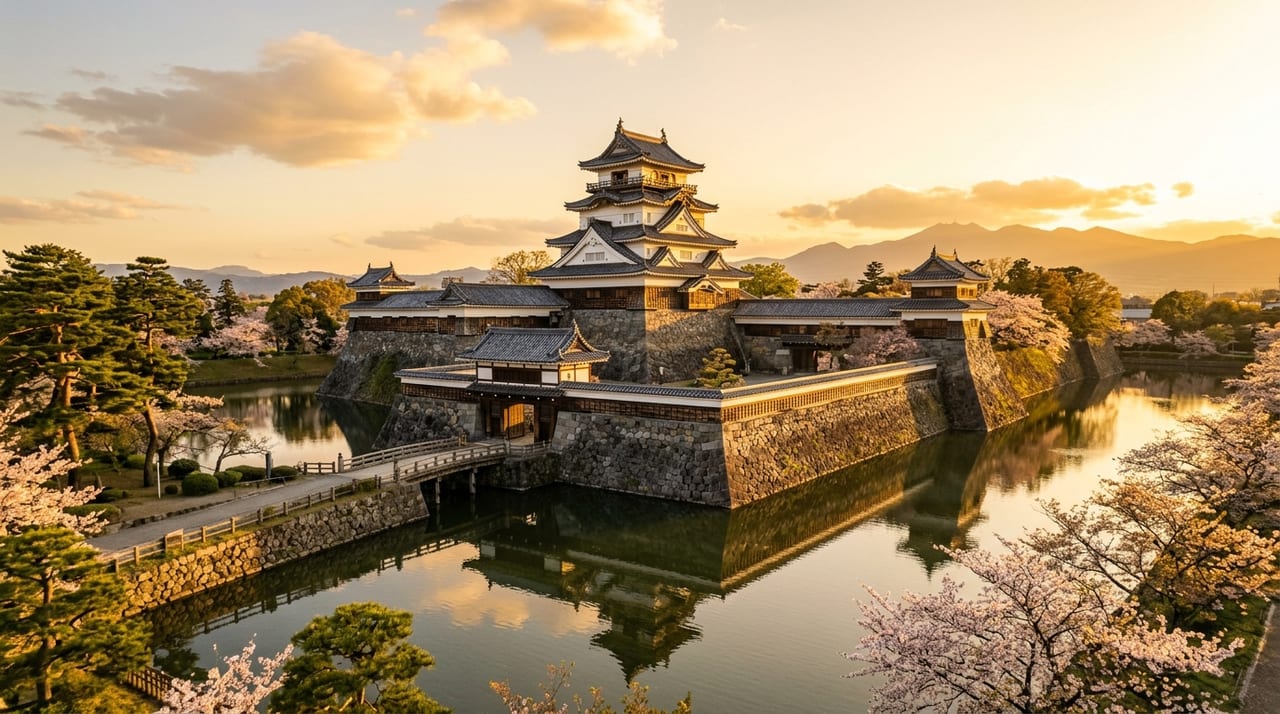
 * Image is for illustrative purposes only.
Maebashi Castle (Umayabashi Castle)
前橋城(厩橋城)
Maebashi Castle (Umayabashi Castle) is a historic castle in the Kantō region (Said to have been founded around 1489 (Entoku 1); developed as seat of Maebashi Domain under the Sakai clan in the Edo period). Its lord was Nagano clan / Hōjō clan / Uesugi Kenshin (jurisdiction) / Hiraiwa Chikayoshi / Sakai clan / Echizen Matsudaira family.
Overview
Maebashi Castle is a flatland castle located in Maebashi, Gunma Prefecture, also known by the name 'Umayabashi Castle.' It was built on the northeastern edge of the Maebashi Plateau, uses the Tone River and the Hirose River as its outer moats, and is characterized by a layout that skillfully makes use of the rivers. During the Sengoku period, it became the stage of a contest between the Hōjō and Uesugi clans as a key strategic point in northern Kantō, and it gained fame especially because Uesugi Kenshin used it as a base during his campaigns into Kantō.
The origins of the castle are said to lie in a residence built along the Tone River by the Nagano clan around Entoku 1 (1489), during the Muromachi period. Later, in the Sengoku period, when the power of the Kantō kanrei Uesugi clan declined and the Later Hōjō clan advanced its control over Kantō, this castle also fell into the hands of the Hōjō clan.
During the Eiroku era (1558–1570), Uesugi Kenshin repeatedly sent troops into Kantō and made use of Umayabashi Castle as an important base in northern Kantō. After Kenshin's death, the castle came under Hōjō control once again, but when the Hōjō clan was destroyed by Toyotomi Hideyoshi's Odawara campaign (1590), Hiraiwa Chikayoshi, a senior retainer of Tokugawa Ieyasu, became castle lord.
In the Edo period, the Sakai clan took over as castle lord, and major works were carried out to develop it as the main castle of the Maebashi domain. However, erosion by the Tone River continued to take away the castle grounds. Matsudaira Tomonori of the Echizen Matsudaira family, who replaced the Sakai clan in Kan'en 2 (1749), moved his residence to Kawagoe Castle (Saitama) in Meiwa 4 (1767). Reconstruction began in Bunkyū 3 (1863) near the end of the Edo period, and in Keiō 3 (1867) domain lord Matsudaira Naokatsu returned to the castle. After the castle was abolished in the Meiji period, the site of the honmaru (main bailey) was occupied by the Gunma Prefectural Government Office, and the outer ward of the third bailey became Maebashi Park. Almost no remains survive.
Today, earthen ramparts remain on the north side of the Gunma Prefectural Government Office and in Maebashi Park, and stone walls of the gate remain at the Kurumabashi Gate site (Historic Site designated by Maebashi City) in 2-chōme Ōtemachi.
Connection to Swords
The historical connection between Maebashi Castle and Japanese swords comes down to its relationship with Uesugi Kenshin. Kenshin went into battle as an incarnation of Bishamonten, and his martial prowess stood out from that of his contemporaries. The fact that Kenshin used Umayabashi Castle as one of the bases for his campaigns to conquer Kantō shows that this castle was located at the center of the highest level of martial culture of the Sengoku period.
Uesugi Kenshin is also known as a collector of swords. He gathered famous blades from various regions, such as Bizen, Yamashiro, and Sōshū, and laid the foundation for the famous sword collection later passed down as the Uesugi family's 'Thirty-Five Hand-Picked Swords' (Otesen Sanjūgo-koshi).
Swords associated with Kenshin have been passed down through the Uesugi family and are still held today, including at the Yonezawa City Uesugi Museum (Yamagata Prefecture).
The Sakai clan, lords of the Maebashi domain in the Edo period, was a prestigious house that produced the tairō Sakai Tadakiyo and held key rōjū posts in succession.
Highlights
- Kurumabashi Gate site (Historic Site designated by Maebashi City) — stone wall of the gate remaining in 2-chōme Ōtemachi
- Stone wall and earthen rampart fragments — a few remaining traces of the castle fortifications
- Maebashi Park — a citizens' park enclosing the castle site, with scenery along the Tone River
- Sites associated with Uesugi Kenshin — historic places where Kenshin used the castle as a base for his campaigns into Kantō
- Gunma Prefectural Museum of History (Takasaki) — exhibits historical materials of Gunma
- Natural water moat of the Tone River — a natural stronghold that served as the castle's defense, still maintaining its scenery today
* Opening hours and admission fees are subject to change. Please check the official website before visiting.