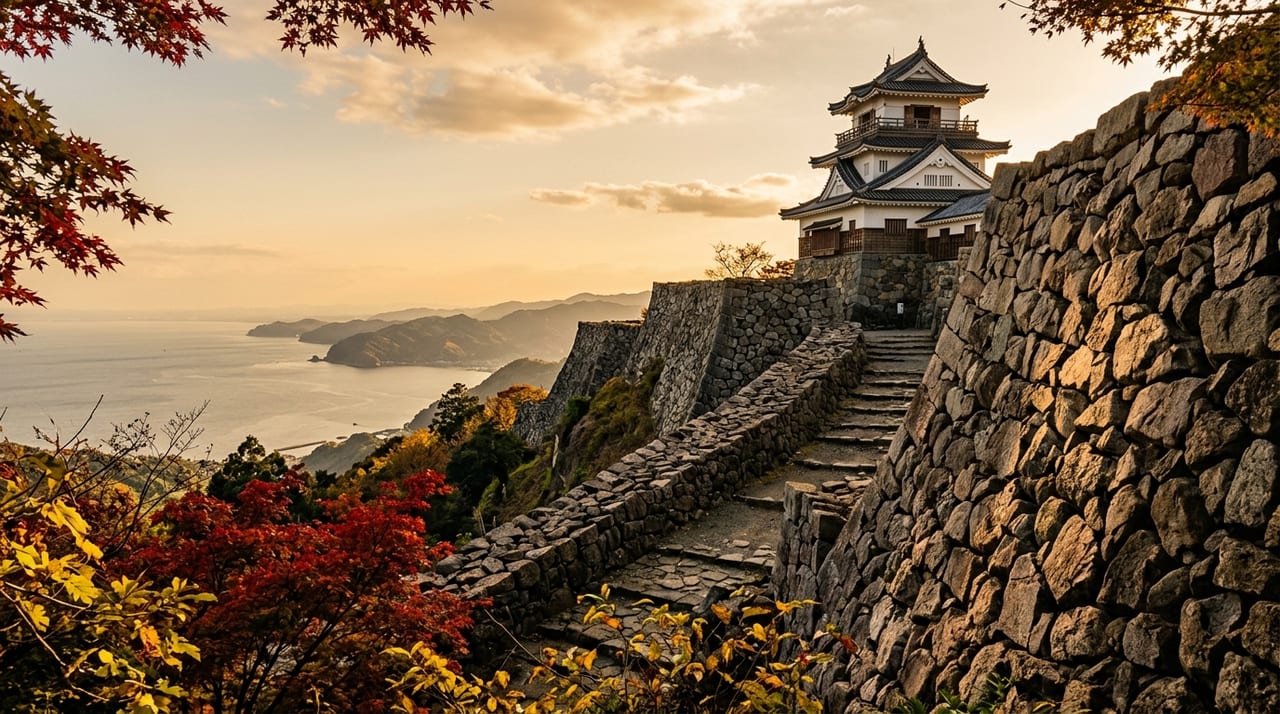
 * Image is for illustrative purposes only.
Ishigakiyama Castle (Ishigakiyama Ichiya Castle)
石垣山城(石垣山一夜城)
Ishigakiyama Castle (Ishigakiyama Ichiya Castle) is a historic castle in the Kantō region (Founded in Tenshō 18 (1590). A total-stone-fortification siege castle built by Toyotomi Hideyoshi in approximately 80 days during the siege of Odawara). Its lord was Toyotomi Hideyoshi (constructed during the siege of Odawara in Tenshō 18 / 1590).
Overview
Ishigakiyama Castle (Ishigakiyama-jō) is a late-Sengoku siege castle (jinjiro) located in Hayakawa, Odawara City, Kanagawa Prefecture. It was built in Tenshō 18 (1590) by Toyotomi Hideyoshi to conquer the Hōjō clan of Odawara, and it is an all-stone-walled castle. Also known as "Ishigakiyama Ichiya-jō" (One-Night Castle), the name comes from the story that when the castle was completed, the surrounding trees were all felled at once, making it appear suddenly before the Hōjō forces inside Odawara Castle.
The Odawara campaign began in the 3rd month of Tenshō 18 (1590), and Hideyoshi mobilized a total force of over 200,000 men to besiege the Hōjō clan's home base, Odawara Castle. Meanwhile, Hideyoshi decided to establish a siege castle on the summit of Mount Kasakake, at an elevation of about 261 m, in the mountains about 3 km southwest of Odawara Castle. In a record-short construction period of just 80 days, using a cumulative workforce said to number tens of thousands of laborers, he completed a full-scale castle with all-stone walls, the first of its kind in the Kantō region. When the trees surrounding the site were removed all at once upon completion, the castle was said to have appeared as if it had suddenly materialized, and this became the origin of the one-night castle legend.
The castle's layout consists of the Honmaru, Ninomaru, Nishi-kuruwa (West Bailey), Minami-kuruwa (South Bailey), and Kita-kuruwa (North Bailey), and it forms a self-contained castle layout that also includes a tenshudai (main tower base), Ido-kuruwa (Well Bailey), and Umaya-kuruwa. The stone walls were built mainly of andesite produced in Sagami. Although the stonework is rough, consisting of nozura-zumi (rough fieldstone stacking), it demonstrates remarkable engineering skill for a wartime rush construction. Hideyoshi invited Lady Yodo and other consorts, Sen no Rikyū, and Noh actors to this castle to hold tea gatherings, and he also received an imperial envoy.
From within the castle, there is a spectacular view overlooking Sagami Bay, the Izu Peninsula, the Manazuru Peninsula, and the castle town of Odawara, which to this day conveys the dignity of the stage for Hideyoshi's unification of the realm. After a siege of 100 days, the Hōjō clan surrendered and capitulated. Some stone walls collapsed in the Great Kantō Earthquake (1923), but Ido-kuruwa and other areas retain well the traces of the castle's former appearance. The castle is now developed as the Ishigakiyama Ichiya-jō Historical Park in Odawara City, and it is counted among the National Historic Site (Ishigakiyama) and the Continued 100 Fine Castles of Japan.
Connection to Swords
Ishigakiyama Castle is a castle that symbolizes Toyotomi Hideyoshi's unification of the realm, and it is directly connected to the so-called Katanagari (sword hunt), one of the most important turning points in the history of Japanese swords.
In Tenshō 16 (1588), Toyotomi Hideyoshi issued the Katanagari Edict (sword hunt edict), ordering the confiscation of weapons such as swords, wakizashi, bows, spears, and firearms from farmers and villagers (hyakushō). This policy was a groundbreaking edict that institutionalized the separation of warriors and farmers (heinō bunri). In sword history, it is noted as a historical turning point that established the privileging of sword possession in Japan and the monopolization of swords by the warrior class. The construction of Ishigakiyama Castle (1590) came two years later and falls within the period in which Hideyoshi established his hegemony, from the Katanagari Edict to the completion of national unification.
Hideyoshi was known as an avid collector of famous swords, and many of the famous blades listed in the Kyōhō Meibutsuchō passed through his hands. As a story set at Ishigakiyama Castle, there is also a popular anecdote that when Hideyoshi met Date Masamune, who had come to join the siege at Odawara, he had Masamune hand over his sword and then showed him around the encampment unarmed.
Furthermore, as a result of the Odawara campaign, the distribution of daimyō across the Kantō and Tōhoku regions was completely reorganized, and Tokugawa Ieyasu's entry into the Kantō (in the same year as the surrender of Odawara) was realized. In the Edo period that followed, the culture of sword appraisal and ranking was systematized, and sword culture flourished under the Hon'ami family, a family of sword appraisers. Considering this, Ishigakiyama Castle can also be said to be a place that symbolizes the early-modern turning point of Japanese sword culture.
Highlights
- Tenshudai stone walls — nozura-zumi rough fieldstone walls that preserve the appearance of the first all-stone castle in the Kantō region
- Ninomaru site — a bailey overlooking the scenic Sagami Bay
- Ido-kuruwa (Well Bailey) — the in-castle water source that supported the 80-day rush construction, with well-preserved stone walls
- Observation spot — a 360-degree panorama of Sagami Bay, the Izu Peninsula, the Odawara city area, and Mount Fuji
- Ishigakiyama Ichiya-jō Historical Park — a National Historic Site with walking paths and information boards
- Odawara Castle (about 10 minutes by car) — the main castle of the Hōjō clan, a historical tour paired with Ishigakiyama Castle
* Opening hours and admission fees are subject to change. Please check the official website before visiting.