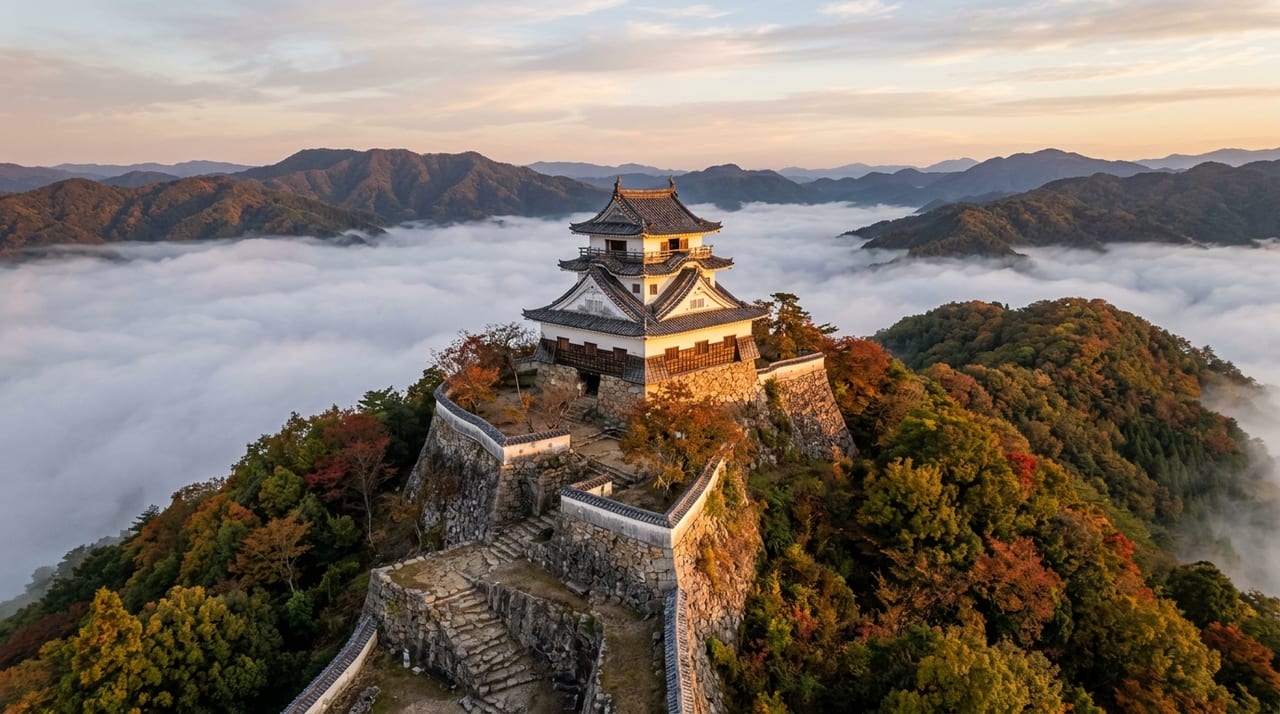
 * Image is for illustrative purposes only.
Kozukue Castle
小机城
Kozukue Castle is a historic castle in the Kantō region (Muromachi to Sengoku period (possibly founded in the Eikyō era; abolished after the 1590 Odawara campaign)). Its lord was The Later Hōjō clan (the Kuno-Hōjō and Kozukue-Hōjō lines); castellans of the Bitchū-Kasahara family, beginning with Kasahara Nobutame.
Overview
Overview
Kozukue Castle stood in Kozukue-chō, Kōhoku Ward, Yokohama — historically Tachibana District in Musashi Province. A hilltop castle of renkaku (linked-bailey) layout, it occupied a peninsular ridge overlooking the Tsurumi River, its baileys strung in sequence and ringed with earthen ramparts and dry moats. It ranks among the largest castles ever built within the area of present-day Yokohama, and in the Sengoku period it served as a key stronghold of the Later Hōjō clan in southern Musashi.
Ōta Dōkan's Siege
The date of construction is unclear, though one view holds that the Uesugi built it in the Eikyō era of the early fifteenth century. The castle first appears clearly in the records with the fighting of 1478: during the Nagao Kageharu rebellion, Ōta Dōkan, house steward of the Ōgigayatsu-Uesugi, attacked Kozukue and took it after a siege of roughly two months — an episode indicating that the castle was already substantial and strongly held.
Later Hōjō Rule in Southern Musashi
Around 1524 Hōjō Ujitsuna repaired and revived the castle, bringing it under Later Hōjō control. Members of the Hōjō family from the Kuno-Hōjō and Kozukue-Hōjō lines held it as lords, while the post of castellan passed through generations of the Echizen-no-kami branch of the Bitchū-Kasahara family, beginning with Kasahara Nobutame. A retainer corps known as the Kozukue-shū was organized here, making the castle a military and administrative hub of Hōjō authority in southern Musashi. During the Odawara campaign of 1590 the castle was surrendered without fighting, and it was abolished after Tokugawa Ieyasu entered the Kantō.
Layout and Surviving Earthworks
The site preserves an unusually complete range of features: cross-cuts, lateral moats, dry moats, earthen ramparts, gate works, earthen bridges, turret platforms and belt baileys. The dry moats are the highlight, exceeding ten meters in depth in places and slicing deep into the ridge to partition the interior. The scheme of enclosing the baileys within a double line of rampart and dry moat exemplifies the Hōjō approach to fortification, which built its defenses out of shaped earth rather than stone, and makes the site a rare place to experience a Sengoku-period castle of the Kantō firsthand.
Recent Excavations
The City of Yokohama carried out excavations at the site in fiscal 2023 and 2024. In the dry moat on the north side of the west bailey, Sengoku-period moat walls were identified, yielding concrete data on the shape and scale of the ditch. Potsherds thought to predate the Later Hōjō era were also recovered, adding new evidence to the debate over when the castle was first established.
Present State
The grounds are maintained as the Kozukue Castle Ruins Citizens' Forest, where paths through bamboo and mixed woodland bring visitors right up to the baileys and moats. On 15 May 2006 the area was designated a Kanagawa Prefecture Special Green Space Conservation District, securing its protection as green space. Though it carries no historic-site designation, it was chosen in 2017 as No. 125 of the Continued Top 100 Japanese Castles, and the annual Kozukue Castle Ruins Festival keeps it alive locally as a piece of the district's heritage.
Connection to Swords
No sword is recorded as having been passed down at Kozukue Castle. Yet the Later Hōjō, who held the castle as their stronghold in southern Musashi, occupy a place in the history of the Japanese sword that cannot be overlooked. Sagami Province, the Hōjō heartland, was the home of the Sōshū tradition that produced Masamune in the Kamakura period. When that tradition lost its former vigor in the late Muromachi era, a line of smiths who had moved from Kamakura to Odawara carried the work forward; their output is known as Sue-Sōshū, or Odawara-Sōshū. Its leading name is Tsunahiro, and the "tsuna" of the first generation's name is said to have been bestowed by Hōjō Ujitsuna, the clan's second head. Under the patronage of the rising Later Hōjō, the smiths of Odawara laid their foundations, offering one model of how sword production took root in a Sengoku daimyo's castle town. The second-generation Tsunahiro was later retained by Tokugawa Ieyasu, and the Tsunahiro line continued forging through the Edo period and into the Meiji era. Kozukue Castle was repaired and revived by Hōjō Ujitsuna and garrisoned by the retainer corps known as the Kozukue-shū. Behind the swords worn by the warriors of Musashi and Sagami who manned it lay this Sōshū smithing centered on Odawara. No famous blade can be traced to the castle itself, but as a fortress within the Later Hōjō domain, Kozukue belonged to the same political sphere in which the successors of the Sōshū tradition were nurtured.
Highlights
- Dry moats over ten meters deep — the finest expression of Hōjō earthwork fortification, cut straight through the ridge
- Double ramparts and linked baileys — a Kantō Sengoku layout built from shaped earth rather than stone
- Kozukue Castle Ruins Citizens' Forest — walking paths through bamboo and woodland lead right to the earthworks
- No. 125 of the Continued Top 100 Japanese Castles — selected in 2017 despite carrying no historic-site designation
- Recent excavations — Sengoku-period moat walls and early potsherds identified north of the west bailey
* Opening hours and admission fees are subject to change. Please check the official website before visiting.