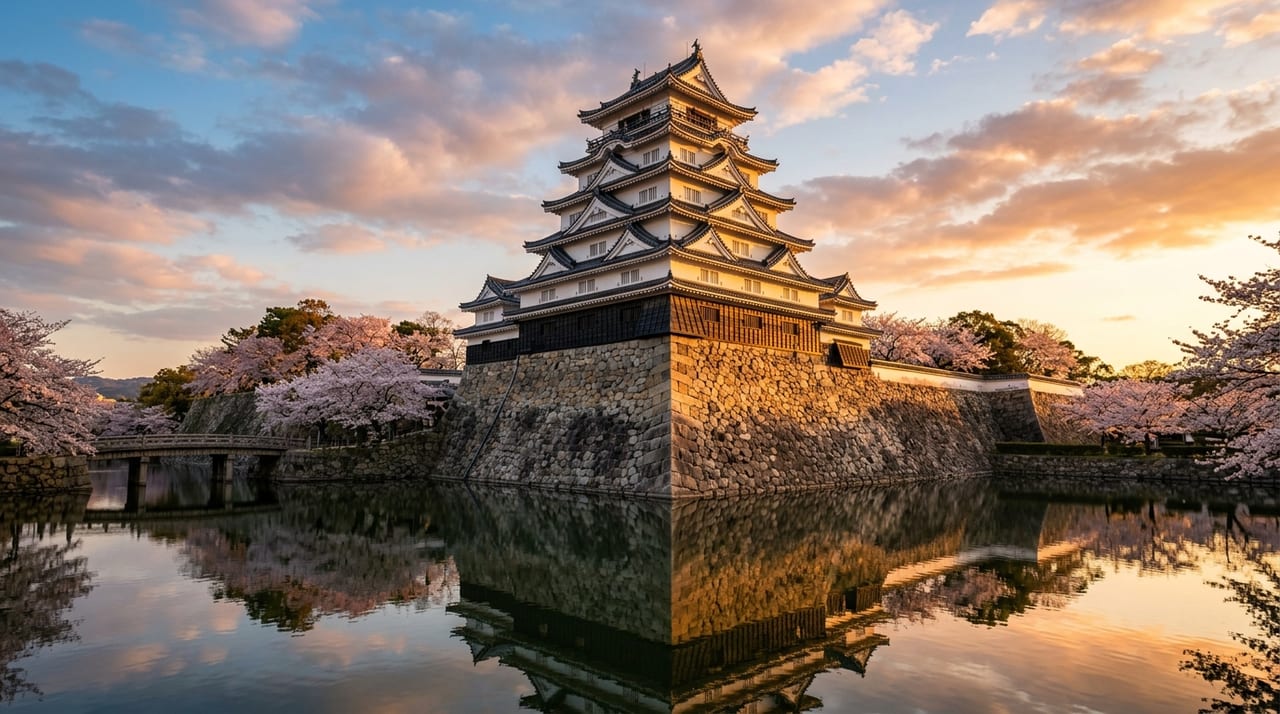
 * Image is for illustrative purposes only.
Tatebayashi Castle
館林城
Tatebayashi Castle is a historic castle in Kantō dating from the Founded in the Sengoku period; Sakakibara Yasumasa became lord in 1590; abandoned in the Meiji era, whose lord was Sakakibara Yasumasa (later Tokugawa Tsunayoshi, the Akimoto clan, and others).
Overview
Overview
Tatebayashi Castle was a flatland fortress built in what is now Jōmachi, Tatebayashi City, Gunma Prefecture, situated in a naturally defensible area surrounded by the Yada River, a tributary of the Tone River, and the surrounding marshland. Its founding date is debated, but records show it was held during the Sengoku period by local Kōzuke lords such as the Akai and Nagao clans.
Sakakibara Yasumasa and Early-Modern Reconstruction
When Tokugawa Ieyasu took control of the Kanto region in 1590, Sakakibara Yasumasa — one of the Tokugawa Four Guardian Kings — became lord of Tatebayashi Castle with a stipend of 100,000 koku. Yasumasa developed the castle town and rebuilt the castle into an early-modern fortress with stone walls and a keep, ruling the domain until his death at Tatebayashi in 1606.
Tokugawa Tsunayoshi and Later Lords
Throughout the Edo period, Tatebayashi domain held an important position for the shogunate. In 1661, Tokugawa Tsunayoshi, the fourth son of Tokugawa Iemitsu, became lord of Tatebayashi before later becoming the fifth shogun. After Tsunayoshi's ascension, the domain was governed by a succession of fudai daimyo households allied with the shogunate, with the Akimoto clan holding it until the Meiji Restoration.
Present State
The castle was abandoned in the Meiji era and most of its structures were lost, but the Tsuchihashi Gate of the third bailey (San-no-maru) has been reconstructed, and portions of its earthworks survive. The former castle grounds today house Tatebayashi City Hall, a cultural center, and a children's museum, and the site is preserved as a Tatebayashi City Historic Site.
Connection to Swords
Sakakibara Yasumasa, lord of Tatebayashi Castle, is said to have carried two named blades: "Sakakibara Masamune" and "Shikibu Masamune." The Sakakibara Masamune is said to have originally been a long tachi that was shortened for practical battlefield use; after Yasumasa's death it passed to Fukushima Masanori and, following the Battle of Sekigahara, to the Shimazu clan of Satsuma, where it was preserved as a family heirloom until it was reportedly destroyed during World War II. The Shikibu Masamune is remembered as a katana emblematic of Yasumasa's status as one of the Tokugawa Four Guardian Kings. For Yasumasa, as lord of Tatebayashi Castle, carrying blades by the master smith Masamune was an expression of his standing as a warrior within the Tokugawa house.
Highlights
- Tsuchihashi Gate — a reconstructed gate in the third bailey (San-no-maru)
- Earthworks — surviving remains tracing the castle's layout
- Ties to Tokugawa Tsunayoshi — he served as domain lord before becoming shogun
- Tatebayashi City Hall area — city facilities now stand on the former main and second bailey sites
* Opening hours and admission fees are subject to change. Please check the official website before visiting.