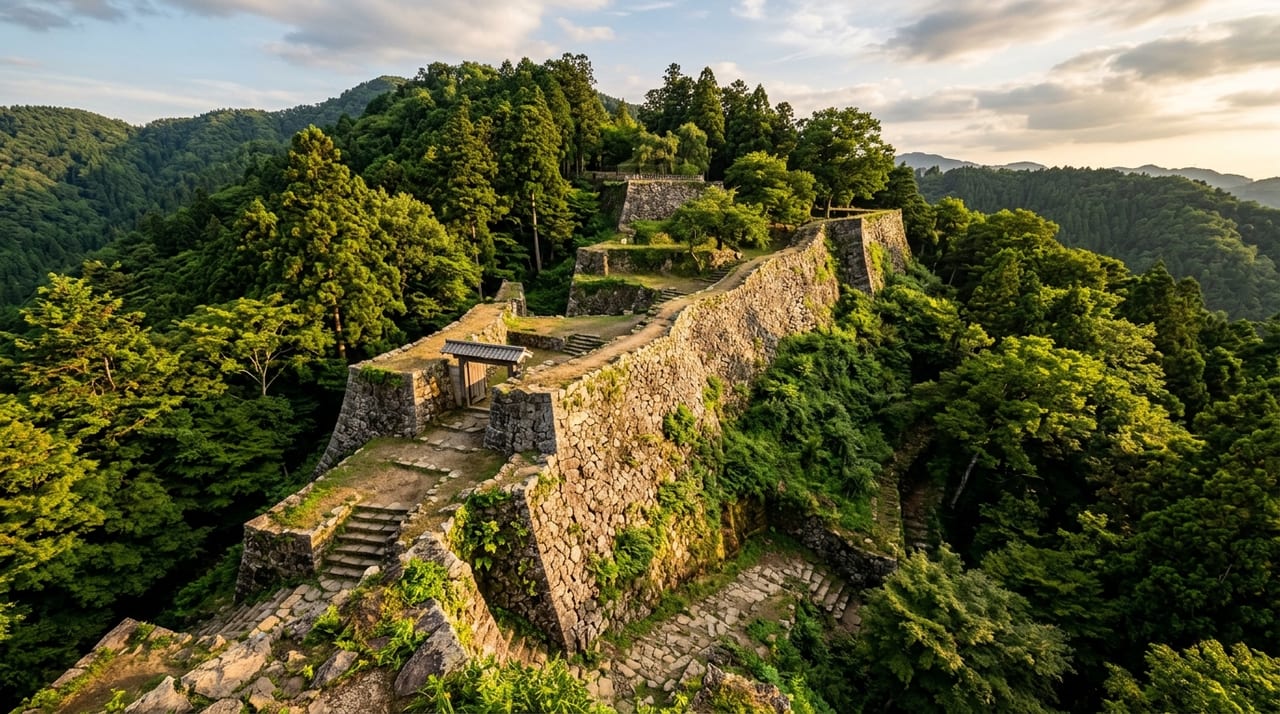
 * Image is for illustrative purposes only.
Hachioji Castle
八王子城
Hachioji Castle is a historic castle in the Kantō region (Built in the Tenshō era (1573–1590)). Its lord was Hōjō Ujiteru.
Overview
About the Castle
Hachiōji Castle is a mountain castle of the Later Hōjō built on Mt. Fukasawa (Shiroyama, elevation approx. 460 m) in Hachiōji, Tokyo. It is recorded in the history of the Kantō Sengoku period as one of its most dramatic falls. Built by Hōjō Ujiteru during the Tenshō era (1573–1590), it was the largest mountain castle among the branch castles of the Later Hōjō, whose main castle was Odawara Castle. Hachiōji sat at a key point on the Kōshū Dōchū highway (Kōshū Kaidō), controlling the transportation axis linking Kai (Yamanashi), held by the Takeda clan, with the Hōjō's Kantō domain. It was a castle of great military importance.
Construction and Layout
As a commander holding the front line that guarded the border region of Musashi, Sagami and Kai, Ujiteru bore central responsibility for the defense of Kantō, working alongside his older brother Hōjō Ujimasa at Odawara. Hachiōji Castle had a composite layout of multiple enclosures, stone walls, dry moats and earthen ramparts centered on the Goshuden at the summit. It functioned as an impregnable fortress that made maximum use of the natural terrain.
Fall in Tenshō 18 (1590)
On July 24, 1590 (Tenshō 18/6/23), in response to Toyotomi Hideyoshi's Odawara campaign, the allied Toyotomi forces led by Maeda Toshiie and Uesugi Kagekatsu attacked Hachiōji Castle. The castellan, Hōjō Ujiteru, was holed up in Odawara Castle, and the garrison left at Hachiōji was under the chief retainers Yokochi Kenmotsu and Nakayama Ienori. Whereas about 3,000 people, including residents, had holed up inside the castle, the attacking side is said to have numbered 15,000 (estimates of the numbers vary). After fierce fighting, the castle fell that very day. It is said that not only the warriors inside but also many women and children took their own lives or threw themselves into Goshuden Falls, and that the blood from this stained the Shiroyama River red.
Downfall of the Hōjō
This tragedy is still passed down today as the "Curse of Hachiōji Castle," and the castle ruins are known as a paranormal hotspot said to be haunted. Shortly after the fall of Hachiōji Castle, Odawara Castle also surrendered, and the Later Hōjō were destroyed. Hōjō Ujiteru committed seppuku at Odawara together with his older brother Ujimasa, and the Later Hōjō's rule over Kantō, spanning five generations and a century, came to an end.
Remains of the Castle
The remains of Hachiōji Castle are carefully protected today as a national historic site, and the stone walls, gateways and falls of the Goshuden have been maintained and opened to the public. Following the Shiroyama River upstream from National Route 20, rough-stacked stone walls appear throughout, creating a landscape that retains the strong character of a medieval mountain castle. The stone paving and walls of the Goshuden site were excavated and restored in the Heisei-era restoration project, conveying the scale of the original residence to the present day.
Ruins Amid Serene Nature
The castle site lies at the foot of Mt. Takao, surrounded by rich nature despite being close to Tokyo. The site shows different faces through the seasons, with cherry blossoms in spring, fresh greenery in early summer and autumn foliage, and has become a popular destination not only for history enthusiasts but also for hikers. It is the largest surviving medieval castle ruin within Tokyo, and there is no other place near the capital where one can experience a mountain castle site of this scale.
Connection to Swords
As the largest Sengoku daimyo in Kantō, the Later Hōjō held a distinctive importance in sword culture as well. Hachiōji Castle, defended by Hōjō Ujiteru, was the most important hub of the military and commercial route that linked the Takeda domains of Kai and Shinano with the Later Hōjō's Kantō via the Kōshū Dōchū highway. To maintain the armament of their retainer corps, the Later Hōjō required large quantities of swords and armor, and they both protected swordsmiths within their domain and procured swords from various regions. The practical quality standards for swords that the Hōjō valued most reflect their nature as a fighting force that waged war against neighboring provinces for decades. The tragedy at the fall of Hachiōji Castle (the blood of the Shiroyama River) is one of the historical events that most directly shows how seriously the warrior's sword played its role on the battlefield. The castle's garrison commander, Nakayama Ienori, died a heroic death in battle. The Nakayama family afterward served the Tokugawa, and descendants continued in service to the Mito Tokugawa family and as hatamoto. Many samurai on the Hōjō side lost their lives in the fall of Hachiōji Castle. The Sōshū tradition (Kanagawa Prefecture) was a major production center that produced history's greatest swordsmiths, including Masamune, Sadamune and Akihiro, and the Kantō and Sagami lands ruled by the Later Hōjō deeply overlap with the home ground of the Sōshū tradition. Today, the Hachiōji Castle Ruins Guidance Facility presents exhibits on the castle's history and the Hōjō samurai culture, where visitors can learn about the tragedy of the fall. There is no other place in Tokyo where one can walk through a mountain castle site of this gravitas while experiencing the history of Sengoku sword culture.
Highlights
- Stone Walls and Gateways of the Goshuden Site — restored residence remains of the Later Hōjō, with impressive rough-stacked stone walls
- Legend of the Blood-Stained Shiroyama River — the historic site where many lives were lost in the fall of the castle in Tenshō 18 (1590)
- Hiking Amid Rich Nature — strolling the castle ruins wrapped in the greenery at the foot of Mt. Takao
- Hachiōji Castle Ruins Guidance Facility — exhibits on the castle's history and the Hōjō samurai culture
- Mt. Takao (nearby) — a sacred mountain with three Michelin stars, combining with the castle ruins for a historical and natural experience near Tokyo
* Opening hours and admission fees are subject to change. Please check the official website before visiting.