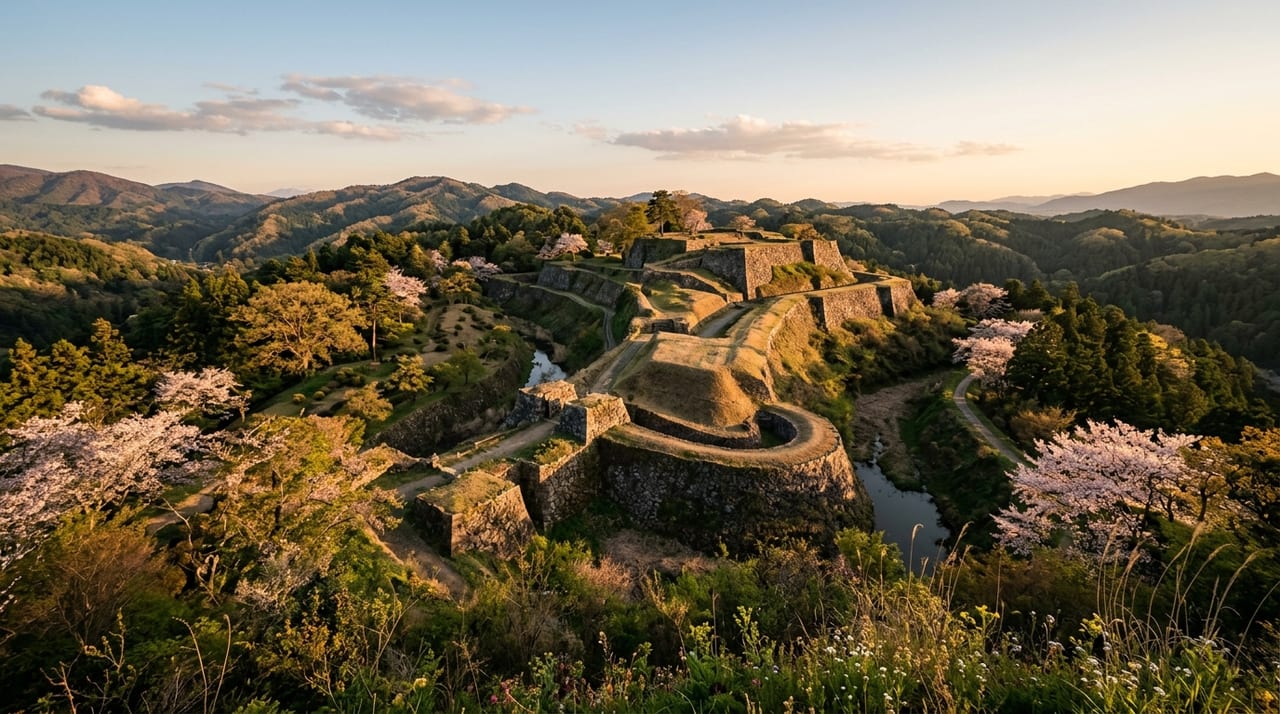
 * Image is for illustrative purposes only.
Minowa Castle
箕輪城
Minowa Castle is a historic castle in the Kantō region (Founded 1512 (Eishō 9) by Nagano Narihisa (another theory: 1526 by Nagano Nobunari); subsequently held by Takeda Shingen, Oda, Hōjō, Tokugawa, and Ii Naomasa). Its lord was Nagano Narimasa → Takeda Shingen → Oda → Hōjō → Tokugawa Ieyasu → Ii Naomasa.
Overview
Minowa Castle is a hirayamajiro (hilltop castle) located in Takasaki City (former Misato-machi), Gunma Prefecture, and is one of the largest-scale castle fortifications of the Sengoku period in Kōzuke Province (present-day Gunma Prefecture). The castle was built on a plateau extending from the southern foot of Mt. Haruna, and through an intricate layout combining dry moats, earthen ramparts, and stone walls, it formed a vast castle domain. Currently preserved as a National Historic Site, it is highly regarded as one of the Kantō region's finest Sengoku-period castle ruins based on its scale and excellent preservation condition.
The castle is said to have been built by Nagano Narihisa; his grandson Nagano Narimasa, a powerful local lord of Kōzuke Province, made Minowa Castle his base and held sway over western Kōzuke. Narimasa is said to have repelled all six of Takeda Shingen's invasions, earning such renown that Shingen is recorded as lamenting, "As long as Narimasa alone lives, Kōzuke cannot be conquered." However, after Narimasa's death, his successor Narimori succumbed to Takeda pressure in Eiroku 9 (1566), and Minowa Castle fell into the hands of the Takeda.
Thereafter, the castle was garrisoned by Shingen's direct vassals, but after Shingen's death and the Takeda's subsequent collapse, the castle lords changed in rapid succession—Oda, Hōjō, then Tokugawa. The final castellan was Ii Naomasa, one of Tokugawa Ieyasu's Four Heavenly Kings, who received Minowa Castle with 120,000 koku in Tenshō 18 (1590); when he moved to Takasaki Castle in Keichō 3 (1598), Minowa Castle was abandoned. The ruins are now maintained as a National Historic Site and attract numerous visitors throughout the year.
Connection to Swords
Minowa Castle's connection to swords and arms involves both its last lord, Ii Naomasa, and the period when the Takeda used it as their base for ruling Kōzuke.
Ii Naomasa was a renowned commander famed for the "Ii red troops" (Ii no akazonae). His elite units, whose armour was uniformly lacquered red, are said to have been modelled on the red troops of the Takeda under commanders such as Yamagata Masakage. Daimyō heirlooms of the Ii family, including armour and swords, are now held by the Hikone Castle Museum.
In the Takeda period, Minowa Castle served as the base for ruling Kōzuke, with Amari Masatada, Sanada Yukitaka, Asari Nobutane and Naitō Masatoyo among its castellans. Naomasa moved to Takasaki Castle in Keichō 3 (1598), and Minowa Castle was abandoned. Throughout its history, Minowa was a castle associated with the Takeda and the Ii, two of the most vivid bearers of warrior culture in Japanese history, which makes it an important place for the history of swords and arms as well.
Highlights
- Main to third bailey dry-moat complex (National Historic Site) — among the best-preserved Sengoku-era moat systems in the Kantō region
- Great trench (ōhorikiri) — one of Minowa's highlights, a large-scale dry moat
- Ii Red Arms heritage — the martial tradition of Minowa's final lord, linking Takeda and Ii warrior culture
- Takasaki Castle connection — the castle to which Ii Naomasa moved in 1598 when he abandoned Minowa
- Mt. Haruna and Haruna Lake — the sacred mountain behind the castle, a Kōzuke spiritual and military landmark
* Opening hours and admission fees are subject to change. Please check the official website before visiting.