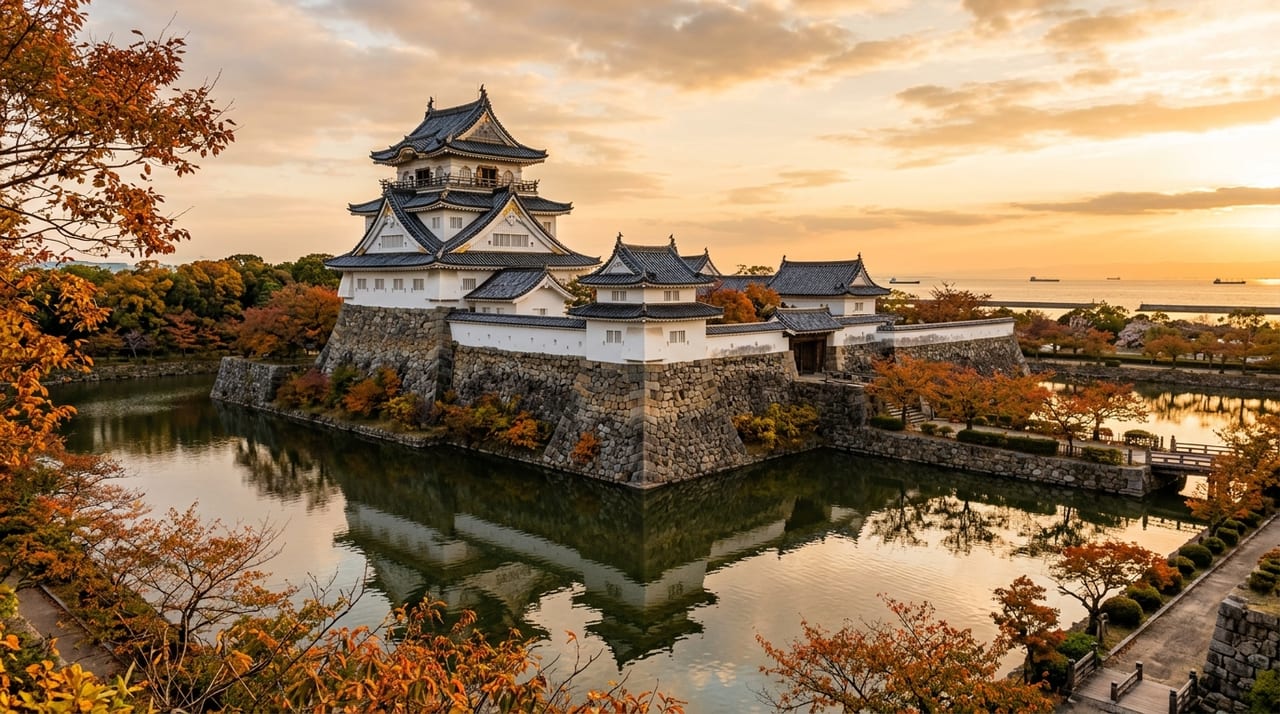
 * Image is for illustrative purposes only.
Iwatsuki Castle
岩槻城
Iwatsuki Castle is a historic castle in the Kantō region (Sengoku to Edo period (ca. 1457–abandoned 1871)). Its lord was Ōta Suketada and Suketoki, the Hōjō clan, and successive daimyo of the Tokugawa house.
Overview
Iwatsuki Castle is a hirayamajiro (flatland-mountain castle) built in Adachi District, Musashi Province (present-day Iwatsuki Ward, Saitama City), and represents a masterpiece of water-castle design that maximized the advantages of the low-lying wetland terrain of the Kantō Plain. There are various theories regarding the castle's founding; the prevailing theory holds that it was built during the chaos of the Kyōtoku Uprising (beginning in 1454) by Ōta Sukekiyō and his son Dōkan of the Ōgigayatsu Uesugi clan, while another account suggests it was constructed by associates of Ashikaga Shigeuji, the Koga kubo. In any case, its foundation is believed to have been solidified between the late 1450s and 1460s. The castle flourished most under Ōta Suketada (1522–1591), functioning as the central base of anti-Hōjō forces in Musashi Province. Suketada coordinated with Uesugi Kenshin while opposing the Gohōjō, navigating the three-way political and military situation in the Kantō region. In Eiroku 7 (1564), Suketada was displaced from his position as domain lord by his eldest son Ujishiro and moved to Matsuyama Castle (present-day Yoshimi), where he continued anti-Hōjō activities. During the Gohōjō's heyday, the castle occasionally fell within their sphere of influence, but after Toyotomi Hideyoshi's Odawara Campaign in Tenshō 18 (1590), Iwatsuki Castle became one of the strongholds under Tokugawa Ieyasu's control when his retainer Takaradori Kiyonaga took command. Following Tokugawa Ieyasu's entry into Kantō that same year, hereditary daimyo succeeded one another as domain lords beginning with Kiyonaga, establishing the Iwatsuki domain. Throughout the Edo period, Iwatsuki was positioned as a key fortress defending Edo's northern approaches, and many of its domain lords held senior bakufu posts such as rōjū or wakadoshiyori. Particularly from the late 17th century through the Bakumatsu period, the Takaradori, Aoyama, Abe, Itakura, Toda, Matsudaira, Ogasawara, Nagai, and Ōoka clans served in succession as daimyo, and the Iwatsuki domain, valued at approximately 100,000 koku, made significant contributions to bakufu governance. The castle fortifications employed a sophisticated defensive system combining water moats and marshland; the honmaru, ninomaru, and sanomaru were surrounded by water moats in a typical flatland-castle configuration. In particular, the Minuma wetland that spread throughout the Iwatsuki area (currently around the Minuma Substitute Channel) functioned as a natural moat, making enemy approach difficult. With the abolition of the domains in Meiji 4 (1871), the castle was abandoned, and most of its buildings were dismantled or relocated. Today it is developed as Iwatsuki Castle Ruins Park, with portions of earthen ramparts, dry moats, and water moats preserved. Additionally, the "Uramono" (rear gate), relocated from within the former castle (a valuable surviving structure of Iwatsuki Castle), is preserved within the city. Iwatsuki has been renowned since the Edo period as the "Town of Dolls" and developed as a major production center for hina dolls and May festival dolls destined for Edo. Regarding sword connections, the influence of the Musashi smiths that the Ōta clan patronized was considerable, and there are records of smithsmiths in the castle town engaging in the production of tachi and katana. Furthermore, Iwatsuki domain lords frequently bore fine swords during Edo Castle ceremonies, fostering a culture of sword collecting and connoisseurship within the domain.
Connection to Swords
As a Sengoku daimyo skilled in military strategy, Ōta Suketada valued the practical effectiveness of blades and invested effort in protecting and cultivating Musashi smiths. Smiths in Iwatsuki's castle town followed the lineage of the Musashi-gata smiths prevalent in Musashi Province, producing functional battle blades centered on katana and wakizashi. During the Edo period, Iwatsuki's daimyo frequently participated in bakufu ceremonies, fostering a culture of distinguished blade collecting and appreciation at the domain-lord level. Since Iwatsuki prospered as a supply route to Edo, it attracted many craftsmen related to swords—blade merchants (togishi), and grip wrappers.
Highlights
- A premier water castle of the Kantō, leveraging moats and marshland
- A stronghold of anti-Hōjō resistance under Ōta Suketada
- A key fortress protecting Edo's northern frontier during the Edo period
- Historical roots of Iwatsuki, the 'Town of Dolls'
- Deep ties to Musashi blade-smithing traditions
* Opening hours and admission fees are subject to change. Please check the official website before visiting.