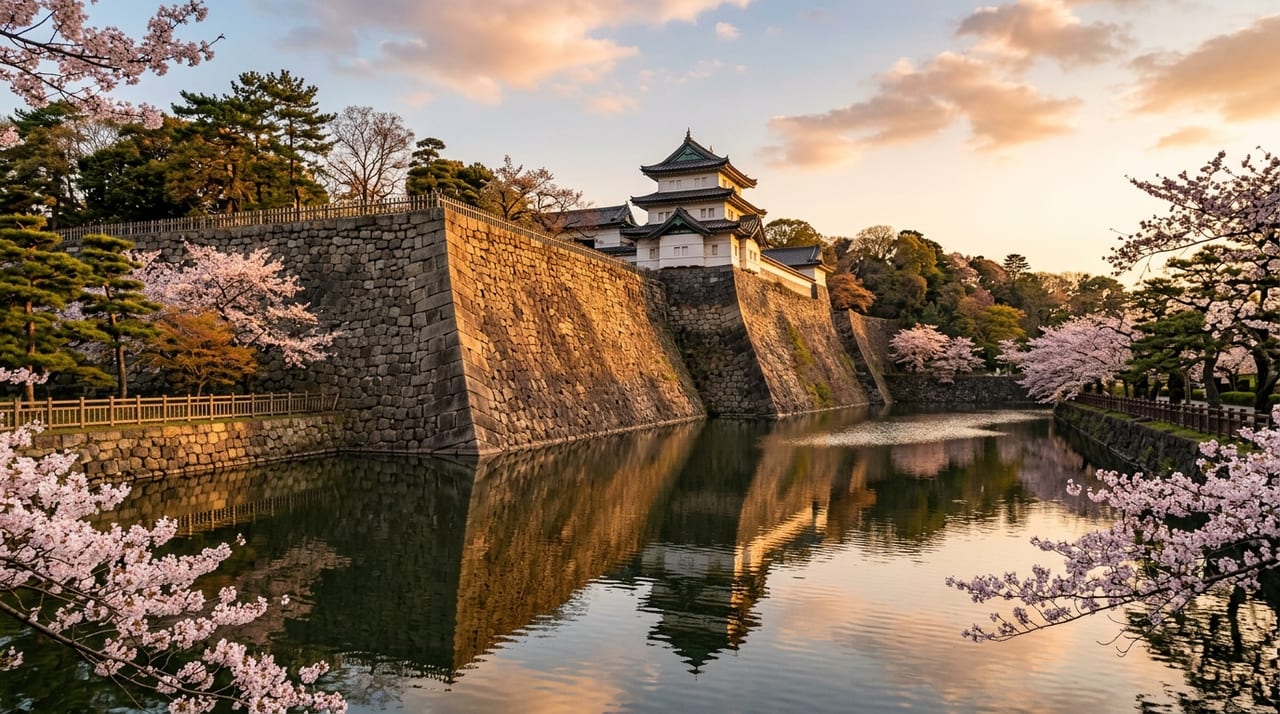
 * Image is for illustrative purposes only.
Edo Castle (Imperial Palace)
江戸城(皇居)
Edo Castle (Imperial Palace) is a historic castle in the Kantō region (Founded 1457 (Chōroku 1); major Tokugawa reconstruction begun 1606 (Keichō 11)). Its lord was Ōta Dōkan / Tokugawa shogunate.
Overview
A Castle Famed Across the Realm — The Founding of Edo Castle and the Tokugawa's Great Reconstruction
Edo Castle originated as a castle built by Ōta Dōkan in Chōroku 1 (1457). From Keichō 11 (1606), it was developed on a large scale through the tenka-bushin (nationwide construction levy) under three generations of the Tokugawa: Ieyasu, Hidetada, and Iemitsu. The completed Edo Castle became the largest castle in Japan, with extensive moats, stone walls, and enclosures lining its perimeter. Its castle town grew into Edo, one of the world's leading large cities, with a population over 1 million.
The main keep (tenshu), completed in the era of the third shogun Iemitsu (Kan'ei period), was the largest main keep of early modern castles, standing about 60 m tall including its stone base. However, this magnificent main keep was destroyed in the great fire of Meireki 3 (1657) (the Meireki Great Fire, also known as the Furisode Fire), and it was never rebuilt. Only the main keep base remained until the end of the Edo period. The reason it was not rebuilt is said to be a political judgment that 'a main keep was unnecessary in an age of peace.' This itself is an interesting phenomenon showing the transformation of warrior culture in a peaceful era.
Kyōhō Meibutsuchō — The Hall of the Shogunal Sword Collection
Edo Castle was the place where Japan's largest sword collection was assembled. Successive Tokugawa shoguns devoted extraordinary passion to collecting famous swords, and through presentations from and grants to the daimyō, the realm's famous swords gathered at Edo Castle.
Of particular importance is the Kyōhō Meibutsuchō, compiled during the Kyōhō era (1716–1736) under the eighth shogun Yoshimune by sword appraisal specialists including Hon'ami Kōchū. It is a major catalog that systematically organizes the famous swords of the entire country. It records each sword's gō (the name given to a sword), owners, provenance, dimensions, and appraisal inscriptions, and it is one of the most important extant sword historical sources. Many of the swords recorded in the Kyōhō Meibutsuchō had deep connections to the shogunal family or the bakufu, and not a few passed through Edo Castle to daimyō houses across the country.
Swords by famous masters of the realm, including Masamune, Yoshimitsu, and Yoshihiro, gathered in the hands of the shogunal family and were stored in the o-kanegura and o-hōzōgura storehouses of Edo Castle. The granting of swords from shogun to daimyō was an important political ritual, and which sword was given to whom carried subtle political messages. Records also survive of the Date family receiving swords from the Tokugawa shogunal family, and Edo Castle is deeply connected to the sword culture of Sendai, where TOUKENZA is based.
The Scale of the Castle — Stone Walls and Moats of Japan's Largest Castle
The outer perimeter of Edo Castle extended about 15.7 km, and the overall scale, including the inner moat, outer moat, and the outer works (sōgamae), was unmatched by any other castle. Parts of the Honmaru, Ni-no-maru, and San-no-maru, now open to the public as the Kōkyo Higashi Gyoen, retain Tokugawa-period stone walls, the main keep base, the Ōbansho, the Hyakunin-bansho, and the Dōshin-bansho guardhouses. The area also preserves castle gates including Sakuradamon, Tayasumon, and Shimizumon.
The main keep base in particular is a massive stone wall about 11 m high, which evokes the grandeur of the main keep in its time. The stones used in the walls were quarried by daimyō from the Izu Peninsula and shipped by sea as part of the tenka-bushin. The series of stone walls running from the Ōtemon gate to the Honmaru is evaluated as one of the pinnacles of the beauty of Japanese castle stone walls.
Edo Castle and Warrior Culture — The Shogun's Seat of Government with Swords at the Waist
Edo Castle was both the seat of government from which the shogun directed the administration of the bakufu and the place where the highest ceremonial etiquette of warrior society was carried out. At audiences with the shogun (o-menami), daimyō and hatamoto wore prescribed ceremonial dress and entered the castle with a long and short sword at the waist. This custom of wearing swords was the most visible indicator of samurai status, and Edo Castle was its symbolic stage.
The shogun's swords were called o-koshimono and received special treatment. The sword worn by the shogun was called the o-sashiryō, and the finest examples, appraised by the Hon'ami family, were selected. The post of koshimono-bugyō, which managed the shogun's swords, was established, showing that swords were built into the political system as symbols of shogunal power.
Edo Castle After the Meiji Era — Writing a New History as the Imperial Palace
Since the relocation of the Emperor Meiji to Tokyo in Meiji 1 (1868), Edo Castle has served as the Imperial Palace and the residence of the imperial family. The inner moat and many of the Edo-period stone walls remain today, and as a historical space remaining in the city center, it is among the largest of its kind in the world. The Kōkyo Higashi Gyoen is open to the public, and visitors can see the remains of the Honmaru, Ni-no-maru, and San-no-maru free of charge. The Ni-no-maru Zōkibayashi (secondary woodland) shows a different appearance in each season and is loved by Tokyo residents as an oasis in the city center.
The Nijūbashi bridge at the Kōkyo Gaien (outer gardens of the Imperial Palace) is one of the landscapes representing Tokyo. In cherry blossom season, the cherry trees reflected on the water of Chidorigafuchi are known around the world as a symbol of spring in Japan.
Connection to Swords
As the castle of the Tokugawa shogunal family, the greatest sword patrons in Japan, Edo Castle held a central position in Japanese sword culture. The sword collection of the shogunal family was of unprecedented scale, and its contents are recorded in documents including the Kyōhō Meibutsuchō.
The Kyōhō Meibutsuchō records 274 famous swords, including those that had been destroyed by fire at the time of compilation and those added later. It lists items held by the Tokugawa shogunal family, the gosanke, and daimyō houses such as the Maeda family of Kaga and the Kuroda family of Fukuoka. Among the recorded swords are many works by the supreme masters of the old swords, including Masamune, Yoshimitsu, and Yoshihiro. This catalog is not merely a list. It is an official document that established the hierarchy of authority over Japanese swords in the Edo period, and it still functions as a fundamental reference in sword appraisal today.
The granting of swords from the shogun to the daimyō was an important political ritual. Especially for swords granted to daimyō who traveled to Edo under the sankin-kōtai system, the sword was a token of the shogun's trust and was treated with great care within the household. Such granted swords had their provenance clearly conveyed through origami and records, and they required a dignity completely different from that of other swords.
The Hon'ami family, which held a monopoly on sword appraisal, served at Edo Castle and supported the management of the shogun's swords. The origami that the Hon'ami family attached was the highest authority that officially certified the value of a sword, and it is the prototype of today's sword appraisal certificates. It can be said that the shogunal family at Edo Castle created the very value system of Japanese swords.
The relationship between the Sendai Date family and Edo Castle was close through the institution of sankin-kōtai. Date Masamune treasured the swords he received from the shogun, and the sword collection of the Sendai domain included items that originated at Edo Castle.
Today, some of the swords that were passed down in the Tokugawa shogunal family are held by the Tokyo National Museum, the Sannomaru Shōzōkan, and other institutions. Combined with a visit to the Kōkyo Higashi Gyoen, the best places to learn the history of Japanese swords are concentrated in central Tokyo.
Highlights
- Tenshudai (main keep base) — the site of Edo Castle's main keep, once Japan's largest, and a massive stone wall rebuilt after the Meireki Great Fire, though the main keep itself was never rebuilt
- Kōkyo Higashi Gyoen (free admission) — a historic site in the city center where the remains of the Honmaru, Ni-no-maru, and San-no-maru can be viewed up close
- Hyakunin-bansho and Ōbansho — guardhouses of the elite guards who protected the shogun, conveying the realities of Edo Castle's security
- Sakuradamon (Important Cultural Property) — the site of the late-Edo assassination of Ii Naosuke, and an extant castle gate of Edo Castle
- Kōkyo Gaien (outer gardens of the Imperial Palace) and Chidorigafuchi — the cherry blossoms of spring, world-famous and the emblem of Tokyo's spring scenery
- Sannomaru Shōzōkan (Museum of the Imperial Collections) — a museum holding art objects, crafts, and swords connected with the imperial family
* Opening hours and admission fees are subject to change. Please check the official website before visiting.