New Arrivals — Browse our catalog for the latest authentic Japanese sword arrivals. Browse →
15th day, 1st month, Bunkyū 2 (February 13, 1862)
Sakashitamon Gate of Edo Castle (present-day Chiyoda Ward, Tokyo)
Forces
Mito Rōnin and others (Sonnō-Jōi Faction)
Shogunate Procession
About 13 min read
In the Ansei Purge of Ansei 6 (1859), Ii Naosuke suppressed the pro-imperial, anti-foreign faction. In the 3rd month of the following year, Ansei 7 (1860), he was assassinated in the Sakuradamon Gate Incident, and the Edo shogunate faced a serious loss of authority. To overcome this crisis, the senior councilor (rōjū) of the time, Andō Nobumasa, vigorously pursued a bold policy called kōbu gattai (union of court and shogunate).
Kōbu gattai was a line in which the imperial court (kō) and the shogunate (bu) would join hands to deal with the expulsion question. As its symbolic measure, it was decided that Princess Kazunomiya, younger sister of Emperor Kōmei, would be married to the shogun, Tokugawa Iemochi. In the 10th month of Bunkyū 1 (1861), Princess Kazunomiya left Kyoto and traveled to Edo.
However, this marriage provoked fierce backlash from the expulsionists. Their logic was that giving an imperial princess to a shogunate that had let foreigners into the country was a national disgrace. Voices grew louder claiming that the kōbu gattai policy was disrespect toward the imperial house and a treasonous act that would cost Japan its independence. The pro-imperial, anti-foreign faction of the Mito domain reacted especially strongly.
The Mito domain was the ideological starting point of the late Tokugawa period. The Mito school (Mitogaku), known for the compilation of the Dai Nihon Shi, nurtured a fierce ideology that regarded the emperor as Japan's legitimate sovereign and called for removing external invaders by the sword. The bearers of this ideology scattered as masterless samurai (rōnin) across the country and pursued a radical course of plotting to assassinate shogunal officials.
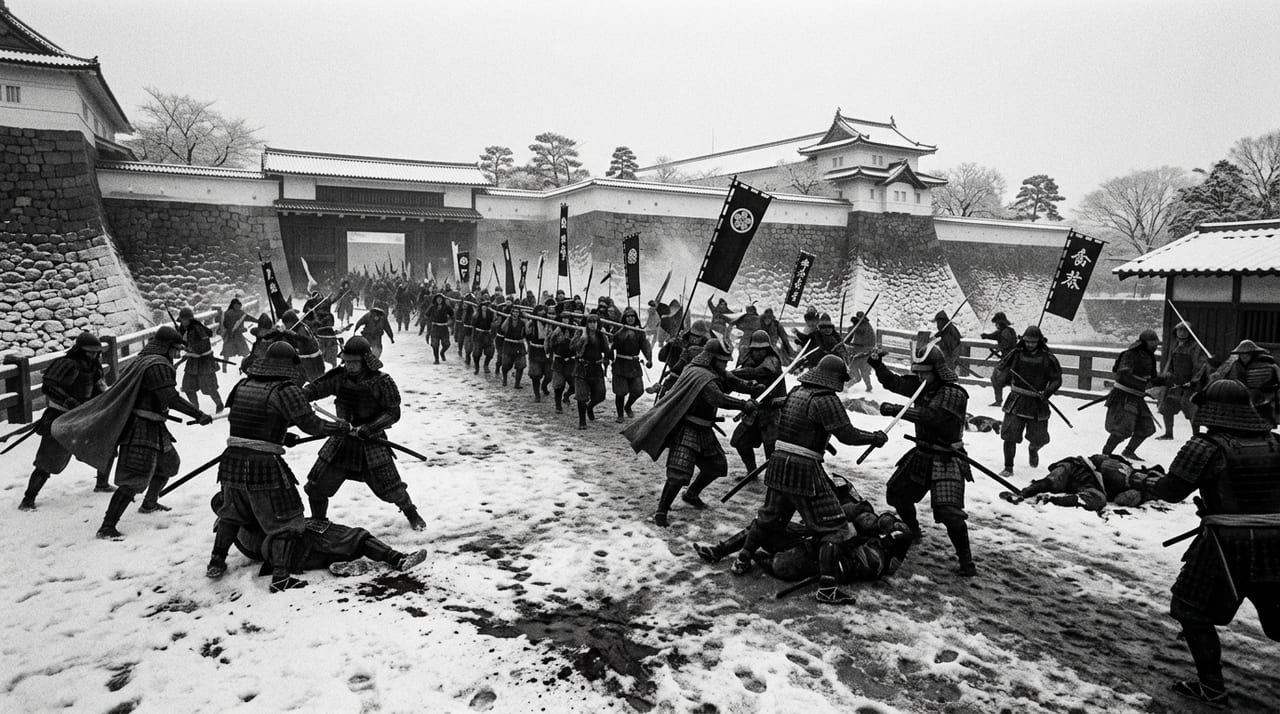
On the 15th day of the 1st month of Bunkyū 2 (1862), on a road outside Sakashitamon Gate of Edo Castle where the morning chill still lingered, the procession of senior councilor Andō Nobumasa was advancing toward the castle. Andō was the lord of the Iwaki-Taira domain (present-day Iwaki City, Fukushima Prefecture) and was running shogunal politics as the central figure of the kōbu gattai policy.
Suddenly, six men charged into the procession. They were mainly Mito masterless samurai who had left their domain, and they were joined by Kōno Kenzō, a physician from Shimotsuke. Ōhashi Totsuan, a Confucian scholar from Utsunomiya who had been the central planner, had been arrested just before the attack. The attackers drew their swords, struck at the samurai guarding the procession, and pressed toward Andō Nobumasa himself.
The guards fought desperately. A melee broke out in sight of Edo Castle. Andō Nobumasa's palanquin was stabbed with swords, and he escaped alone into the castle with a minor wound to his back, so he escaped death.
All six attackers were killed on the spot. Among the guards, a dozen or so were wounded, but none died.
In the Sakuradamon Gate Incident, Ii Naosuke was fully assassinated. In the Sakashitamon Gate Incident, Andō Nobumasa survived. Does that make the Sakashitamon Gate Incident merely a failed attack?
It does not. Andō Nobumasa did survive. However, within several months of the incident he was forced to resign as senior councilor. The reasoning was that a wounded senior councilor remaining in office would damage the "dignity of the shogunate," and his position inside the shogunate deteriorated rapidly.
The more fundamental problem lies in the political meaning of the fact that "the core of the shogunate was attacked by the expulsionists once again." Following the Sakuradamon Gate Incident, the Sakashitamon Gate Incident left a strong impression at home and abroad that the shogunate could not suppress the expulsionists with Tokugawa military power, and this sense of helplessness deepened.
The authority of the shogunate had been protected by the sword. The swords of the samurai guarding the shogun's procession and the swords of the guards protecting a senior councilor failed to function (or were unable to function). This reality shook the foundations of the Tokugawa system, which had lasted more than 250 years.
The Sakashitamon Gate Incident also marks an important turning point in the history of Japanese swords. The Ansei and Bunkyū periods (1850s–1860s) were a time when the return of Japanese swords to actual combat was called into question.
After the mid-Edo period, the long peace caused Japanese swords to take on an increasingly decorative character as "symbols of the samurai," and many beautiful works were made that did not presuppose use in real combat. However, as the turmoil of the late Bakumatsu approached, demand for swords that could "truly cut down a person" rose rapidly.
A swordsmith who preceded this period was Minamoto no Kiyomaro (real name Yamaura Tamaki). Kiyomaro forged swords in the Sōshū-den style until his death in January 1855 (the 11th month of Kaei 7), and because he lived in Yotsuya in Edo, he earned the nickname "Yotsuya Masamune."
Although no concrete records remain of the swords carried by the Mito ronin who took part in the Sakashitamon Gate Incident, the sword culture of the Mito domain deserves attention. In the Mito domain, scholars and swordsmen were united in spirit, and sword training and imperialist thought were inseparably bound together. The swords of the Mito patriots were a symbol of the Bakumatsu spirit, in which thought and action were one.
From immediately after the Sakashitamon Gate Incident, Andō Nobumasa's political position deteriorated rapidly. Criticism of a wounded senior councilor continuing to carry out official duties, pressure from opponents of Princess Kazunomiya's marriage, and a further intensification of the anti-foreign movement all converged, and in the 4th month of Bunkyū 2 (1862), Andō was dismissed from his post as senior councilor.
The kōbu gattai policy collapsed, and in its place the rivalry between the domains of Satsuma, Chōshū and Tosa and the shogunate over political leadership in Kyoto intensified. The Sakashitamon Gate Incident was a watershed showing that the shogunate could no longer control political violence within the country by its own power.
From then on, late Tokugawa politics moved away from Edo and unfolded centered on Kyoto. The conflict between the anti-shogunate movement, which used the emperor's authority as its shield, and the kōbu gattai line eventually led to the civil war known as the Boshin War.
The sequence from the Sakuradamon Gate Incident (1860) to the Sakashitamon Gate Incident (1862) shows the establishment of a culture of assassination by sword in late Tokugawa politics. These two incidents symbolize the transition from a society that had been, in principle, a time of peace throughout the Edo period to one in which the sword again functioned in practice as a tool of political violence.
The era in which the sword changed from the "soul of the samurai" to a "tool of revolution" came to an end with the Haitōrei (Sword Abolishment Edict) of 1876. The Sakashitamon Gate Incident is an important passage in that process, and it stands as evidence of an age in which the Japanese sword lived out its last period of turmoil at the center of history.