New Arrivals — Browse our catalog for the latest authentic Japanese sword arrivals. Browse →
September 14, 1862 (Bunkyū 2, 8th month, 21st day)
Namamugi village, Tachibana District, Musashi Province (present-day Namamugi, Tsurumi-ku, Yokohama)
Forces
Satsuma domain procession (retainers of Shimazu Hisamitsu)
British horse-riders
About 11 min read
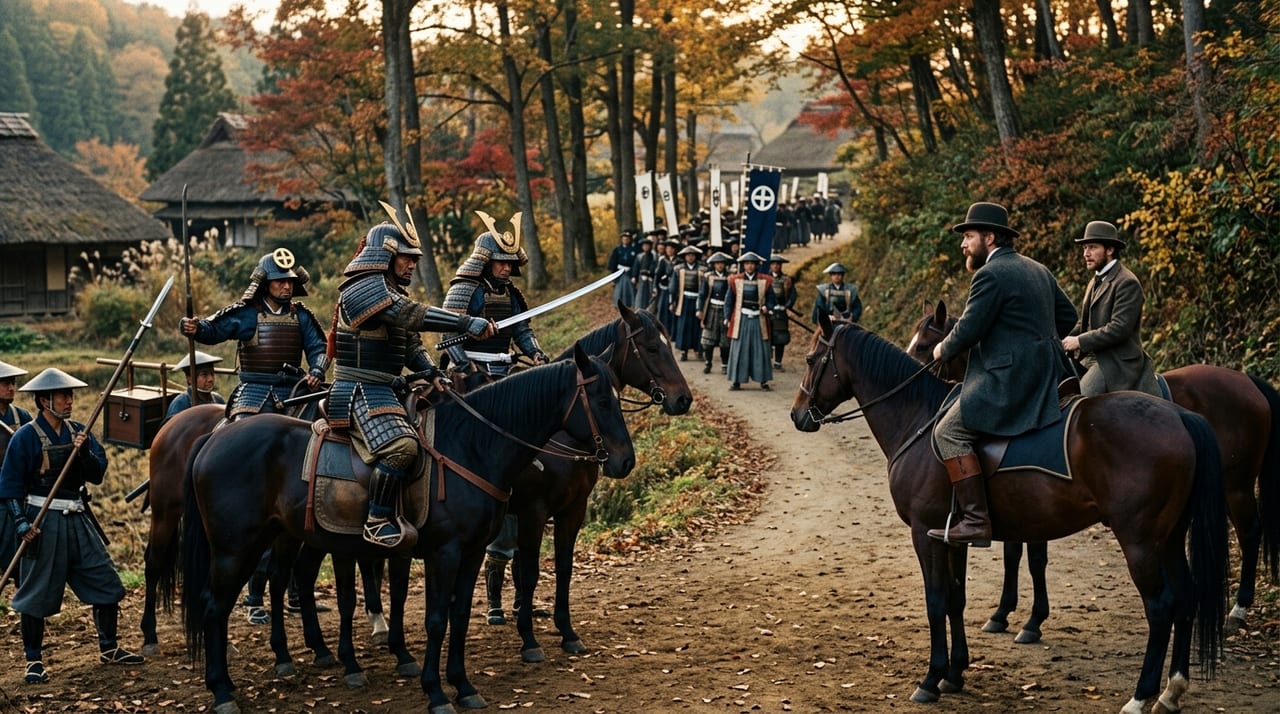
On the afternoon of the 21st day of the 8th month of Bunkyū 2 (September 14, 1862), an instant that changed the course of Japanese history occurred near Namamugi village on the Tōkaidō (present-day Tsurumi Ward, Yokohama City). The British merchant Charles Lennox Richardson, who rode his horse into the procession of Shimazu Hisamitsu, father of the Satsuma domain lord, was slain by Satsuma samurai. This was the Namamugi Incident, the best-known case of an international “incident” involving the Japanese sword in the late Edo period.
In 1862, Yokohama was a rapidly developing treaty port, having grown quickly since the conclusion of the Japan–US Treaty of Amity and Commerce in Ansei 5 (1858). British merchants in the Yokohama foreign settlement made horseback excursions a daily routine and rode freely along the Tōkaidō. Meanwhile, Shimazu Hisamitsu, father of the Satsuma domain lord and the highest leader of domain administration, had led troops up to Kyoto earlier that year. He then traveled down to Edo with the imperial envoy Ōhara Shigetomi and brought about shogunal reform (the Bunkyū Reforms). On the 21st day of the 8th month, he was on his way back to Kyoto after leaving Edo.
At this time, the Satsuma domain placed great value on samurai dignity and pride. Daimyo processions followed strict rules of etiquette, and crossing in front of a procession or “riding over” it was regarded as an insult to the samurai. Foreigners were not widely informed of the etiquette governing processions, or perhaps did not take it seriously, and this became a factor in the tragedy.
The procession that day numbered several hundred men. Four British nationals, including Richardson (aged 29), were riding along the Tōkaidō when they encountered the procession. They were William Marshall, Woodthorpe Charles Clarke, and Mrs. Margaret Borradaile. The samurai at the head of the procession signaled them by gesture to dismount and yield the way. The British, however, believed they had been told to pass along the side, and they pushed forward against the flow of the procession.
When they rode their horses up close to Hisamitsu's palanquin and tried to turn their horses around, several Satsuma samurai drew their swords and attacked Richardson. Richardson, badly wounded, escaped on horseback, but about 200 meters farther on he fell from his horse and was finished off. Marshall and Clarke were also badly wounded but escaped at a gallop. Mrs. Borradaile had only her hat and part of her hair knocked off, and she galloped safely back to the Yokohama settlement.
Narahara Kizaemon is said to have struck first, and Kaieda Nobuyoshi is said to have delivered the final blow. However, the person responsible was never identified, and no punishment was carried out, even after the incident.
The significance of the Namamugi Incident for the history of Japanese sword culture is multifaceted. First, it is a typical example of the Japanese sword functioning as a spiritual and physical weapon of the sonnō jōi movement. Whether the Satsuma samurai drew their swords with a deliberate jōi political intent is a matter of debate. Their action was a samurai-code reflexive response to the “discourtesy” of riding through the procession. Nonetheless, because foreigners were killed by Japanese swords, the incident was widely reported as a symbol of jōi thought.
Second, the Namamugi Incident is also a symbol of the age when Satsuma's sword tradition shone one last time. Smiths of the Naminohira school had long been active in Satsuma, producing distinctively robust blades. Narahara Kizaemon, who is said to have struck Richardson first, was also a samurai reputed to be a master of Yakumaru Jigen-ryū.
After the incident, the British chargé d'affaires, Lieutenant-Colonel Neale, demanded that the bakufu apologize and pay an indemnity of 100,000 pounds. He also notified the Satsuma domain directly that it must punish the offenders and pay an indemnity of 25,000 pounds. The bakufu paid the 100,000 pounds in the 5th month of Bunkyū 3 (1863), but negotiations with the Satsuma domain broke down.
On the 27th day of the 6th month of Bunkyū 3 (1863), a British fleet of seven warships entered Kagoshima Bay. The talks ended without agreement. On the 2nd day of the 7th month, British warships seized a Satsuma domain vessel, and the Satsuma batteries opened fire on the British fleet, beginning the fighting (the Anglo-Satsuma War). Both sides suffered losses, but the outcome taught the Satsuma side the overwhelming power of foreign modern weapons. This experience became a major turning point that led Satsuma to shift from jōi to a policy of opening the country and overthrowing the shogunate.
The Satsuma domain, which had “cut down foreigners with swords” in the Namamugi Incident, came to realize after the Anglo-Satsuma War that “swords cannot defeat cannons.” It later became a leading force in the Meiji Restoration and an active embracer of Western civilization, embodying a paradox of Japan's modernization.
Richardson's body was left at the scene, shocking the foreign community in the Yokohama settlement. The Namamugi Incident was also widely reported in Western newspapers. Some commentary, such as that of The New York Times, held that the fault lay with Richardson, who had disregarded Japanese customs.
Today, the Namamugi Incident monument stands in Namamugi, Tsurumi Ward, Yokohama City, preserving the memory of the incident site. As a historic site where a single moment symbolizing the turmoil of the late Edo period occurred, a Japanese sword that profoundly moved international diplomacy, many visitors still come today.
Saigō Takamori
Key Satsuma figure who navigated the aftermath of the incident and Anglo-Satsuma War
Katsura Kogorō
Chōshū activist engaged in the jōi debates that the Namamugi Incident intensified
Sakamoto Ryōma
Mediator of the Satchō Alliance whose thinking evolved from jōi to modernization after Namamugi
Sonnō-Jōi and the Swords of Bakumatsu Activists
Sonnō-jōi sword culture exemplified by the Namamugi Incident
The Black Ships and the Transformation of Late Edo Sword Culture
The xenophobic current unleashed by the Kurofune crisis that produced the Namamugi attack
Satsuma School
Satsuma blade tradition carried by the retainers who committed the Namamugi attack
The Sword Abolition Edict — The Day the Samurai's Soul Was Taken
The Namamugi Incident shaped international opinion that informed the later Haitōrei edict