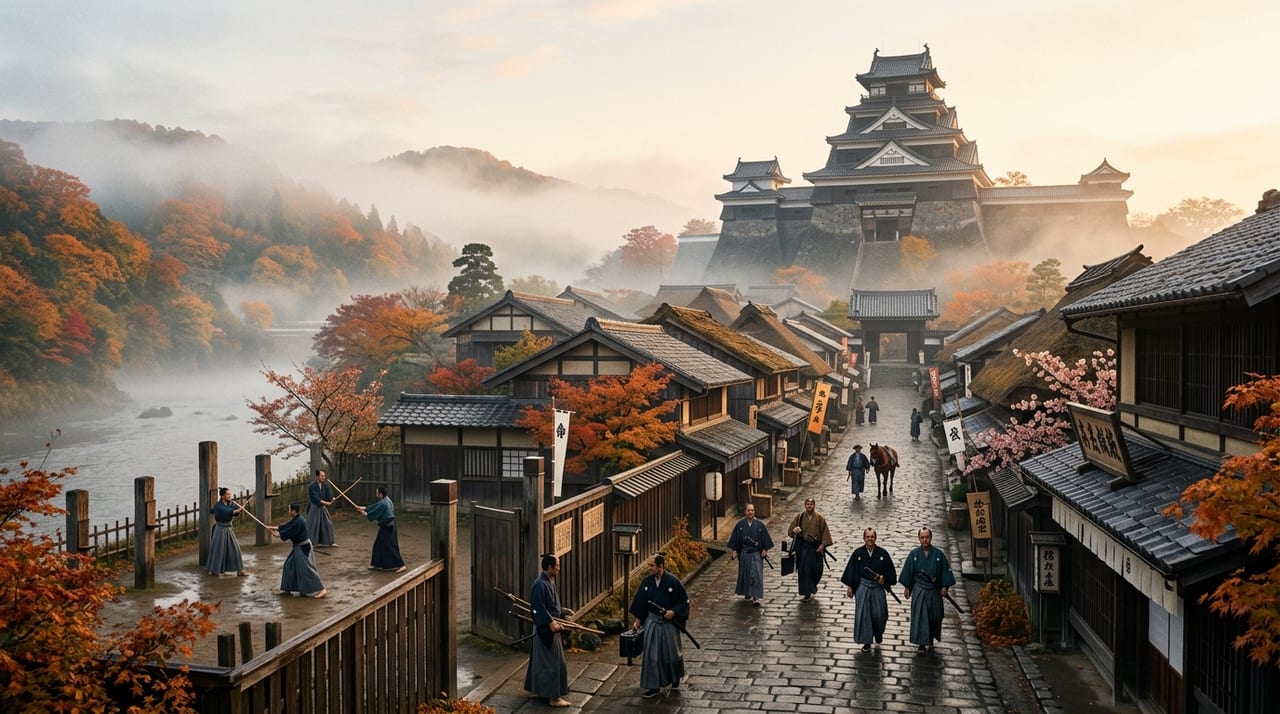
 * Image is for illustrative purposes only.
Satsuma School
薩摩伝
The sword culture of Satsuma Province (present-day Kagoshima Prefecture) developed in its own distinctive way, against the backdrop of about 700 years of Shimazu clan rule and the Satsuma domain's intense martial culture (shōbu). The Satsuma smiths who produced imposing uchigatana suited to the fast-striking swordsmanship of Satsuma Jigen-ryū were favored by Satsuma domain samurai, who played a vanguard role in the movement to overthrow the shogunate during the Bakumatsu period. The smith names Masayuki, Motohira, Naminohira, and others embody the deep connection between the spirit of the Satsuma samurai and their swords.
Description
Samurai Culture in Satsuma and Swords
The Satsuma domain (Shimazu clan, 770,000 koku) is known as one of the domains in Japan where the spirit of bushidō was most emphasized throughout the Edo period. In Satsuma, samurai made up about one quarter of the population, an unusually high proportion (the national average was about 6 percent), and through the 'tojō system,' under which lower-ranking samurai called gōshi also resided in rural areas, the entire domain was kept in a constantly armed state. This thoroughly samurai-based social order kept demand for swords far higher than in other domains, and fostered a pragmatic aesthetic sense that placed 'sharpness and durability in actual combat' above the quality of the blade itself.
Jigen-ryū and Satsuma Swords
The greatest factor that determined the character of Satsuma swords was the existence of the swordsmanship school called 'Satsuma Jigen-ryū.' Jigen-ryū is a swordsmanship style founded by Tōgō Shigekata (1561–1643), and its core is a lightning-fast overhead great cut delivered from the tonbo stance. The secret of Jigen-ryū lies in the ichi no tachi, that is, 'defeating the enemy in one blow before they begin to move,' and the swordsmanship that pursued this extreme speed and power demanded from Satsuma swords a distinctive form: 'an imposing uchigatana with slightly less curvature, a wide blade width, and thick kasane.' Jigen-ryū training included tachiki-uchi, in which an upright tree is struck with a wooden stick, and it is said that the strikes of Jigen-ryū practitioners were extremely forceful.
History of the Naminohira School
The Naminohira school has the longest history among the lineages of Satsuma swords. The Naminohira school is a group of smiths said to have continued from the Heian period in Naminohira, Taniyama District, Satsuma Province (present-day Kagoshima City), and the representative smith name Yukiyasu was passed down under the same name from generation to generation, surviving into the Edo period. Naminohira school works were valued from early times as 'Satsuma kotō' (old swords); the jigane shows itame with masame mixed in, and the hamon is mostly suguha and ko-midare, a simple style in which the influence of the Yamato tradition can be felt. From the late Edo period onward, Naminohira swords were mainly practical uchigatana, and they spread widely as everyday swords for Jigen-ryū swordsmen. Yamato no Kami Yasuyuki (Naminohira Yasuyuki, 1620–1695) is a smith who represents the Naminohira school of the early Edo period.
Satsuma and Swords in the Bakumatsu Period
During the Bakumatsu period (1853–1868), when the Satsuma domain stood at the forefront of the movement to overthrow the shogunate, Satsuma swords were deeply involved in the course of history. Records of Satsuma samurai playing active roles in historical events such as the Namamugi Incident (1862), the Anglo-Satsuma War (1863), the Kinmon Incident (1864), and the Battle of Toba–Fushimi (1868) are, together with the Satsuma swords they wore, important elements of Bakumatsu history. The Seinan War (1877), which Satsuma shizoku launched with Saigō Takamori as their leader in opposition to the Haitōrei (Sword Abolition Edict) (1876) of the early Meiji period, was the last armed uprising of shizoku in Japanese history, and many of the Satsuma shizoku who took part in this war wore Satsuma swords and faced government forces.
The Renowned Smiths Masayuki and Motohira
Masayuki and Motohira are cited as renowned smiths representing Satsuma swords of the early modern period. Masayuki, who inscribes the signature 'Sasshū-jū Masayuki,' is a representative smith of the late Edo period, and his style is distinctive for imposing blades: practical uchigatana with wide blade width and thick kasane, producing gunome and midare hamon with strong nie. These Satsuma swords combine historical value with quality as practical swords, and they attract attention as collecting targets for collectors of Bakumatsu swords.
Characteristics of This Era
- Deep connection with Jigen-ryū swordsmanship: practical uchigatana with a broad blade width and thick kasane, suited to the fast-striking Satsuma Jigen-ryū swordsmanship centered on the 'ichi no tachi.' Functional demands, rather than aesthetic considerations, determined the direction of sword-making.
- Satsuma's martial culture and the tojō system: an unusual samurai society in which a quarter of the population were samurai produced sword demand far higher than in other domains, along with a pragmatic aesthetic sense.
- The long lineage of the Naminohira school: a representative Satsuma sword school said to have continued from the Heian period, with the name Yukiyasu passed down through generations and continuing into the Edo period. A simple style with itame mixed with masame, and suguha and ko-midare, influenced by the Yamato tradition.
- A direct historical connection to the Bakumatsu turmoil: the Satsuma swords worn by Satsuma Jigen-ryū swordsmen were directly involved in historical events such as the Namamugi Incident, the Anglo-Satsuma War, the Battle of Toba–Fushimi, and the Seinan War.
- The Seinan War, Japan's last armed rebellion by those wearing swords: the history of Satsuma shizoku who opposed the Sword Abolition Edict and went into their last battle wearing Satsuma swords symbolizes the end of sword culture in the modern era.
- High reliability as practical swords: the swords produced by Satsuma's making philosophy, which gave top priority to 'sharpness and durability,' pursued the utmost standard as tools for actual combat rather than as art objects.