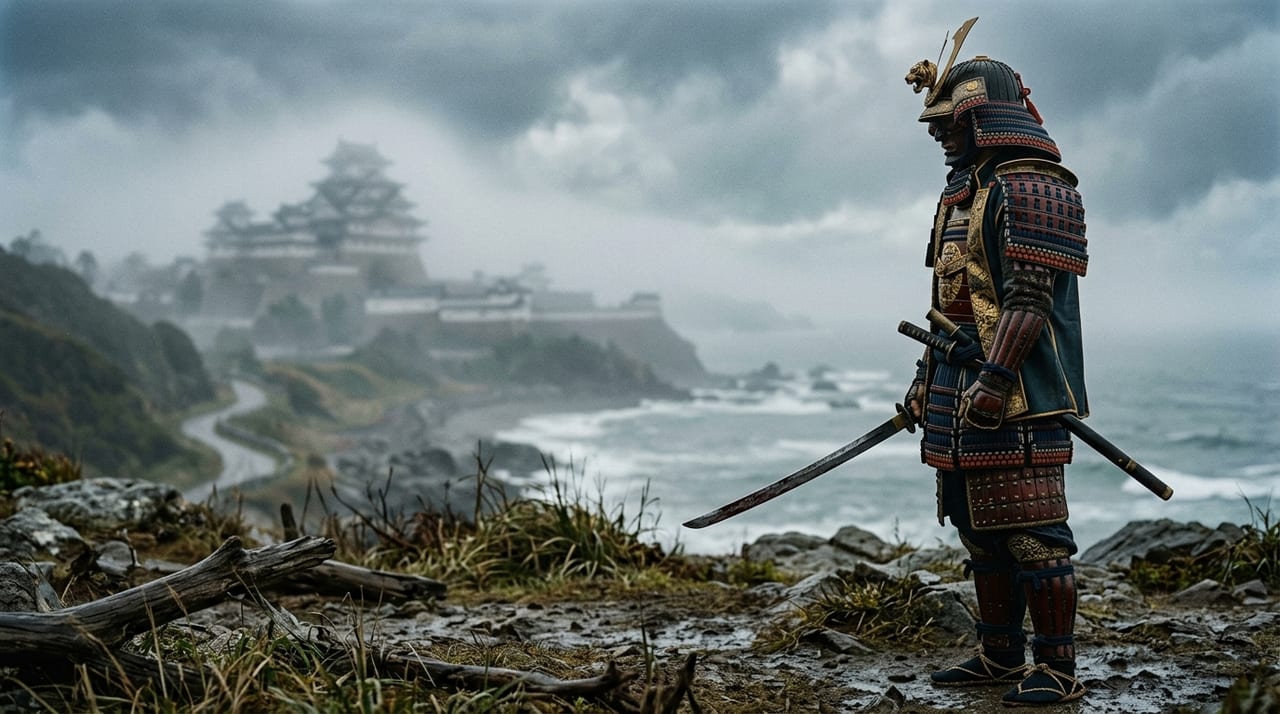
 * Image is for illustrative purposes only.
Sakamoto Ryōma
坂本龍馬
The Revolutionary of Bakumatsu
Description
The Birth of a Shishi
Born in 1836 (Tenpō 6) into a gōshi (lower-ranking samurai) family in the castle town of Kōchi in Tosa Province, Sakamoto Ryōma was the greatest shishi of the late Edo period. He played a decisive role in brokering the Satchō Alliance and in the petition for the restoration of imperial rule (Taisei Hōkan), opening the path to Japan's modernization. Ryōma's achievements were not merely political. His foresight, shown in his founding of the Kaientai to advance the shipping business and in his proposal of a new national vision in the Senchū Hassaku, far surpassed the framework of traditional samurai.
Days of Swordsmanship Training
At the age of 14, Ryōma began studying Oguri-ryū wajutsu at the dōjō of Hineno Benji in the castle town of Kōchi. In 1853 (Kaei 6), he traveled to Edo to train in swordsmanship and became a disciple at the Chiba Sadakichi dōjō of the Hokushin Ittō-ryū. His training at the Chiba dōjō laid the foundation for his swordsmanship, and it is also said that he received menkyo kaiden (full transmission) in the Hokushin Ittō-ryū. However, what survives is the Hokushin Ittō-ryū Naginata Heihō Mokuroku, a naginata technique document. Chiba Sana, the daughter of Chiba Sadakichi, is said to have held feelings for Ryōma, and a faint romantic story has been passed down between the two.
Beloved Sword: Mutsu-no-Kami Yoshiyuki
The most famous of Ryōma's swords is the "Mutsu-no-Kami Yoshiyuki." This sword, handed down in the Sakamoto family, was requested by Ryōma from his elder brother Gonpei. In 1867 (Keiō 3), it was entrusted to Saigō Takamori and delivered to Ryōma in Nagasaki. Ryōma boasted that it was a gift from his brother, and it is said that he always wore it when he went to Kyoto. Yoshiyuki was a swordsmith who was invited to the Tosa Domain during the Genroku era and became its swordsmith magistrate.
The Ōmiya Inn Incident
On the 15th day of the 11th month of Keiō 3 (1867), Ryōma was assassinated together with Nakaoka Shintarō at the Ōmiya inn in Kawaramachi, Kyoto. Ryōma was struck deeply on the forehead, a wound that proved fatal. It is said that when he received an assassin's blade with the Mutsu-no-Kami Yoshiyuki, together with its scabbard, the blade itself was shaved down. This Yoshiyuki is now held by the Kyoto National Museum. As for the actual perpetrators, the leading theory names Sasaki Tadasaburō and others of the Kyōto Mimawarigumi, but debate continues over who the mastermind was.
Thoughts on Swords
There is a symbolic episode that shows how far ahead of his time Ryōma looked. Ryōma carried a Smith & Wesson revolver given to him by Takasugi Shinsaku, and during the Teradaya Incident he returned fire with this pistol against the arresting officers of the Fushimi magistrate's office. Ryōma, who combined the traditional samurai weapon of the sword with the modern firearm, embodied the Bakumatsu period itself, an era in which tradition and innovation collided fiercely. Ryōma himself is said to have once remarked, "From now on it will be the age of international law (Bankoku Kōhō), not swords," suggesting that his understanding of the sword changed along with the times.
Ryōma's Stature
For Ryōma, the sword was both the soul of the samurai and a symbolic presence bridging the old era and the new. The cut marks said to have been left on the Mutsu-no-Kami Yoshiyuki at the Ōmiya inn quietly tell of how the turbulent Bakumatsu period came to an end along with Ryōma's life. The new Japan that Ryōma dreamed of was realized only a few months after his death, through the Meiji Restoration. He died at the age of 33 (31 by full-age reckoning). His short yet fierce life continues to shine eternally in the hearts of the Japanese people.
Notable Swords
- Mutsu-no-Kami Yoshiyuki (the work of the swordsmith Yoshiyuki, who served as swordsmith magistrate of the Tosa Domain. A sword handed down in the Sakamoto family, given by his elder brother Gonpei in 1867 (Keiō 3), and in Ryōma's possession at the time of his assassination at the Ōmiya inn. It is said to have been shaved down when he received an assassin's blade together with its scabbard. Held by the Kyoto National Museum.)