New Arrivals — Browse our catalog for the latest authentic Japanese sword arrivals. Browse →
August 20, 1864 (19th day, 7th month, Genji 1)
Near Hamaguri-gomon Gate, Kyoto (present-day Kyoto City, Kyoto Prefecture)
Forces
Chōshū Domain Forces (Kijima Matabei, Kusaka Genzui, etc.)
Shogunate and allied domains (Aizu, Kuwana, Satsuma, etc.)
About 12 min read
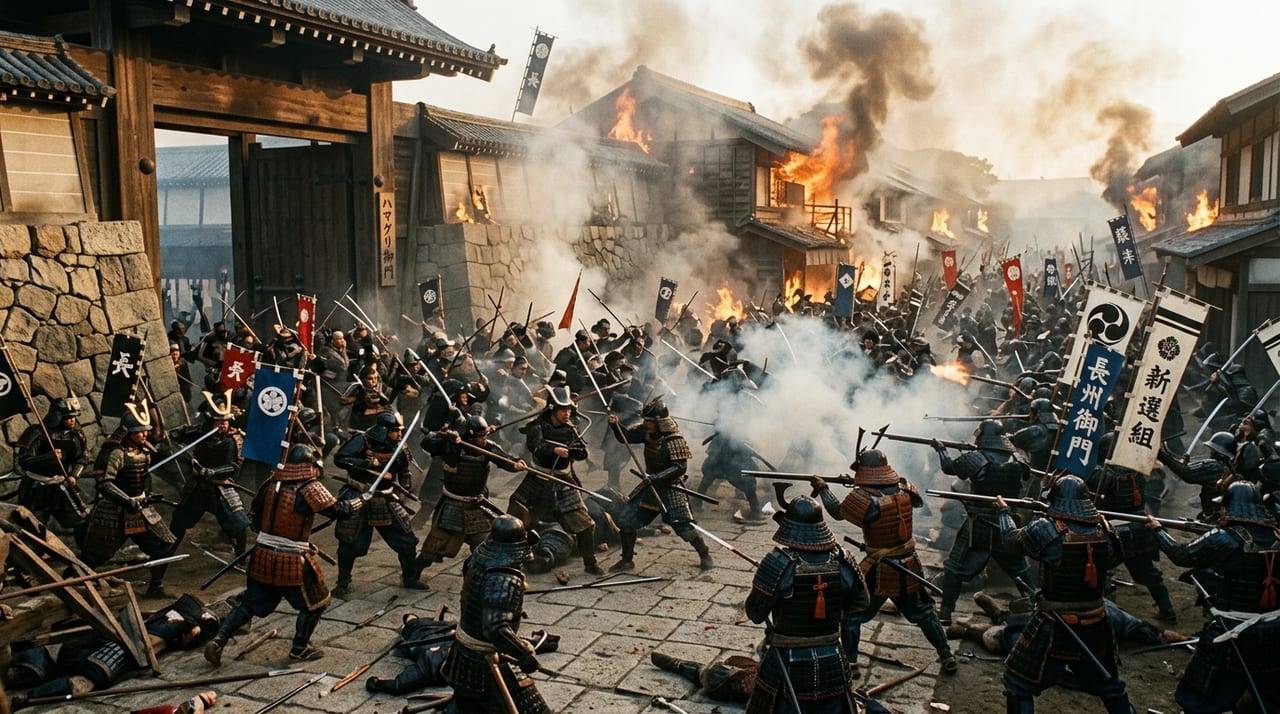
On the 19th day of the 7th month of Genji 1 (August 20, 1864), Chōshū domain troops clashed with the combined forces of Satsuma and Aizu near the Hamaguri-gomon, one of the kinmon (forbidden gates) of the Kyoto Imperial Palace. Known as the "Kinmon Incident" or the "Hamaguri-gomon Incident," this battle was the greatest street battle of the Bakumatsu period. It was also the event that became the decisive turning point at which the Chōshū domain was designated an "imperial enemy (enemy of the Emperor)."
The large-scale fire that broke out during this battle, the "Genji Fire (Dondon-yake)," burned some 30,000 houses in the city of Kyoto. It is remembered as a historical event in which the political violence of the Bakumatsu period directly inflicted damage on the lives of the people of a major city.
On the 18th day of the 8th month of Bunkyū 3 (1863), the Satsuma and Aizu domains acted in concert to carry out the "Eighteenth Day of the Eighth Month Coup." They expelled the Chōshū domain and the radical court nobles of the sonnō-jōi faction from Kyoto. In this coup, known as the "Flight of the Seven Nobles" (Shichikyō Ochi), the Chōshū domain completely lost its influence in Kyoto and found itself on the brink of being denounced as an "enemy of the court."
The Chōshū domain set as its goal a "return to favor" (kisan), meaning the restoration of its standing with the court. It chose the path of advancing on Kyoto backed by armed force. As the units to carry out this plan, Chōshū troops led by Kijima Matabei, Kusaka Genzui, Kunishi Shinano and others gathered around Kyoto.
Just before that, on the 5th day of the 6th month of Genji 1 (July 8, 1864), the "Ikedaya Incident" had occurred. In it, the underground organization of Chōshū-affiliated activists in Kyoto was destroyed by the Shinsengumi. The Kinmon Incident also had an aspect of retaliation for this Ikedaya Incident.
In the early morning of the 19th day of the 7th month, Chōshū troops deployed around the Kyoto Imperial Palace and attempted to break into the palace through the Hamaguri-gomon, the Sakaimachi-gomon and other gates. The aim of the Chōshū domain was to remove Matsudaira Katamori, lord of Aizu and Kyoto Shugoshoku (military governor of Kyoto), and others. It also aimed to appeal to the court about the wrongful accusation against the lord of the domain, and thereby restore its political standing.
At the Hamaguri-gomon, Chōshū troops led by Kijima Matabei clashed with the garrison forces of the Aizu and Satsuma domains. Kijima fought bravely at the head of the troops on horseback, but he was shot and wounded, and committed suicide. Kusaka Genzui entered the Takatsukasa residence (Takatsukasa-tei) and attempted to negotiate, but, cornered, he took his own life.
The Shinsengumi also took part in this street battle, engaging in the apprehension of Chōshū-affiliated ronin who had left their domains and of activists. The Shinsengumi's exploits are passed down to later generations as their "fierce fighting in the Kinmon Incident."
The greatest tragedy of the Kinmon Incident was the great fire that burned the town of Kyoto, the "Dondon-yake (Genji Fire)." The routed Chōshū forces set fire to the Chōshū domain residence. The Aizu forces also attacked houses near the Nakadachiuri-gomon, where Chōshū samurai were said to be hiding. The fires that rose from these two places spread until the morning of the 21st.
This fire is recorded in detail in contemporary historical sources, and the number of houses burned is said to have reached about 30,000. Districts, shrines and temples over a wide area, from Ichijō-dōri in the north to the Higashi Hongan-ji at Shichijō in the south, were reduced to ashes.
Among the things lost in this great fire, many famous swords stored in the storehouses of Kyoto's swordsmiths and sword dealers may have been included. Kyoto has been one of the centers of sword culture since the Heian period, and many famous swordsmiths, polishers (togishi) and sword dealers were concentrated there. How many famous swords were lost in the "Dondon-yake" is unknown in detail. However, there is no doubt that it dealt a serious blow to the sword culture of the Bakumatsu period.
The swords used by the activists and samurai who took part in the Kinmon Incident reflect the sword culture of the Bakumatsu period.
The Chōshū samurai were equipped with both firearms and Japanese swords, and cannon were also deployed in the battle. In the close combat of a street battle, sword-to-sword fighting also took place. The valor Kijima Matabei displayed in his mounted charge is one of the last images of the "traditional warrior" among samurai who wore Japanese swords.
The Jigen-ryū of the Satsuma domain is known as the swordsmanship of which the Bakumatsu-period Satsuma samurai were proud. The Satsuma domain samurai who took part in the Kinmon Incident should also have faced the battle with the sword skills they trained in the Jigen-ryū. Also, Kondō Isami, Hijikata Toshizō and Okita Sōji of the Shinsengumi, continuing from the Ikedaya Incident, maintained public order in Kyoto and were active even amid the confusion of the Kinmon Incident.
After the defeat in the Kinmon Incident, the Chōshū domain was formally designated an "imperial enemy" by order of the Emperor (Emperor Kōmei). In response, the shogunate launched the First Chōshū Expedition (1864–1865) to intimidate the Chōshū domain. However, within the Chōshū domain, Takasugi Shinsaku raised an armed uprising backed by the Kiheitai and other units, regained actual control of the domain (the Kōzan-ji uprising), and sought a comeback.
The Kinmon Incident, the upheaval of 1864 that began with the Ikedaya Incident, drew Bakumatsu politics from a clash of words and diplomacy over "sonnō-jōi or kaikoku" into a "resolution by armed force." After this, the Satsuma-Chōshū Alliance (1866), the Taisei Hōkan (1867) and the Boshin War (1868–1869) followed, and the Bakumatsu period rapidly moved toward the Meiji Restoration.
The blood of the Bakumatsu activists shed in the Kinmon Incident, and the traces of swords and bullets that fell on the stone pavement of the Hamaguri-gomon, were the prelude to the end of the 260-year Edo shogunate. And the flames of Kyoto that blazed in the "Genji Fire" may have foreshadowed that a new era would be built on the rubble of the old order.
Hijikata Toshizō
Shinsengumi vice-commander, active during the Kinmon turmoil; one of the Bakumatsu's greatest swordsmen
Okita Sōji
Shinsengumi 1st unit captain; participated in Kyoto security following the Ikedaya Incident and Kinmon
Sakamoto Ryōma
Sakamoto Ryōma was working toward the Satsuma-Chōshū alliance during the Kinmon period
Kondō Isami
Shinsengumi commander who maintained order in Kyoto during the Kinmon Incident
Saigō Takamori
Commanded Satsuma forces that repelled the Chōshū army at the Kinmon Incident
Matsudaira Katamori
Kyoto Military Commissioner Who Commanded Aizu Forces at the Kinmon Incident
元治元年(1864年)、禁門の変で朝敵となった長州藩内では俗論派が実権を握り、三家老切腹・四参謀斬首・野山獄での甲子殉難十一烈士処刑という粛清が続いた。切腹と斬首を分けた作法、そこに用いられた刀剣を通じて藩内闘争の実相を読み解く。
2026-10-09
幕末最後の激動期である文久・元治・慶応年間(1861〜1868年)に、尊王攘夷運動と刀剣文化がいかに結びつき、志士・浪士・武家の帯刀習慣と刀匠の動向を決定づけたかを探る。
2026-06-01
ペリー来航後の激動期に刀匠たちが感じた社会変動と、尊王攘夷思想が生み出した幕末最後の高品質古典刀の実態を探る。
2026-05-17
江戸時代に京都で活躍した刀工集団「三品派(みしなは)」を詳解。創始者から代々の刀工たちの系譜、山城伝の継承と独自発展、代表作の技術的特徴、現代での市場評価を解説する。
2026-04-26