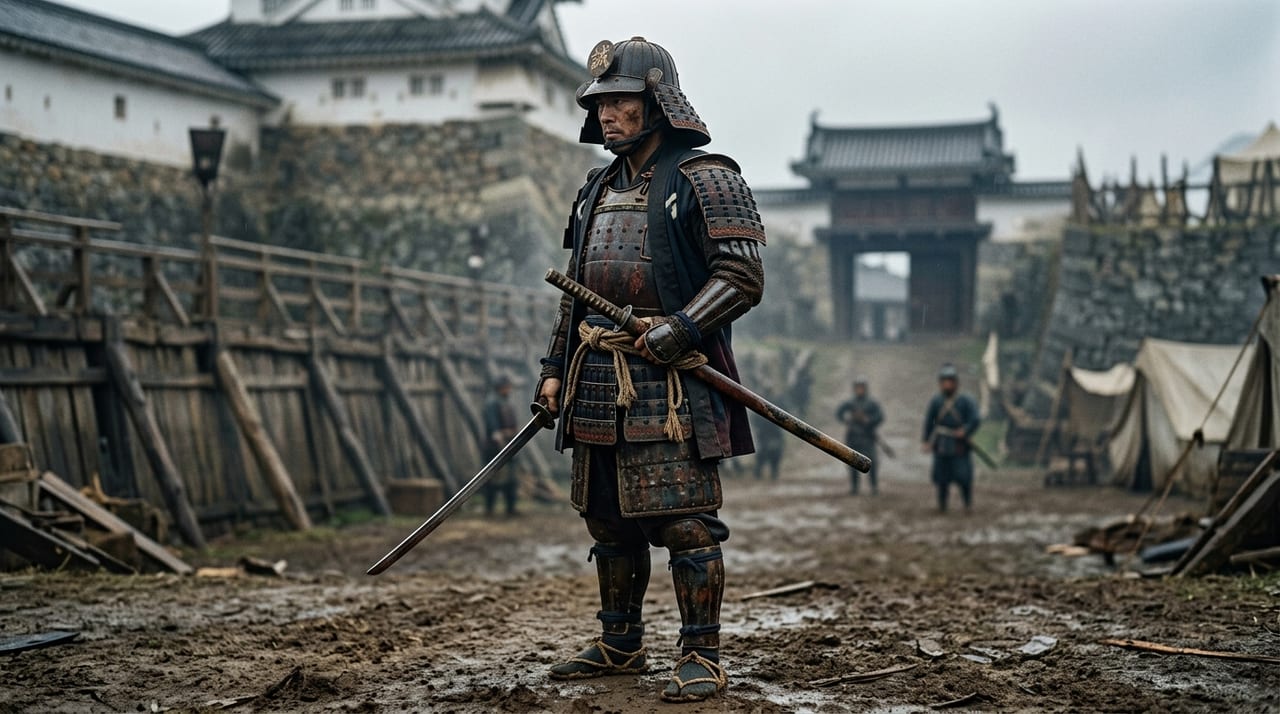
 * Image is for illustrative purposes only.
Hijikata Toshizō
土方歳三
The Demon Vice-Commander
Description
The Birth of the 'Demon Vice-Commander'
In 1835 (Tenpō 6), Hijikata Toshizō was born in Ishida Village, Tama District, Musashi Province. He was one of the strongest swordsmen of the late Edo period, feared under the name 'Demon Vice-Commander' as deputy commander of the Shinsengumi. Born the youngest child of a farming family, Toshizō kept burning with longing for the samurai class. He met Kondō Isami, who had come to give outside instruction, entered Tennen Rishin-ryū under him, and from there threw himself into the turbulent years of the late Edo period.
Kyokuchū Hatto and Iron Discipline
Toshizō's martial prowess and organizational command were most fully displayed in the Shinsengumi's activities in Kyoto from 1863 (Bunkyū 3) onward. Toshizō enacted a strict code of discipline called the Kyokuchū Hatto and ordered seppuku without mercy for those who violated it. That iron discipline forged the group, which had been a gathering of masterless samurai, into a formidable armed unit. Toshizō himself took the lead in enforcing the rules, and even for friends who broke them he showed no leniency. This coldness is the origin of the name 'Demon Vice-Commander'.
The Ikedaya Incident
The Ikedaya Incident of 8 July 1864 (Genji 1/6/5) made the name of the Shinsengumi known throughout the land, and Toshizō split the force and led one of the units. Having obtained intelligence that pro-Imperial, expel-the-barbarians activists, including those of the Chōshū Domain and the Tosa Domain, were plotting to set fire to Kyoto, the Shinsengumi split up to search. Kondō and the others stormed into the Ikedaya. Toshizō's unit searched the area around Tanko (Shikokuya) and then rushed to the Ikedaya, but did not charge in immediately; instead it surrounded the building. This incident is also said to have delayed the Meiji Restoration.
Beloved Blade: Izumi-no-Kami Kanesada
The most famous of Toshizō's beloved swords is the 'Izumi-no-Kami Kanesada'. It is a work of the Aizu Domain's master smith, Izumi-no-Kami Kanesada (11th-generation Aizu Kanesada). Kanesada's blades are known for carrying on the Mino-den tradition while having sharp edges with excellent cutting performance in actual combat. One blade now preserved at the Hijikata Toshizō Museum in Hino City (blade length approximately 70.3 cm) is said to have been delivered to Satō Hikogorō in Hino around the time of the Battle of Hakodate. A letter from Kondō Isami dated 1863 (Bunkyū 3) mentions an Izumi-no-Kami Kanesada of 2 shaku 8 sun. Its length does not match the extant blade, and since the 11th-generation Aizu smith had not yet received the Izumi-no-Kami title at that time, it is also considered that Toshizō in the Kyoto period wore Mino's Izumi-no-Kami Kanesada (Nosada).
Another Beloved Blade
Another beloved blade, by 'Yamato-no-Kami Minamoto no Hidekuni', is preserved at the Ryōzen Museum of History in Kyoto. Hidekuni was a swordsmith of the late Edo period.
Campaigns of the Boshin War
In the Battle of Toba–Fushimi in the 1st month of Keiō 4 (1868), the shogunate forces suffered a crushing defeat, and the Shinsengumi also took heavy losses. But Toshizō refused to surrender. He moved on through the Battle of Kōshū-Katsunuma, the Battle of Utsunomiya Castle, and the Aizu War, heading north while fighting one campaign after another. During this period Toshizō changed into Western-style dress, studied French military tactics, and was reborn as a modern commander. Yet he never once let go of his sword. The Izumi-no-Kami Kanesada was the very soul of Toshizō as a samurai.
His End at Hakodate
On 20 June 1869 (Meiji 2/5/11), in the midst of the Battle of Hakodate, Toshizō met his end near the Ippongi Gate in Hakodate. He was commanding on horseback when he is said to have fallen to a bullet. He was 35 years old. Toshizō, in Western dress with a Japanese sword at his side, perfectly embodied the late Edo period, when old and new eras intersected. The handsome profile preserved in photographs conveys to the present the last brilliance of the age of the samurai. For Toshizō, the Izumi-no-Kami Kanesada was the sign of his final loyalty to the collapsing shogunate, and the symbol of his unwavering resolve to live as a samurai and die as a samurai.
Notable Swords
- Izumi-no-Kami Kanesada (11th-generation Aizu Kanesada. A practical blade by the Aizu Domain's master smith. Inherits the Mino-den tradition and has a sharp cutting edge. Said to have been delivered to Hino around the time of the Battle of Hakodate. Extant, preserved at the Hijikata Toshizō Museum)
- Yamato-no-Kami Minamoto no Hidekuni (A work of the late Edo-period swordsmith Hidekuni. Handed down at the Ryōzen Museum of History as the sword worn by Hijikata Toshizō)