New Arrivals — Browse our catalog for the latest authentic Japanese sword arrivals. Browse →
6th day, 3rd month, Keiō 4 (March 29, 1868)
Katsunuma village, Yamanashi District, Kai Province (present-day Katsunuma-chō, Kōshū City, Yamanashi Prefecture)
Forces
Former Shogunate Forces (Kōyō Chintai-tai)
Imperial Army
About 12 min read
When the former shogunate forces were defeated by the new government forces at the Battle of Toba-Fushimi in the 1st month of Keiō 4 (1868), and Shogun Tokugawa Yoshinobu fled to Edo, the greatest military organization of the late Edo period began to collapse. Amid this, the Shinsengumi sought to make its own comeback.
The Shinsengumi, a band of swordsmen who rose to fame with the Ikedaya Incident (1864) and kept fighting for the shogunate in the Kinmon Incident and at Toba-Fushimi, planned after their defeat at Toba-Fushimi to march again into Kōshū (Kai Province, present-day Yamanashi Prefecture). Seizing Kōfu Castle, a shogunal domain holding, carried major military significance for the defense of Edo. The Kōshū Kaidō was also one of the main highways to Edo, and by holding it they sought to slow the advance of the imperial forces.
Commander Kondō Isami and deputy commander Hijikata Toshizō, leading fewer than 200 men, called themselves the “Kōyō Chintai-tai” and departed Edo on March 24, 1868 (Keiō 4/3/1). Kondō had received the order from the shogunate to pacify Kōfu on the 28th day of the 2nd month, and contemporary sources record the unit as the “Chinbu-tai.”
Katsunuma in Kai Province was a strategic point where the Kōshū Kaidō, passing through the mountainous Gunnai region, first entered the Kōfu Basin. Lying at the eastern entrance as seen from Kōfu, this area was a narrow terrain pinched between mountains and rivers, a site where even a small force could easily hold back a large army.
However, when the Kōyō Chintai-tai arrived at Katsunuma, the situation had taken an unexpected turn. The new government forces (the Tosa domain troops led by Itagaki Taisuke) had already occupied Kōfu Castle ahead of them, blocking the road by which the Kōyō Chintai-tai could enter Kōfu. Kōfu was a shogunal domain, and Kōfu Castle had passed into the hands of the new government forces without a fight.
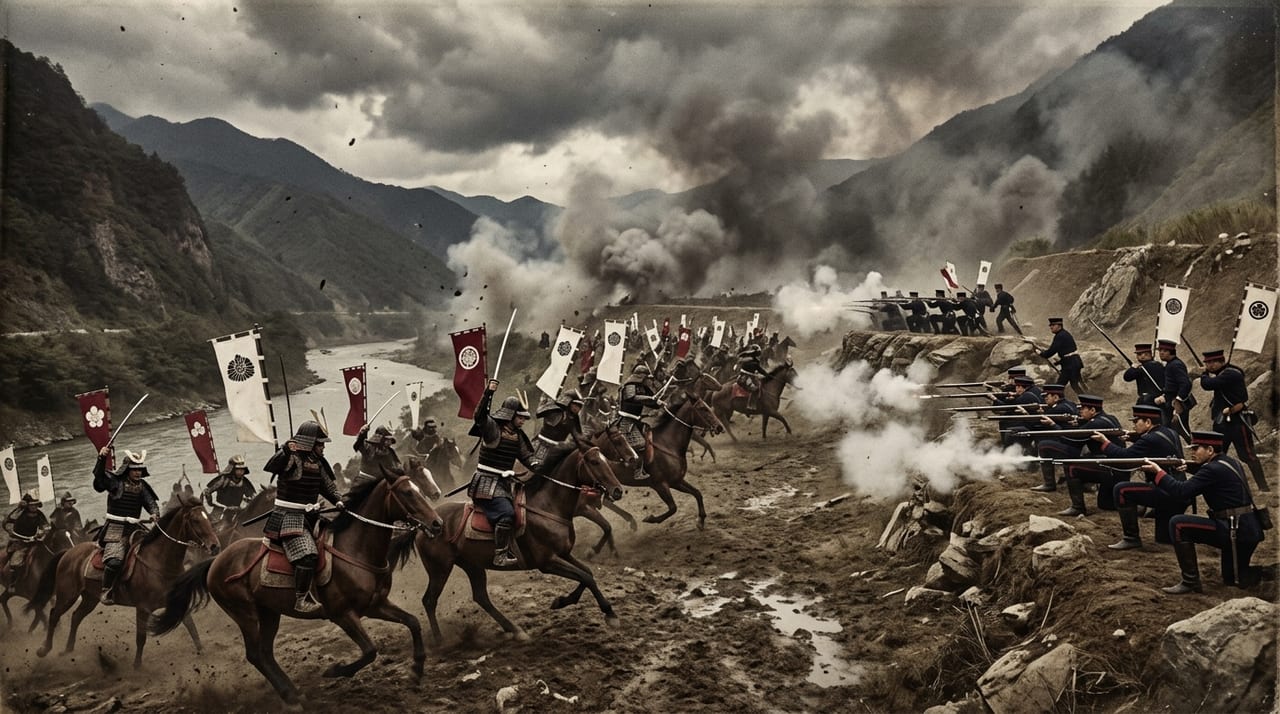
On March 29, 1868 (Keiō 4/3/6), the Kōyō Chintai-tai faced the imperial forces near Kashio and Mount Iwasaki in Katsunuma. Not only did the imperial forces have an overwhelming numerical advantage, they were also equipped with the latest firearms.
The most important historical significance of the Battle of Kōshū Katsunuma is understood within the context of “the end of the age of the sword.”
The Shinsengumi, led by Kondō Isami, Hijikata Toshizō, and Okita Sōji (who, due to illness, did not take part in the fighting in Kōshū), was a band of swordsmen standing at the pinnacle of late Edo-period swordsmanship, beginning with Tennen Rishin-ryū. In the Ikedaya Incident, they displayed formidable skill in cutting down multiple opponents at once in the darkness, and were feared as the “Wolves of Mibu.”
At Katsunuma, that swordsmanship hardly mattered. The former shogunate forces had brought only 2 of the 6 cannons provided by the Tokugawa house, and the disparity in firepower was plain. Attacked from a distance within range of bullets, no matter how skilled a swordsman, he would fall before he could draw his sword.
The battle ended in an overwhelming defeat for the Kōyō Chintai-tai. Before the power of the guns, the unit's formation collapsed, and Kondō Isami and others fled back toward Edo, hiding in the mountains (Hijikata Toshizō had returned to Edo by express palanquin before the fighting began).
This battle symbolizes the end of the sword culture of the late Edo period. It was the moment when the swords of the Shinsengumi, which had cut down many Chōshū radicals in the Ikedaya Incident, were proven powerless. Swords had remained effective in close combat even against matchlock muskets, but against modern rifles, even getting close was itself impossible.
After the defeat at Katsunuma, Kondō Isami returned to Edo and tried to establish a base at Nagareyama (Chiba Prefecture). However, in the 4th month of Keiō 4 (1868), he was surrounded by the new government forces and surrendered. After being escorted to Itabashi (Tokyo), he was sentenced to decapitation. The leader of the strongest band of swordsmen of the late Edo period lost his life not to the sword but to execution by officials. He died at the age of 35.
Deputy commander Hijikata Toshizō continued fighting across Edo, Utsunomiya, Aizu, and Hakodate (Goryōkaku). On June 20, 1869 (Meiji 2/5/11), he fell to a bullet in the battle at Ippongi Gate in Hakodate. He died at the age of 35. Hijikata's death, which later generations praise as “a samurai who fought to the very end,” was likewise caused by a bullet, not by a sword.
The swords favored by the Shinsengumi swordsmen were a lineup of masterpieces that shone with the final brilliance of late-Edo sword culture.
Kondō Isami's beloved sword, “Kotetsu,” is widely known, and as Hijikata Toshizō's favorite, “Izumi-no-kami Kanesada” is also known. Made by the 11th-generation Izumi-no-kami Kanesada (Aizu Kanesada), a late-Edo Aizu swordsmith, this sword still remains in Hino, Tokyo, Hijikata's birthplace, and is preserved as a valuable heritage of modern sword culture.
As Okita Sōji's favored sword, “Kashū Kiyomitsu” is cited. The sword Okita is said to have actually used does not survive, but the legend of his swiftness and his reputation as a “master of the thrust” continue to be passed down.
From this point, when swords were effectively rendered powerless at the Battle of Kōshū Katsunuma, Japan's samurai were forced to choose between “modernization or death.” Though some, like Hijikata Toshizō, embodied the spirit of fighting with the sword to the very end, eight years later the Sword Abolition Edict (Haitōrei) of 1876 prohibited Japanese people from routinely wearing swords.
The Battle of Kōshū Katsunuma was one of the last battlefields on which Japanese swords moved from being “weapons of real combat” to “symbols of the spirit.” The swords of the Shinsengumi defeated here never returned to the battlefield and eventually passed into the hands of museums and collectors. That was the fate the swords of the late-Edo swordsmen met.
The Battle of Kōshū Katsunuma is still commemorated today at Katsunuma, Kōshū, Yamanashi, as the “Kashio battlefield site.” In Hino, Tokyo, the birthplace of Hijikata Toshizō, the Shinsengumi no Furusato History Museum of Hino City is established, displaying materials related to the Shinsengumi.
The fact that the Shinsengumi swordsmen lived through the turbulent late Edo period and fought their last battle on Kai soil is eternally inscribed in the history of the Japanese sword as “the memory of the sword in real combat.”
Kondō Isami
Commander of the Kōyō Chintai-tai; captured at Nagareyama and executed after the defeat
Hijikata Toshizō
Vice-commander who continued fighting after Katsunuma until his death at Hakodate
Okita Sōji
Shinsengumi sword master who missed the Katsunuma campaign due to illness
Nagakura Shinpachi
Shinsengumi second-unit captain who participated in the Kōyō Chintai-tai
Saitō Hajime
Shinsengumi third-unit captain who fought from Kai to Aizu