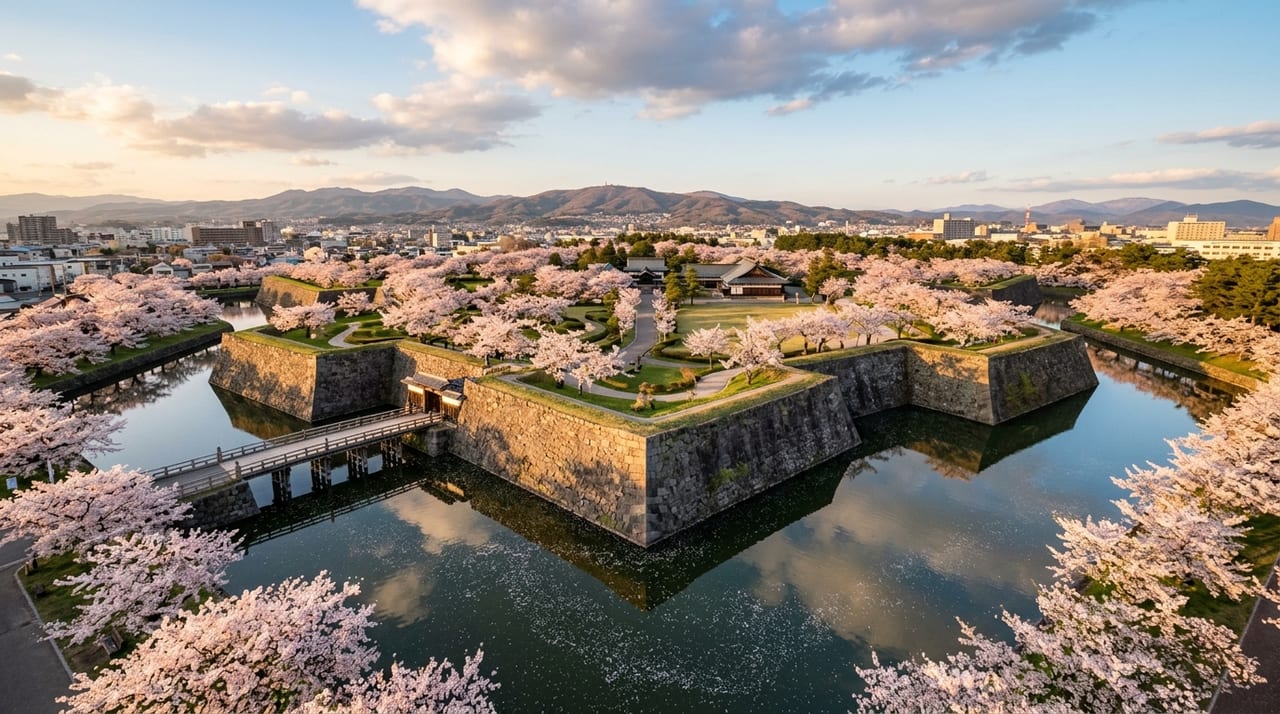
 * Image is for illustrative purposes only.
Goryōkaku Fort
五稜郭
Goryōkaku Fort is a historic castle in the Hokkaidō region (Construction began 1857 (Ansei 4), completed 1864 (Genji 1)). Its lord was Tokugawa Shogunate (Hakodate Magistracy) / Enomoto Takeaki.
Overview
A Star-Shaped Western-Style Fortress
Goryōkaku is a star fort, a Western-style castle built as the most innovative military facility of late Edo-period Japan. Construction began in Ansei 4 (1857) and was completed in Genji 1 (1864). The fortress was designed by Takeda Ayasaburō on the basis of Western fortification techniques. Its five-pointed star plan provides a rational defensive system in which each projecting point can cover the adjoining ramparts with gunfire. It was the first full-scale introduction in Japan of the bastion fort (bastioned fortification) form of early modern European fortress.
The Stage of the Bakumatsu Upheaval
The Tokugawa Shogunate established the Hakodate Magistrate's Office (Hakodate Bugyōsho) to develop Ezo (Hokkaidō) and respond to foreign ships, and made Goryōkaku its base. However, Goryōkaku became the centerpiece of history during the Boshin War of Meiji 1 (1868). Enomoto Takeaki, commander-in-chief of the former shogunate forces, led the navy to land in Ezo, occupied Goryōkaku, and declared the establishment of the "Republic of Ezo." Under Enomoto Takeaki, who took office as chief executive (sōsai), deputy army magistrate (rikugun bugyō-nami) Hijikata Toshizō directed the defense of the area around Hakodate.
Hijikata Toshizō and the Japanese Sword
The most dramatic figure in the history of Goryōkaku is Hijikata Toshizō, vice-commander of the Shinsengumi. Hijikata was the de facto battlefield commander of the Shinsengumi, a band of swordsmen renowned as the strongest of the late Edo period. His beloved sword, "Izumi no Kami Kanesada," is known as a famous blade forged by a swordsmith employed by the Aizu Domain. Even in the final battles at Hakodate, Hijikata fought bravely while directing from horseback. On June 20, 1869 (Meiji 2/5/11), Hijikata Toshizō was killed by a bullet near the Ippongi Barrier (Ippongi Sekimon) while on his way to relieve the Benten Battery (Benten Daiba). As one of the last samurai to wear a Japanese sword, Hijikata's name is forever engraved in Hakodate.
The End of the Republic of Ezo
In the 5th month of Meiji 2 (1869), the new government forces launched a large-scale attack employing artillery and warships. The Benten Battery fell, and the strength of the former shogunate forces holed up inside Goryōkaku rapidly diminished. After Hijikata Toshizō's death, Enomoto Takeaki continued the siege of Goryōkaku, but on the 18th day of the 5th month (1869) he finally surrendered. With this surrender the Boshin War came to an end, and the fate of the Tokugawa Shogunate was completely sealed. The last battle at Goryōkaku is recorded in history as a symbolic scene of the late Edo period, in which swords and guns coexisted.
Goryōkaku Today
After the Meiji era, Goryōkaku was used as an army facility, and in Shōwa 27 (1952) it was designated a National Special Historic Site and developed into a park. Today it is one of the most important sights in Hakodate tourism, and the star-shaped fortress seen from Goryōkaku Tower is known worldwide as one of the most beautiful aerial photographs. The approximately 1,600 cherry trees of spring have exceptional beauty, and the blossoms blooming along the star-shaped moat captivate visitors. In Hakodate city there is a statue of Hijikata Toshizō, and the spirit of the bakumatsu patriots still lives on in the land of Hakodate.
Connection to Swords
As the final battlefield where swords and guns clashed at the end of the bakumatsu period, Goryōkaku holds a special place in the history of the Japanese sword. The "Izumi no Kami Kanesada" beloved by Hijikata Toshizō, vice-commander of the Shinsengumi, is the most famous blade among the swordsmen of the late Edo period. The surviving Izumi no Kami Kanesada of Hijikata is a work of the 11th-generation Kanesada, a smith employed by the Aizu Domain, and is held at the Hijikata Toshizō Museum in Hino. The battles of Goryōkaku also symbolized the "shift from sword to gun" in Japanese history. Samurai who fought with swords as their main weapon remained in the former shogunate forces, but they were defeated by the new government forces armed with modern guns and artillery. However, the spirit and aesthetics of Hijikata Toshizō and the other last swordsmen have been passed down to the present day as the spiritual heritage of the Japanese sword. On the observation deck of Goryōkaku Tower there is a seated statue of Hijikata Toshizō, as well as the Goryōkaku History Corridor, which introduces the history of Goryōkaku and the Battle of Hakodate.
Highlights
- Goryōkaku Tower (107m) — complete aerial view of the star fort; Hijikata Toshizō statue and exhibition
- Restored Hakodate Magistracy — faithful reconstruction of the Bakumatsu administrative headquarters
- Cherry blossoms — approx. 1,600 trees along the star-shaped moats
- Hijikata memorial sites — Bakumatsu history walk through nearby monuments
- Combined visit with Hakodate night view (one of the world's three great night views)
* Opening hours and admission fees are subject to change. Please check the official website before visiting.