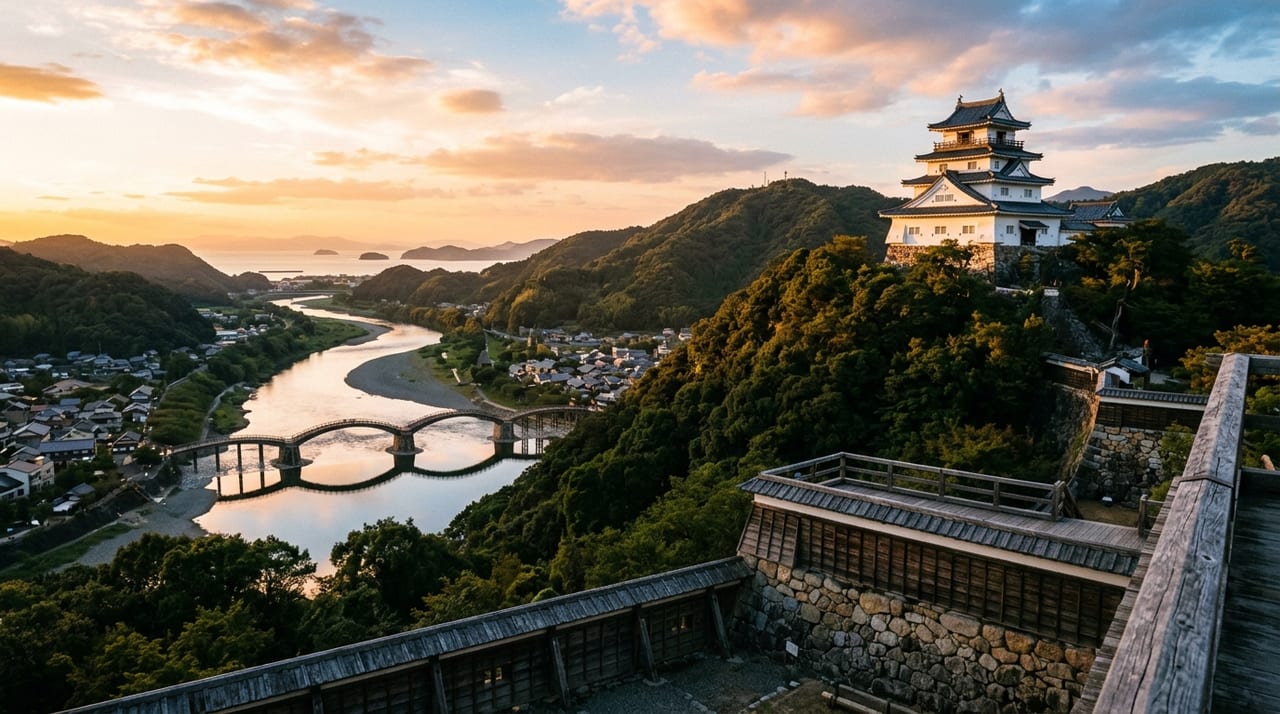
 * Image is for illustrative purposes only.
Kaminokuni Katsuyama-date (Kaminokuni Fort Ruins)
上ノ国勝山館(上之国館跡)
Kaminokuni Katsuyama-date (Kaminokuni Fort Ruins) is a historic castle in the Hokkaidō region (Late Muromachi period (built in the latter half of the 15th century), functioning as a stronghold until around the end of the 16th century). Its lord was Takeda Nobuhiro (builder, progenitor of the later Matsumae clan); subsequently held by successive heads of the Kakizaki clan (the renamed Takeda line).
Overview
Overview
Katsuyama-date is a mountain fortress in Kaminokuni, Hiyama District, Hokkaido, and one of the strongholds of the Wajin (ethnic Japanese) forces on the southern Oshima Peninsula. It is traditionally said to have been built in the latter half of the 15th century by Takeda Nobuhiro, progenitor of the later Matsumae clan.
Founding and History
Takeda Nobuhiro took refuge with Kakizaki Suetoshi, who held Hanazawa-date (one of the Twelve Forts of Southern Hokkaido), and after distinguishing himself in suppressing the Kōshamain War (1457) succeeded to headship of the Kakizaki clan. He is said to have then built Katsuyama-date as a highly defensible mountain fortress. It went on to serve as a major center of politics, military affairs, and trade for the Takeda/Kakizaki clan along the Sea of Japan coast until around the end of the 16th century, when the clan's base moved to Matsumae.
Structure and Remains
More than two decades of excavation have revealed palisades, dry moats, a bridge, building foundations, and well remains. Over 100,000 artifacts have been recovered, including Chinese celadon and blue-and-white porcelain, domestic ceramics, and metal and wooden objects. More than 500 bone and antler tools used by the Ainu were also found, making the site academically significant as evidence that Wajin and Ainu coexisted and traded within the same space.
Present State and Access
Preserved as the National Historic Site "Kaminokuni Fort Ruins," it was selected in April 2017 among the Continuation of Japan's Top 100 Castles. The remains have been developed with three-dimensional reconstructions and ground-level markers, and an adjacent guidance facility displays excavated artifacts with explanations. Walking paths and interpretive signage are maintained throughout the site.
Highlights
- Mountain fortress built by Takeda Nobuhiro, progenitor of the Matsumae (Kakizaki) clan, and a major hub of Sea of Japan coastal trade
- Over 100,000 artifacts recovered through more than two decades of excavation
- More than 500 Ainu bone and antler tools found, evidencing Wajin-Ainu coexistence
- National Historic Site "Kaminokuni Fort Ruins"; selected in 2017 among the Continuation of Japan's Top 100 Castles
* Opening hours and admission fees are subject to change. Please check the official website before visiting.