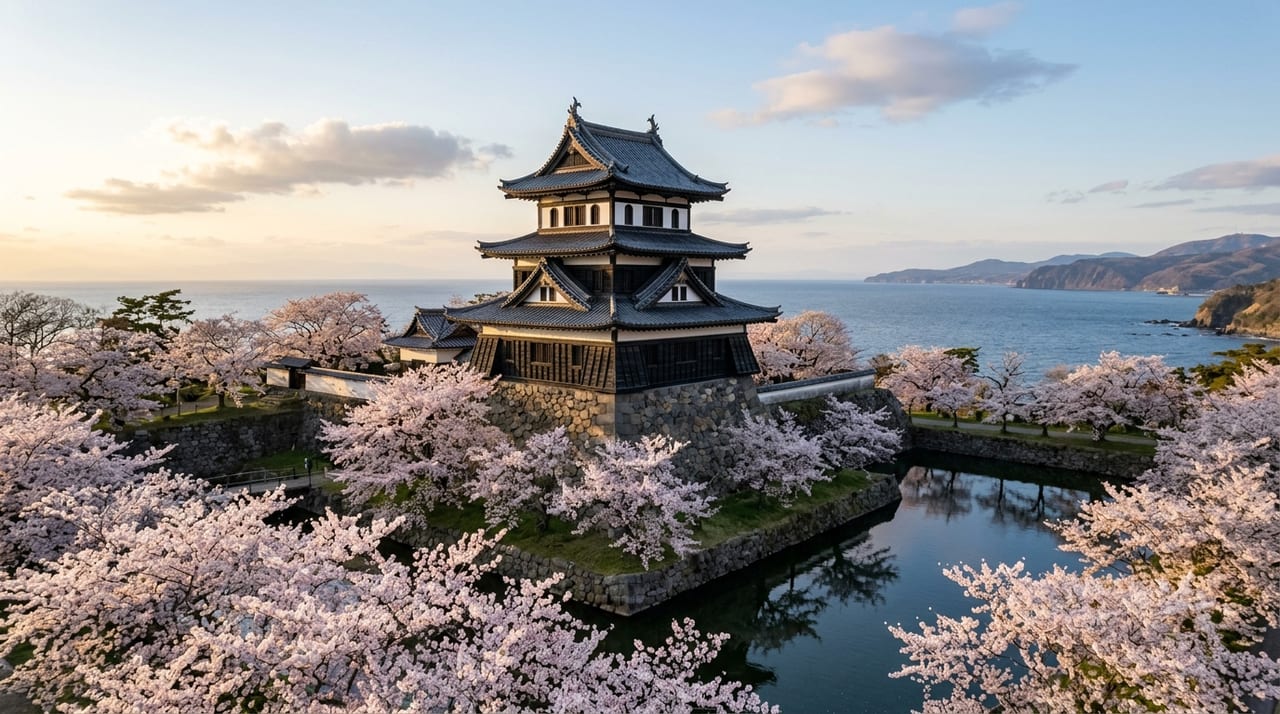
 * Image is for illustrative purposes only.
Matsumae Castle
松前城
Matsumae Castle is a historic castle in the Hokkaidō region (Built in 1849 (Kaei 2)). Its lord was Matsumae Takahiro.
Overview
About the Castle
Matsumae Castle is located in Matsumae Town, Hokkaido, and is Hokkaido's only Japanese-style castle. Completed in Ansei 1 (1854), this castle was built by the Matsumae domain at the shogunate's command as a northern defense fortification to respond to Russia's advancing southern expansion policy and pressure for opening Japan during the late Edo period. The tenshu is a three-story tower structure with black exterior walls that stands dignified on a plateau overlooking the Tsugaru Strait. While smaller in scale compared to celebrated castles on the main islands, it is highly regarded as a pure example of castle architecture born in the final era of the Edo period.
The Northern Frontier Castle and the History of Matsumae Domain
The Matsumae domain was the only han that ruled Ezo (Hokkaido), and was an exceptional daimyo that prospered through monopolizing trade with the Ainu people. Operating outside the rice-tax (kokudaka) system and based on "Ezo trade rights," the Matsumae domain centered its economy not on rice but on northern products such as seafood, furs, and kelp. The Matsumae clan, which governed the northern frontier while repeating cycles of trade and tension with the Ainu throughout the Edo period, was ordered by the shogunate to defend Ezo at the beginning of the 19th century when Russia's southward expansion became a genuine threat. Matsumae Castle became one of the final Japanese-style castles built in the late Edo period as the fruition of this mission.
The Hakodate War and the Castle's Fate
During the Boshin War, the Hakodate War broke out in Meiji 1 (1868). In this conflict, Matsumae Castle was attacked by the former shogunate navy under Enomoto Takeaki and fell in merely one day. The assault on Matsumae Castle led by Hijikata Toshizō was conducted as a lightning-strike ambush that overwhelmed both the new government army and the Matsumae domain forces. Subsequently, after intense fighting between former shogunate and new government forces, the center of the war shifted to Hakodate and Goryokaku, and Matsumae Castle eventually returned to the hands of the new government army. After the Meiji Restoration, the castle was used as a military barracks, but the tenshu and the hon'maru palace burned in a fire in Showa 24 (1949). The current tenshu is a reinforced concrete structure rebuilt in Showa 36 (1961) and houses a historical museum of the Matsumae domain.
Ainu Culture and the Sword Culture of the North
The history of Matsumae Castle and the Matsumae domain is inseparable from the culture of the Ainu people. The Ainu possessed a unique short-blade culture, and the small knife called "makiri" was used in daily life, craftsmanship, and rituals. The Matsumae domain exported Ainu blades (makiri) to the main islands as trade goods, and also used Japanese swords from the main islands as trade items with the Ainu. Hijikata Toshizō, who captured Matsumae Castle in the late Edo period, was known as a swordmaster and vice-commander of the Shinsengumi, and anecdotes concerning his beloved sword continue to attract many sword enthusiasts in the modern era.
Cherry Blossoms: The Castle of Sakura
Matsumae Castle is also widely known throughout Japan as a "celebrated cherry blossom site." The castle grounds are planted with approximately 10,000 cherry trees of some 250 varieties, and due to their extended blooming period, its popularity as the "Castle of Sakura" is immense. The contrast between the cherry blossoms blooming splendidly in Hokkaido's brief spring and the black tenshu is a particularly striking sight in Japan's castle landscapes, making it popular among photography enthusiasts. Combined with the spectacular view overlooking the Tsugaru Strait, one can fully savor the distinctive ambiance of a castle on the northern frontier.
Connection to Swords
Matsumae Castle's connection to swords can be understood from two perspectives: the presence of Hijikata Toshizō in the Boshin War, and the sword culture of the Ainu people. In 1868 (the fourth year of Keiō), Hijikata Toshizō, who led the former Bakufu forces, demonstrated exceptional military command during the assault on Matsumae Castle. Known as the vice-commander of the Shinsengumi for his swordsmanship and leadership, Hijikata's prized blade, the Izumi-no-Kami Kanesada, remains one of the most celebrated swords of the Bakumatsu era and is beloved by countless sword enthusiasts. The Kanesada was forged by Izumi-no-Kami Kanesada, the eleventh-generation smith of the Aizu clan, and with this blade Hijikata survived the fierce battles of the Bakumatsu period. He ultimately met a tragic end in the Battle of Bentendai Fort near Hakodate in 1869 (Meiji 2). His deep attachment to his beloved sword is evident, and the relics and photographs displayed in Hakodate have become pilgrimage sites visited by sword enthusiasts and Bakumatsu history fans from across the nation. Meanwhile, the "makiri" (Ainu knife) traded by the Matsumae domain in commerce with the Ainu embodies a northern blade culture entirely distinct from the Japanese sword. The makiri has a scabbard made of birch wood, and while the blade is simple and practical as a single-edged knife, the handle is also an artistic craft adorned with geometric Ainu patterns. The Matsumae domain profited substantially as a middleman, selling makiri to mainland merchants and supplying mainland Japanese swords and iron goods to the Ainu. The Matsumae Castle Museum displays Ainu crafts alongside swords and armor related to the Matsumae domain, allowing visitors to observe the intersection of samurai culture and indigenous culture at the northern frontier. Although few sword smiths originated from Matsumae, records reveal that among criminals exiled to Ezo, some possessed smithing skills, and these techniques were transmitted through generations in Hokkaido's forging culture. Matsumae Castle stands as the "northern endpoint" of Japanese sword culture, an important castle demonstrating the diversity of weapon culture distinct from mainland Japan.
Highlights
- Hokkaido's only traditional Japanese-style tenshu — the black-walled tower against the Tsugaru Strait is a unique northern landscape
- 10,000 cherry trees of 250 varieties — one of Japan's premier cherry blossom castles, peak bloom late April to early May
- Matsumae Castle Museum — displays on Matsumae domain history, Ainu trade, armor, and sword-related artifacts
- Hakodate War historic sites — key battlefield for Hijikata Toshizō and the Shinsengumi's last stand
- Matsumae Park — vast park surrounding the castle, with food stalls and traditional performances during the cherry blossom festival
- Fresh seafood — bluefin tuna, sea urchin, and scallops from the Tsugaru Strait are exceptional
* Opening hours and admission fees are subject to change. Please check the official website before visiting.