New Arrivals — Browse our catalog for the latest authentic Japanese sword arrivals. Browse →
January 1868 – June 1869 (Keiō 4, 1st month – Meiji 2, 5th month)
Nationwide, centered on Kyoto, Tōhoku, Echigo, and Hokkaidō
Forces
Imperial Government Forces
Tokugawa Forces and Northern Alliance
About 13 min read
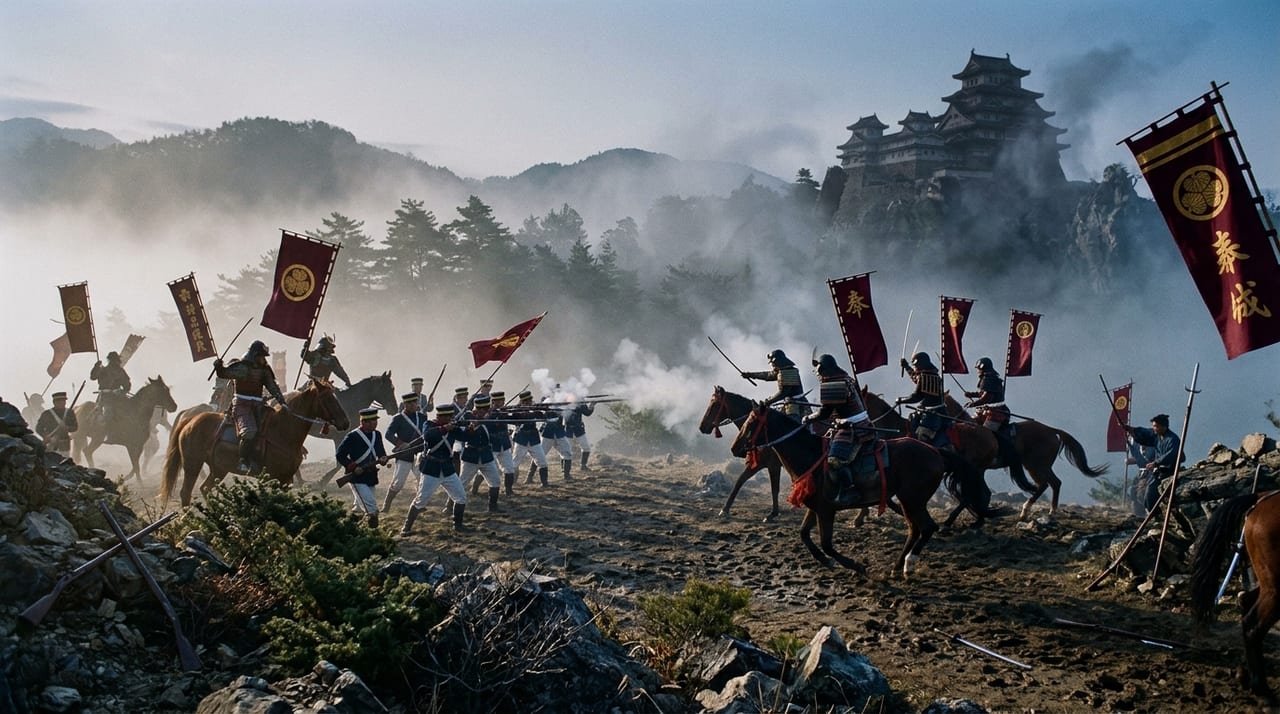
The Boshin War opened with the Battle of Toba–Fushimi in the 1st month of Keiō 4 (1868). It lasted about a year and a half, until the surrender of Goryōkaku in Hakodate in the 5th month of Meiji 2 (1869), and was the largest civil war in modern Japanese history. The new government forces, centered on the Satsuma, Chōshū, Tosa and Hizen domains, which drove the overthrow of the shogunate and the Restoration, clashed with the former shogunate forces and the Northern Alliance (Ōuetsu Reppan Dōmei). The war did not merely overturn Japan's political system at its foundations. It also became a decisive turning point in the history of the Japanese sword. About eight years before the Sword Abolition Edict (Haitōrei) was promulgated in Meiji 9 (1876), the Boshin War was a large-scale civil war in which samurai fought while wearing swords.
In the 10th month of Keiō 3 (1867), the 15th shogun, Tokugawa Yoshinobu, carried out the Return of Political Power to the Emperor (Taisei Hōkan), formally handing the government back to the imperial court. However, the Satsuma and Chōshū domains seized leadership of the new government through the Proclamation of the Restoration of Imperial Rule (Ōsei Fukko no Daigōrei), which made a confrontation with the former shogunate forces unavoidable. The Battle of Toba–Fushimi broke out from the 3rd to the 6th day of the 1st month of Keiō 4 (1868) in present-day Fushimi Ward, Kyoto, and other areas. In this battle the new government forces, centered on Satsuma and Chōshū, defeated the main units of the former shogunate, and they made use of modern rifles and cannon. The former shogunate forces also had Western-style infantry units, but some units were armed only with swords and spears, such as the Kyoto Mimawarigumi. The close-quarters charges by the Aizu domain troops and the Shinsengumi repeatedly failed in the face of the new government forces' gunfire.
Tokugawa Yoshinobu fled from Osaka Castle to Edo, and the new government forces began their eastward campaign as the “imperial forces” (kangun). The subsequent surrender of Edo Castle without bloodshed (the 4th month of Keiō 4 / May 1868) was a historic reconciliation achieved through talks between Katsu Kaishū and Saigō Takamori.
After Edo Castle surrendered, the fighting moved to Tōhoku. The Tōhoku domains first attempted to mediate between the old and new governments. To resist the hard-line stance of the new government forces, however, they formed the Northern Alliance (Ōuetsu Reppan Dōmei), composed of 31 domains including Sendai, Yonezawa and Nagaoka, and resisted together with the Aizu and Shōnai domains.
Kawai Tsuginosuke, chief retainer of Nagaoka domain, independently procured Gatling guns and led the strong Nagaoka domain troops, armed with modern weapons, against the new government forces. In the Hokuetsu campaign (Boshin War in northern Echigo), the Nagaoka domain under Kawai inflicted heavy losses on the new government forces. However, Nagaoka Castle was eventually taken, and Kawai was wounded and died during the retreat.
In the Aizu domain, under the domain lord Matsudaira Katamori, the samurai resisted the new government forces to the end. The defense of Aizu-Wakamatsu Castle (Tsuruga-jō) was especially tragic and fierce, and the story of the Byakkotai boys who took their own lives is still told today. The swords carried by Aizu samurai, practical blades including the Aizu Kanesada, were also used in actual combat during this siege.
Among the organizations most closely tied to Japanese swords in the Boshin War was the Shinsengumi. Formed to maintain order in Kyoto in the late Edo period, the Shinsengumi moved north as the shogunate collapsed and kept fighting as far as Tōhoku and Hakodate. Vice commander Hijikata Toshizō was one of the samurai who fought to the end with a sword at his side. On the 11th day of the 5th month of Meiji 2 (1869), he was struck by a bullet and killed in combat at the Ippongi checkpoint (Ippongi Sekimon) in Hakodate.
The sword most famously associated with Hijikata Toshizō is the Izumi-no-kami Kanesada. Hijikata's Kanesada was made by the 11th-generation Izumi-no-kami Kanesada of the Aizu Kanesada line, who was active in the Aizu domain in the late Edo period. The sword Hijikata wore is still loved by many Japanese sword enthusiasts today as a symbol of sword use from the late Edo period through the Boshin War, the era in which the Shinsengumi was active.
The Nagasone Kotetsu is renowned as the favorite sword of Shinsengumi commander Kondō Isami. Kotetsu is the common name of Nagasone Okisato, a master smith representing Edo shintō (new swords). The prevailing view holds that Kondō's Kotetsu was a fake rather than an authentic work. Even so, “the cutting power of the Kotetsu” was legendary among late Edo-period samurai. In the Boshin War, the swords carried by Shinsengumi members exposed their limits in the face of modern gunfire, yet they embodied the samurai pride to the very end.
In the Hakodate War (Meiji 1 (1868) to Meiji 2 (1869)), the final phase of the Boshin War, Enomoto Takeaki of the former shogunate navy, together with Hijikata Toshizō and others, fought the new government forces from Goryōkaku in Hakodate (present-day Hakodate City) in Hokkaido. Goryōkaku was a Western-style bastioned fort, a defensive structure suited to modern warfare. Ultimately, however, it yielded to attacks by the new government forces from both sea and land.
Hijikata Toshizō was killed by a bullet while commanding on horseback in the fighting at the Ippongi checkpoint in Hakodate. His final moments are passed down as a scene that symbolizes the Boshin War. Enomoto Takeaki surrendered, and afterward served the Meiji government, becoming active in the fields of diplomacy and education.
The position the Boshin War holds in the history of the Japanese sword is important in two senses.
First, it was a large-scale civil war in which swords were still used in actual combat even in the age of firearms. In the Boshin War, firearms had become the main weapons, but in close combat swords and spears were still used. Swords were especially wielded in street fighting and in night raids.
Second, the conclusion of the Boshin War and the establishment of the Meiji Restoration opened the direct path to the Sword Abolition Edict (Haitōrei) of Meiji 9 (1876). The “right of samurai to carry swords” was maintained for a time after the Restoration. However, in building a modern national army, the Meiji government needed to dismantle the status privileges of the samurai class. The Sword Abolition Edict was promulgated about eight years after the Boshin War.
The swords of the many samurai and domain retainers who took part in the Boshin War were, after the war, sold or discarded, or preserved as family treasures. Countless famous swords were scattered in the wave of sword abolition after the Restoration. Conversely, not a few swords were carefully handed down together with the memory of the Boshin War. The Boshin War stands at the historic turning point where the Japanese sword changed from a “weapon” into “cultural property and works of art.”
Hijikata Toshizō
Shinsengumi vice-commander, fought to the last battle at Hakodate
Ōmura Masujirō
Architect of the imperial army's modernization, 'father of the Japanese army'
Katsu Kaishū
Negotiated the bloodless surrender of Edo Castle
Katsura Kogorō
Chōshū leader and central figure in establishing the new government
Kawai Tsuginosuke
Nagaoka domain elder who armed his forces with Gatling guns
Matsudaira Katamori
Aizu domain lord, last major resistance against the imperial forces
戊辰戦争北関東の激戦・宇都宮城の戦いを刀剣の視点から解説。土方歳三ら旧幕府方の攻防と、銃砲時代への転換期における帯刀の実態を紹介する。
2026-10-09
奥羽越列藩同盟を離脱し新政府側についた久保田藩が、周囲の同盟諸藩から攻撃を受けた秋田戦争の経緯と、当時の武士が帯びた刀剣の実態を解説する。
2026-10-08
明治維新の端緒となった戊辰戦争では、旧幕府軍・諸藩の武士たちが刀を手に近代銃砲と戦った。新選組の刀、会津藩士の最後の戦い、そして戦後の廃刀へと続く流れまで、刀剣史の観点から戊辰戦争を読み解く。
2026-04-28
2026-10-12