New Arrivals — Browse our catalog for the latest authentic Japanese sword arrivals. Browse →
October 24, 1876 (Meiji 9)
Kumamoto (Kumamoto Garrison and surroundings)
Forces
Shinpūren (League of the Divine Wind)
Kumamoto Garrison (Meiji Government Forces)
About 15 min read
On the night of October 24, Meiji 9 (1876), some 170 former samurai armed with swords and spears gathered in the castle town of Kumamoto. They called themselves the "Shinpūren (Keishintō)," a radical samurai group of Shintō militants who harbored fierce hostility toward the modernizing Meiji government. The events of that night are remembered as among the most emblematic incidents in the history of the Japanese sword.
The direct trigger for the Shinpūren Rebellion was the Haitōrei (Sword Abolishment Edict, also called the prohibition on wearing swords), promulgated on March 28, Meiji 9 (1876). This order legally banned the wearing of swords, the symbol of the samurai throughout the Edo period, and struck at the very core of the former samurai's pride. To be deprived of the sword, the soul of the warrior, meant not merely the loss of a weapon but the total negation of their social identity.
The Shinpūren (officially the "Keishintō") was a secret-society-like group formed mainly of former samurai of the Higo domain, which advocated the purity of Shintō and the revival of bushidō. Its ideological leader, Ōtaguro Tomoo (1835–1876), regarded the Meiji government's Westernization policies as "pollution of the divine land of Japan." He vehemently rejected Western weapons (firearms and cannon) as "impure." His convictions were said to be so thorough that when he touched "defilement," such as a person wearing Western clothing, he purified himself with salt.
Following the Haitōrei, the Kinroku Kōsai Shōsho Hakkō Jōrei (pension bond ordinance), issued in August of the same year, carried out the abolition of samurai stipends (chitsuroku shobun). This abolished the hereditary stipends and commendation stipends of the former samurai and forced their conversion into lump-sum bonds, pushing them into economic hardship as well. Having been legally stripped of the sword, the spiritual pillar of their identity, and having lost the hereditary stipends that sustained their livelihood, the former samurai's anger had by now surpassed its breaking point.
The Shinpūren were concentrated in Kumamoto. Kumamoto had a political culture distinct from that of Satsuma and Chōshū, and it was the Hosokawa clan that ruled as lords of the Higo domain. The martial spirit of the former samurai, who took pride in "the martial spirit inherited since Katō Kiyomasa," remained deeply rooted there.
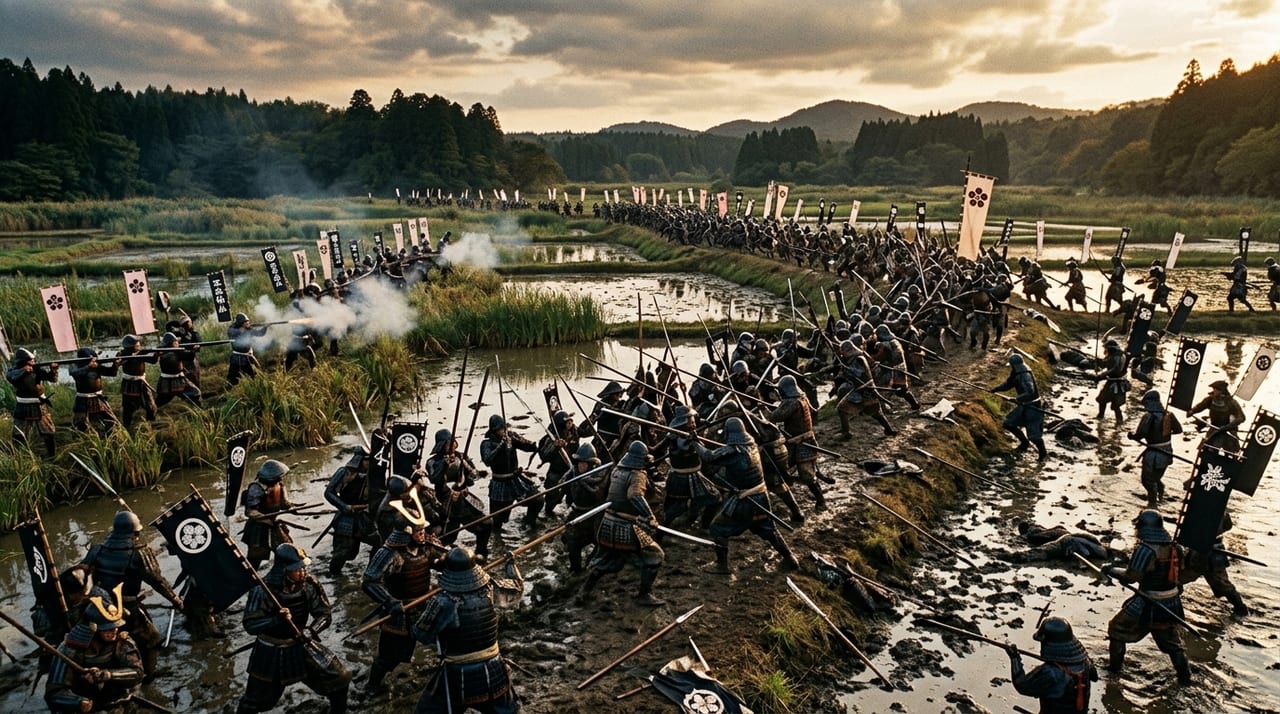
On the night of October 24, Meiji 9, about 170 Shinpūren warriors, armed only with swords and spears, launched a night raid on the Kumamoto Garrison (a Meiji army military facility established within what is now Kumamoto Castle).
That they did not carry modern weapons (guns and cannon) was not merely a matter of difficulty in obtaining them; it was an expression of deep conviction. To outside eyes, the logic that "fighting with impure Western weapons runs counter to the spirit of Shintō" may appear fanatical. However, if one pushes the cultural and religious meaning of the Japanese sword to its limit, that is, "the sword is the soul of the samurai, and the sword is the vessel that embodies the will of the gods," this logic holds internal consistency. For them, the Haitōrei was "an act of seizing the sacred treasures," and fighting with those treasures alone was a religious and political declaration.
After gathering at Fujisaki Shrine, the Shinpūren split into seven units and acted. One unit raided the private residence of Major General Taneda Masaaki, commander of the Kumamoto Garrison, and cut him down. Another unit attacked the home of Yasuoka Ryōsuke, governor (kenrei) of Kumamoto Prefecture, and inflicted a fatal wound on him. Other units burst into the garrison's artillery and infantry barracks within Kumamoto Castle. In the nighttime close combat with swords and spears, the surprise attack initially succeeded, and many officers and soldiers were killed, including Lieutenant Colonel Takashima Shigenori, the garrison's chief of staff.
But as dawn approached, the government forces regained their footing and overwhelmed the Shinpūren units with gunfire. For those with swords and spears to confront a modern army armed with guns was nearly impossible in physical terms. Kaya Harukata and others were killed by gunfire, and the gravely wounded Ōtaguro Tomoo took his own life. Having lost their leaders, the Shinpūren retreated, and many took their own lives. By the next day, the 25th, the rebellion had been suppressed.
Casualties totaled 124 dead or suicides on the Shinpūren side. The government forces suffered about 60 dead and about 200 wounded.
The swords wielded by the Shinpūren warriors embodied the sword culture of Kumamoto (Higo).
Throughout the Edo period, Higo (Kumamoto) was known for its distinctive sword-mounting culture, called "Higo-koshirae," and for a sword aesthetic that prized pure practicality. The representative example is Dōtanuki Masakuni. The Dōtanuki swords made by a school of Higo smiths led by Dōtanuki Kōzuke-no-suke Masakuni, of the Azuchi–Momoyama period, eschewed ornate decoration. They were characterized by thick blade cross-sections and practical, battle-oriented construction, and were known as robust swords (gōtō).
This Dōtanuki aesthetic, "practicality over decoration, essence over form," deeply resonated with the spirit of the Shinpūren. To them, the modernization (Westernization) they despised appeared as the loss of essence accompanied by changes in outward appearance, such as Western clothing and Western-style armies. Valuing the purity of the soul over outward beauty, like a Dōtanuki sword, was the thought of the Shinpūren, and it was also their sword taste.
The swords that the Haitōrei legally excluded as "outdated relics" shone with their final brilliance in the Shinpūren Rebellion.
The Shinpūren Rebellion was an incident that occurred at a turning point in the cultural and social status of the Japanese sword.
Before the Haitōrei (1876), the sword was the identity certificate of the samurai, and appearing in public without a sword was considered a disgrace for a samurai. The Haitōrei negated this symbol of status at a stroke. Following the Conscription Ordinance (1873), which stripped the samurai class of its military role, the Haitōrei functioned as the law that completed the dissolution of the warrior class.
The Shinpūren regarded this law as a desecration of the "sacred weapon" and resorted to direct action. From their logic, to submit silently to the Haitōrei was to accept "the death of bushidō."
Within a few days, the Shinpūren Rebellion triggered the Akizuki Rebellion (Fukuoka) and the Hagi Rebellion (Yamaguchi). It became one of the triggers for a series of samurai rebellions that led to the Satsuma Rebellion (Seinan War) of the following year, 1877. What fundamentally distinguishes the Shinpūren from other rebellions, however, is their "obsession with swords alone." Saigō Takamori's army in the Satsuma Rebellion ultimately also fought modern battles with firearms, whereas the Shinpūren clung to the end to the unrealistic armament of "swords and spears only."
This was a tactically foolish strategy. At the same time, it was also an act that proclaimed, at the cost of their lives, the claim that "the Japanese sword is not merely a weapon but a sacred treasure that embodies the soul of the samurai."
The swords that the Shinpūren warriors wielded were defeated, physically, by modern firearms. But the "spiritual devotion to the sword" their actions demonstrated has influenced Japanese culture in various forms since then.
Mishima Yukio depicted the Shinpūren in the second volume of The Sea of Fertility, Runaway Horses, and frequently discussed them in essays and dialogues. Even today, the Haitōrei and the Shinpūren Rebellion remain important reference points when considering "what the Japanese sword is."
There were people who risked their lives to defend the right to carry a sword. They lost. But their conviction that "swords have spirituality" lives on in the history of Japanese sword culture.
At Sakurayama Shrine in Kurokami, Chūō Ward, Kumamoto, the martyrs of the Shinpūren are enshrined together, and the grounds contain the graves of 123 warriors. Even now, 150 years after the Haitōrei, the Shinpūren Rebellion remains one of the most intense answers to the questions "What is the spirituality of the Japanese sword?" and "What is bushidō?" The memory of those who chose to carry a sword and died in an age when carrying one was forbidden serves as a light illuminating the spirit that runs at the foundation of Japanese sword culture.