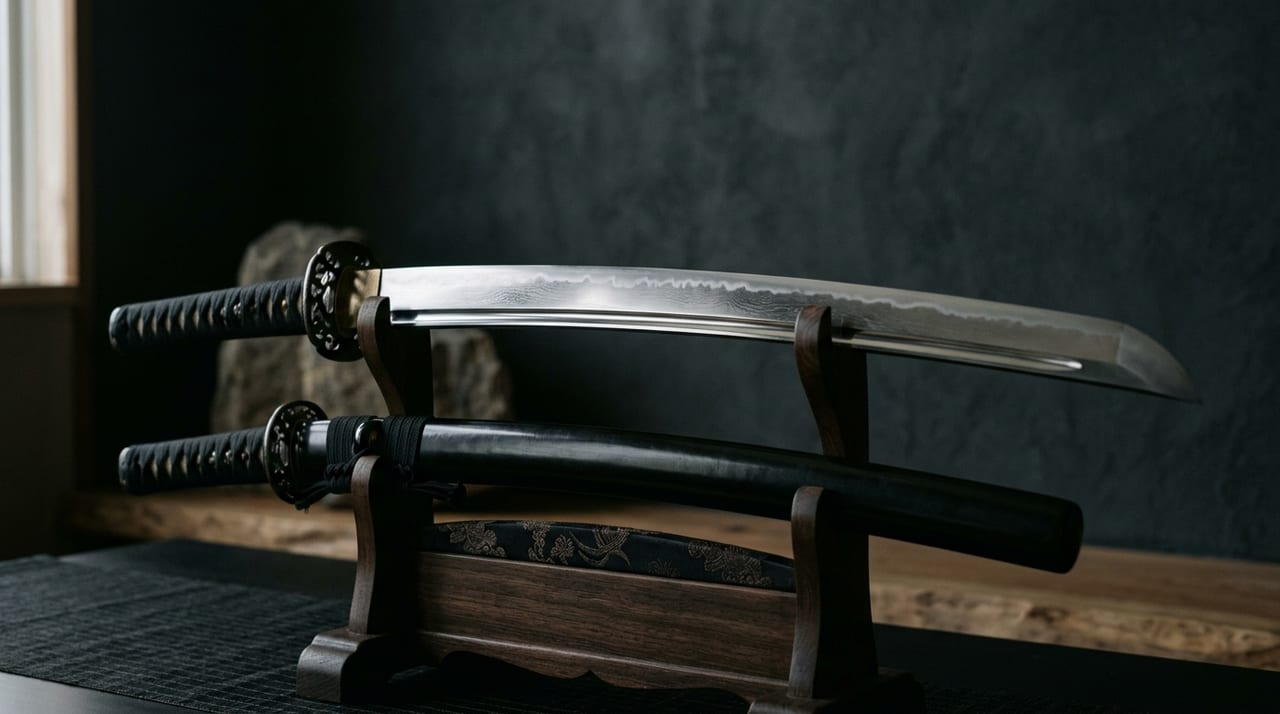
 * Image is for illustrative purposes only.
Dōtanuki Masakuni
同田貫正国
Also known as: Dōtanuki; the pinnacle of practical combat swords that neither break nor bend and cut well; Katō Kiyomasa's army swords; the mighty swords of Higo
Description
Overview of the Sword
The Dōtanuki school was a group of swordsmiths in Higo Province (present-day Kumamoto Prefecture). Its representative smiths embodied plain, sturdy practicality and held as their creed the three essential qualities of a Japanese sword: it does not break, does not bend, and cuts well. The name Dōtanuki is said to derive from the place name Dōtanuki in Kikuchi District, Higo Province (around present-day Hiegata, Kikuchi City, Kumamoto Prefecture).
Swordsmiths
The Dōtanuki school was active from around the Eiroku era to the early Edo period. Smiths known to have worked in it include Masakuni (later Kōzuke-no-suke), Kiyokuni, Hyōbu, and Matahachi. The defining feature of their work is thorough pragmatism.
Forging Method and Characteristics
The jigane shows itame-hada that is somewhat raised, with ji-nie, and displays a powerful forged texture. The forging, however, prioritizes sturdiness over artistic refinement. The hamon is based on suguha or ko-midare. Its splendor is restrained, but the cutting quality was regarded as certain and excellent. Dōtanuki blades are generally of ordinary width (mihaba) but have thick kasane and abundant haniku, and many are imposing, majestic constructions. Their weight and the sense of security they give when held are characteristic. This is the result of deliberately choosing a heavy construction so that the blade would not break or bend in actual combat, and it reflects the design philosophy of the Dōtanuki itself. Katō Kiyomasa (1562–1611) was a fierce general who served Toyotomi Hideyoshi and is also known for the anecdote of slaying a tiger. When Kiyomasa entered Higo Province, the Dōtanuki became his retained smiths. Their swords were made the standard swords of Kumamoto Castle, and the school reached its peak. Their evaluation as art objects is more modest than that of famous swords of the Bizen and Sōshū traditions. In recent years, however, they have been reappraised as the smiths who most purely embody "the essence of the Japanese sword as a weapon."
Legends & Stories
Legends and Anecdotes
Historically, it is recorded that after Katō Kiyomasa entered Higo Province (Kumamoto) in Tenshō 16 (1588), he retained the Dōtanuki as his smiths, and their swords were regarded as the standard swords of Kumamoto Castle.
Tenran Kabuto-wari
In Meiji 19 (1886), at a hachi-tameshi (helmet test) held during an imperial visit by the Meiji Emperor, known as Tenran Kabuto-wari (helmet-cutting before the Emperor), Sakakibara Kenkichi of the Jikishinkage-ryū used a Dōtanuki blade to cut into a helmet made by Myōchin. This anecdote is known as evidence of the strength of the Dōtanuki. The Dōtanuki’s pragmatism stands at the opposite pole from the pursuit of artistic splendor, and it shares something with the subtractive aesthetics of wabi-sabi in the tea ceremony. There is a kind of beauty in the resolve that removes superfluous ornament and concentrates on the single act of cutting. Even today, the Dōtanuki remains a blade name popular among shizan (test-cutting) enthusiasts. The feel of cutting straw bundles or bamboo and the sense of reassurance it gives are said to set it apart from the work of other smiths. In the game Touken Ranbu, the Dōtanuki is depicted as a bold, unpretentious warrior, and a character who puts its identity as a "battle sword" front and center has won the hearts of fans. The Dōtanuki embodies the aesthetics of the Japanese sword as a weapon. Approaching the essence of the Japanese sword from an angle different from that of the art sword, it is an irreplaceable presence.