New Arrivals — Browse our catalog for the latest authentic Japanese sword arrivals. Browse →
September 23, 1543 (Tenbun 12, 8th month, 25th day)
Tanegashima Island, Ōsumi Province (present-day Kumage-gun, Kagoshima Prefecture)
Forces
Portuguese Traders (Introducing Party)
Tanegashima Domain (Receiving Party)
About 15 min read
On the 25th day of the 8th month of Tenbun 12 (23 September 1543), a ship reportedly carrying the Chinese smuggling merchant Wang Zhi drifted ashore at Nishimura no Koura (present-day Maenohama) on Tanegashima in Ōsumi Province (present-day Kumage District, Kagoshima Prefecture). Several Portuguese were aboard, and the two matchlock firearms (teppō) they carried became one of the most influential “imports” in Japanese history. Later called the “Introduction of Firearms to Japan,” this event fundamentally transformed Sengoku-period warfare and brought a lasting change to the way samurai fought, which had been centered on the Japanese sword.
Tanegashima Tokitaka (1528–1579), lord of Tanegashima, was deeply amazed by the Portuguese “tool that produces fire and sound from an iron tube to shoot down distant objects.” The young lord, then sixteen years old, immediately recognized the military potential of this weapon and purchased two firearms (the price is also said to have been 2,000 ryō of gold).
The most famous record of the circumstances of the drift is the later-written “Teppōki” (1606, a record of the Tanegashima family). According to this record, the Portuguese demonstrated the firing of the firearm, and Tokitaka, astonished by its power, decided to buy it.
This encounter was also the first “meeting” of the Japanese sword and the firearm. It was the moment when Japanese warriors carrying swords first faced a long-range weapon against which swords could not compete. Initially, however, firearms were not recognized as something that would “replace” the Japanese sword; they were accepted as a “new missile weapon” complementing bows, arrows, and spears.
Tanegashima Tokitaka gave one of the firearms he had purchased to Yaita Kinbei Kiyosada, a swordsmith on the island. Tokitaka ordered him, “Make a copy of this weapon,” and Kinbei, after disassembling and studying it, set about manufacturing domestic firearms.
The greatest technical barrier was the “screw-type breech plug (bisen)” that seals the base of the barrel. Japanese metalworking had no experience with screw-cutting at that point, and Kinbei struggled to reproduce this part. According to tradition, a tale also survives that Kinbei's daughter, Wakasa, married a Portuguese smith, learned the technique, and returned to the island, but whether this is historical fact is unknown.
As a result, Yaita Kinbei learned how to seal the breech from a foreign smith who arrived the following year, and within a little over a year produced several dozen domestically made firearms. This success was possible only because of the metalworking skills that Japanese swordsmiths had cultivated over many years: folded-steel forging (orikaeshi tanren), heat treatment, and polishing. The techniques of Japanese sword manufacture became, as they were, the foundation for firearm manufacture.
In this way Tanegashima became famous as a production center for firearms, and initially the name “Tanegashima” was widely used as an alternate name for firearms. This usage survives today in the custom of calling matchlocks “Tanegashima.”
Following the success of domestic production on Tanegashima, firearms spread rapidly across the country. The most important agents of this spread were the Negoro-shū (the Negoro group), based at Negoro-ji temple in Kii Province (present-day Wakayama Prefecture), and merchants of Sakai (present-day Sakai, Osaka Prefecture), a port city that prospered through trade.
The Negoro-shū actively embraced firearms, and by the mid-16th century they had become a mercenary group armed with firearms, employed by various daimyō. Sakai was then Japan's largest trading city, and through trade with China and Portugal it actively promoted the importation and domestic production of firearms and gunpowder. Sakai smiths refined firearm manufacturing techniques and produced high-quality firearms called “Sakai-zutsu.”
Sengoku daimyō also quickly recognized the potential of firearms and organized firearm units, beginning with the wealthiest lords. Date Masamune, Mōri Motonari, Uesugi Kenshin, Takeda Shingen, and others also actively adopted firearms, but the one who employed them on the largest scale and most systematically was Oda Nobunaga.
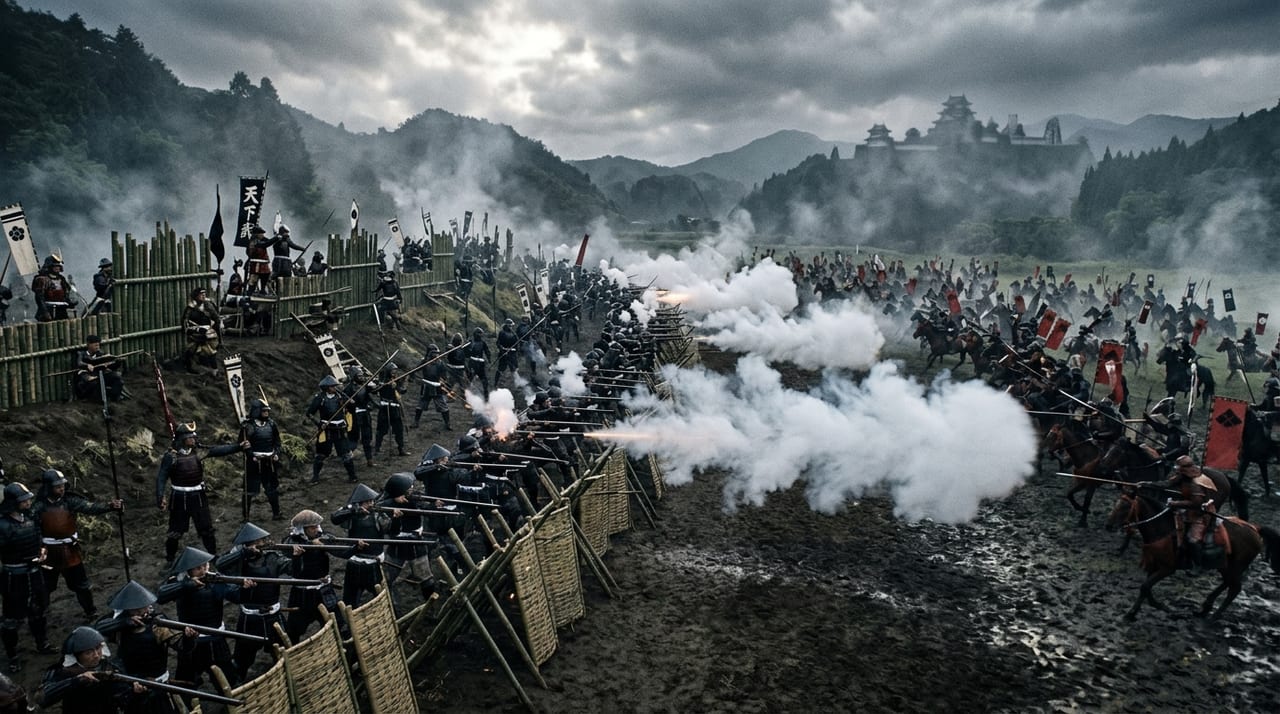
On the 21st day of the 5th month of Tenshō 3 (1575), the “Battle of Nagashino” at Shitarahara in Mikawa Province (present-day Shinshiro, Aichi Prefecture) was the emblematic battle in which firearms decisively changed Sengoku warfare.
Oda Nobunaga gathered firearms from his retainers (the Shinchōkōki gives about 1,000; some hold that it was 3,000) and deployed them as an organized firing unit. The later-popularized story of the “three-rank volley” (alternating fire) derives from the Edo-period Hoan Shinchōki, and is considered doubtful as historical fact. This tactic, an organized firearms method of sustained fire from positions protected by wooden palisades, destroyed the cavalry charges of Takeda Katsuyori's horsemen and dealt a devastating blow to the Takeda army, which had been described as the “strongest cavalry force.”
The Battle of Nagashino was the decisive moment when Sengoku warfare, centered on individual martial valor and swordsmanship, shifted toward organized group battle and firearm use. The age of individual heroes who charged on horseback with swords, spears, and bows began to move toward its end amid the roar of gunfire.
It is a misunderstanding to think that the spread of firearms made the Japanese sword an “obsolete weapon.” From the Sengoku to the Edo period, the Japanese sword and the firearm coexisted rather than conflicted.
In actual combat, firearms had weaknesses: they were vulnerable to rain and humidity and took time to load. In close combat, when the enemy closed in, swords and spears remained the most effective weapons. Accordingly, in Sengoku battles a combined style became established in which long-range firing by firearms was followed by close fighting with spears and swords.
Ironically, the spread of firearms also had the effect of raising the “cultural value” of the Japanese sword. While the sword's weight as a practical weapon declined, its value as a spiritual symbol of the warrior, a mark of status, and a work of art rose toward the Edo period. Toyotomi Hideyoshi's Sword Hunt Edict (1588) likewise had the effect, through disarming farmers, of sanctifying the sword as something “only warriors possess.”
The significance of the Introduction of Firearms to Japan in Japanese history and sword history goes beyond a mere innovation in weapons technology.
First, firearms transformed the power structure of the Sengoku period. Daimyō with the financial resources and organizational capacity to procure large numbers of expensive firearms gained the advantage, heralding an age in which organizational and economic strength, rather than individual martial prowess, determined the outcome of war.
Second, the spread of firearms lowered the barrier to war, which had been the preserve of professional warriors (bushi), and expanded the possibilities of “mass-manpower tactics” using ashigaru foot soldiers and peasant soldiers. Toyotomi Hideyoshi himself was a typical beneficiary of this.
Third, through the spread of firearms, Japan had become one of the world's leading firearm-holding nations by the end of the 16th century. Estimates suggest that in the early 17th century Japan's firearm holdings were reportedly greater than those of any European country.
Fifty-seven years after the Introduction of Firearms to Japan, at the Battle of Sekigahara (1600), both the Eastern and Western armies deployed large numbers of firearms, and the battlefield was enveloped in gunfire and gunsmoke. From the day two firearms drifted ashore on Tanegashima, the history of Japanese warfare and of the warrior had changed beyond recovery.
Oda Nobunaga
The warlord who adopted firearms on the largest scale and with the greatest organizational sophistication, culminating in the massed volley fire at Nagashino
Toyotomi Hideyoshi
A primary beneficiary of the firearms revolution; issued the sword hunt of 1588 restricting weapons to the warrior class
Tokugawa Ieyasu
Deployed massive firearms forces at Sekigahara; the Tokugawa shogunate subsequently regulated firearms production and possession
Takeda Shingen
Famed for his cavalry; also adopted firearms, but his successor Katsuyori was defeated at Nagashino by organized arquebusier tactics
Uesugi Kenshin
Primarily a sword-and-spear commander at battles like Kawanakajima, but also adopted firearms; associated with the sword Raikiri
Dōtanuki Masakuni
A representative practical battle sword; its robust, purely functional character symbolizes the continued demand for close-combat blades even as firearms transformed ranged warfare
Raikiri
The famous blade of Tachibana Dōsetsu, one of the great Kyūshū commanders of the firearms era; its name means 'lightning-cutter'
Hirado Castle
Hirado Castle; the port used by Portuguese, Spanish, and Dutch traders as a base; a key entry point for imported firearms and gunpowder
Nagashino Castle
Nagashino Castle; the site of the 1575 battle where Nobunaga's organized arquebus volley fire destroyed the Takeda force
Azuchi Castle
Azuchi Castle; Nobunaga's seat of power, built on revenues from trade networks that supplied his massive firearms acquisition
1543年の種子島への鉄砲伝来は、日本の戦場と武器体系を大きく変えた。新兵器の普及のなかで、日本刀が戦場で担い続けた接近戦・組討ちの役割と、刀剣需要の変質を歴史的に考察する。
2026-07-06
室町時代の刀の特徴(太刀から打刀への移行・先反り・寸法の短縮)を軸に、応永備前の盛光・康光、末備前の祐定・勝光、美濃の兼定・兼元、伊勢の村正ら有名刀工の一覧、応仁の乱後の数打物と明への刀剣輸出、脇差の普及、鉄砲伝来まで、室町約240年の刀剣文化の変遷を解説する。
2026-04-19
戦国時代(15〜16世紀)の大量需要を支えた武器産業の全貌。刀工・具足師・弓師・鉄砲鍛冶が形成した生産ネットワーク、大名による職人保護政策、そして量産体制が日本刀の質と種類に与えた影響を詳述する。
2026-04-15